

On this page
What is ceramic engineering?
Ceramic engineering is the science of creating heat-resistant objects from inorganic, non-metallic materials using heat or precipitation reactions. According to Wikipedia's summary of the field, ceramics are naturally heat-resistant and replace metals and polymers when those materials fail in extreme environments.
The origins of the field go back centuries, but modern ceramic science leapt forward when E. G. Acheson heated a mixture of coke and clay in 1893 to invent synthetic silicon carbide, known as carborundum. Today, engineers develop everything from zirconium dioxide for durable cutting blades to the insulating tiles that shield spacecraft during atmospheric re-entry.
How do glass, cement and advanced ceramics differ?
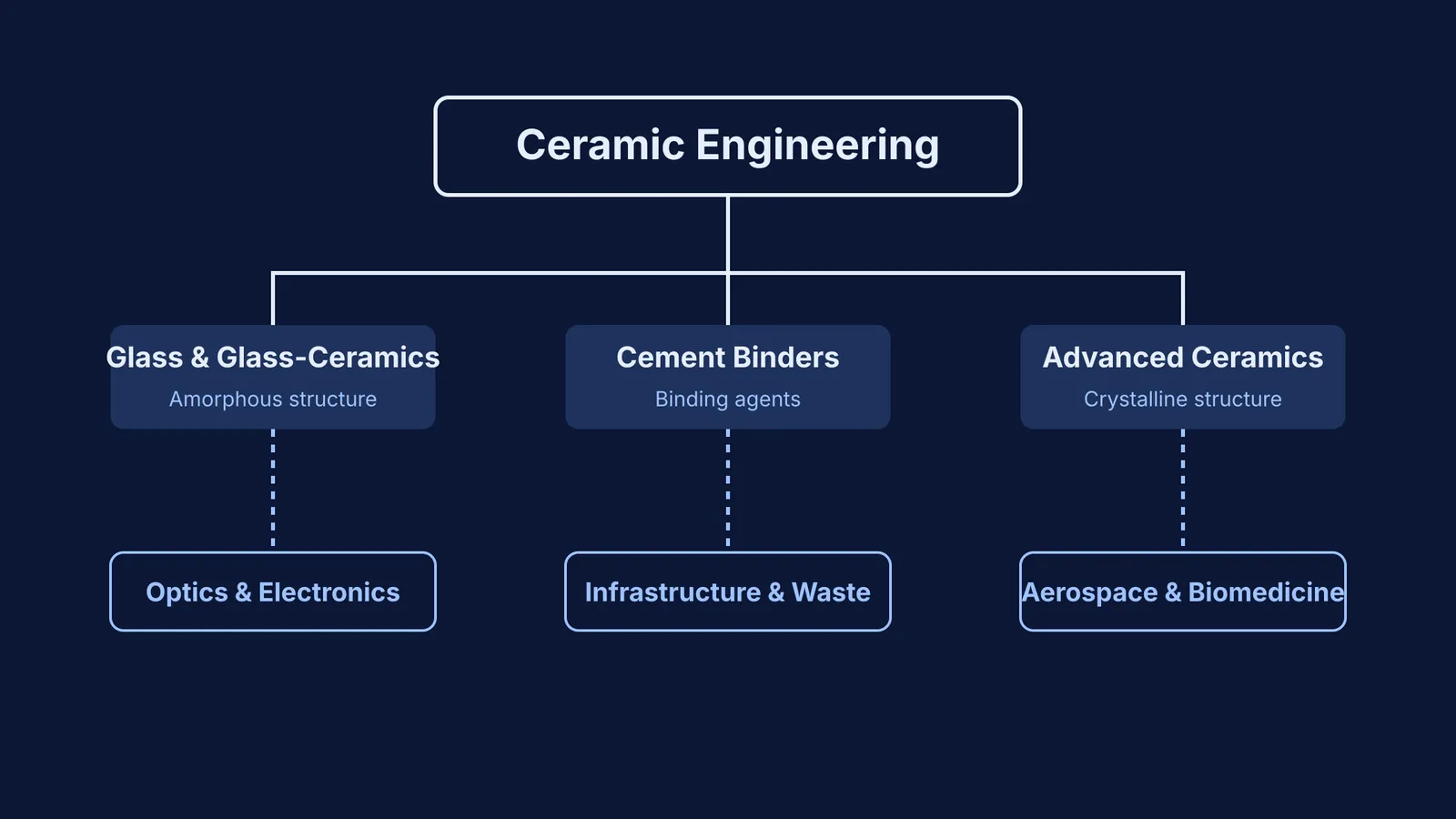
Most ceramic materials possess a crystalline or partly crystalline structure with long-range atomic order. In contrast, glass-ceramics and conventional glass have an amorphous, or glassy, structure. They are often formed from a molten mass that solidifies upon cooling. For more on how light behaves in these materials, you can read our guide to tracing a ray through a glass slab.
Cement acts as a binding agent that sets and hardens to adhere other materials together, forming concrete. Researchers are constantly finding ways to blend these categories. For example, a 2015 study in Key Engineering Materials noted that in Italy in 2013, approximately 1,600,000 tons of container glass were collected, much of which could not be recycled in the standard melting process. The researchers demonstrated how this glass waste can be converted into an alternative raw material for new cement and ceramic products.
In dentistry, advanced polymer-based ceramics are replacing older materials. A 2023 study in the journal Materials tested 160 specimens to measure the shear bond strength of resin cements to CAD/CAM materials. The researchers found that specific surface treatments, such as hydrofluoric acid etching, significantly enhanced the bond strength for glass-ceramics.
How are advanced ceramics manufactured?
Before a ceramic product reaches an aircraft engine or a dental clinic, it undergoes a precise manufacturing sequence. The traditional process moves from milling and batching raw powders to forming and firing them into shapes.
The most critical step in creating advanced materials is sintering. During this phase, a loosely bound object—known as a green body—is fired in a kiln at a temperature just below its melting point. Atomic and molecular diffusion processes cause the microscopic pores in the material to close up. This leads to a net shrinkage of the object but results in a significantly denser product with far greater strength.
A material's ultimate strength depends heavily on its microstructure, which is dictated by this thermal processing. The yield stress of the ceramic is linked to its grain size; generally, a smaller grain size maximizes yield strength, though grains that are too small can make the material brittle. Balancing these factors is a daily challenge for materials engineers.
Where do ceramic engineering graduates work?
Because ceramics withstand extreme heat and wear, graduates find roles across several high-tech industries.
Biomedicine: Engineers design artificial bones and dental implants. Hydroxyapatite, the natural mineral component of bone, is synthesized into porous ceramics that bond readily to human tissue without rejection.
Aerospace: Ceramic ball bearings made of silicon nitride are used in aircraft because they deform less under load and resist friction heat better than metal bearings, while ceramic turbochargers are lighter than traditional nickel-based superalloys.
Electronics: Electroceramics are foundational to optical fibers, piezoelectric sensors and laser amplifiers. If you are interested in the history of optics, see our piece on Katharine Burr Blodgett and the glass that stopped reflecting.
How do engineers select materials?
When designing a new component, ceramic engineers evaluate materials across four dimensions:
Thermal limits: Can the material withstand the operating temperature without melting or deforming?
Structural order: Does the application need the long-range atomic order of a crystalline ceramic or the amorphous flexibility of a glass?
Fracture toughness: Will the part face sudden impacts?
Biocompatibility: If the part will be implanted in a human body, is the material porous enough to allow natural bone to bond to it?
How to get started in materials science?
If you are aiming for a career in this field, you will need a strong grasp of solid-state physics and chemistry. Understanding concepts like chemical bonding, crystal lattices and the thermodynamics of sintering is essential.
When you do not know where to start, Fermi's AI tutor works out what you already know and builds a plan for the session. It teaches rather than answers, holding a line of reasoning and checking your understanding as it goes. For ideas that are easier to see than to read, such as atomic packing or crack deflection, you can explore the Fermi Simulation Lab.


