

On this page
When Class 12 exams conclude, students face a fundamental choice between central and state universities. While both grant degrees recognized across India, they operate under distinct constitutional mandates, funding models, entrance tests, and seat reservation frameworks. Choosing the right institution requires looking past brochures to evaluate how these structural differences influence your campus environment, annual expenses, and admission odds.
How do central and state universities differ in funding and administration?
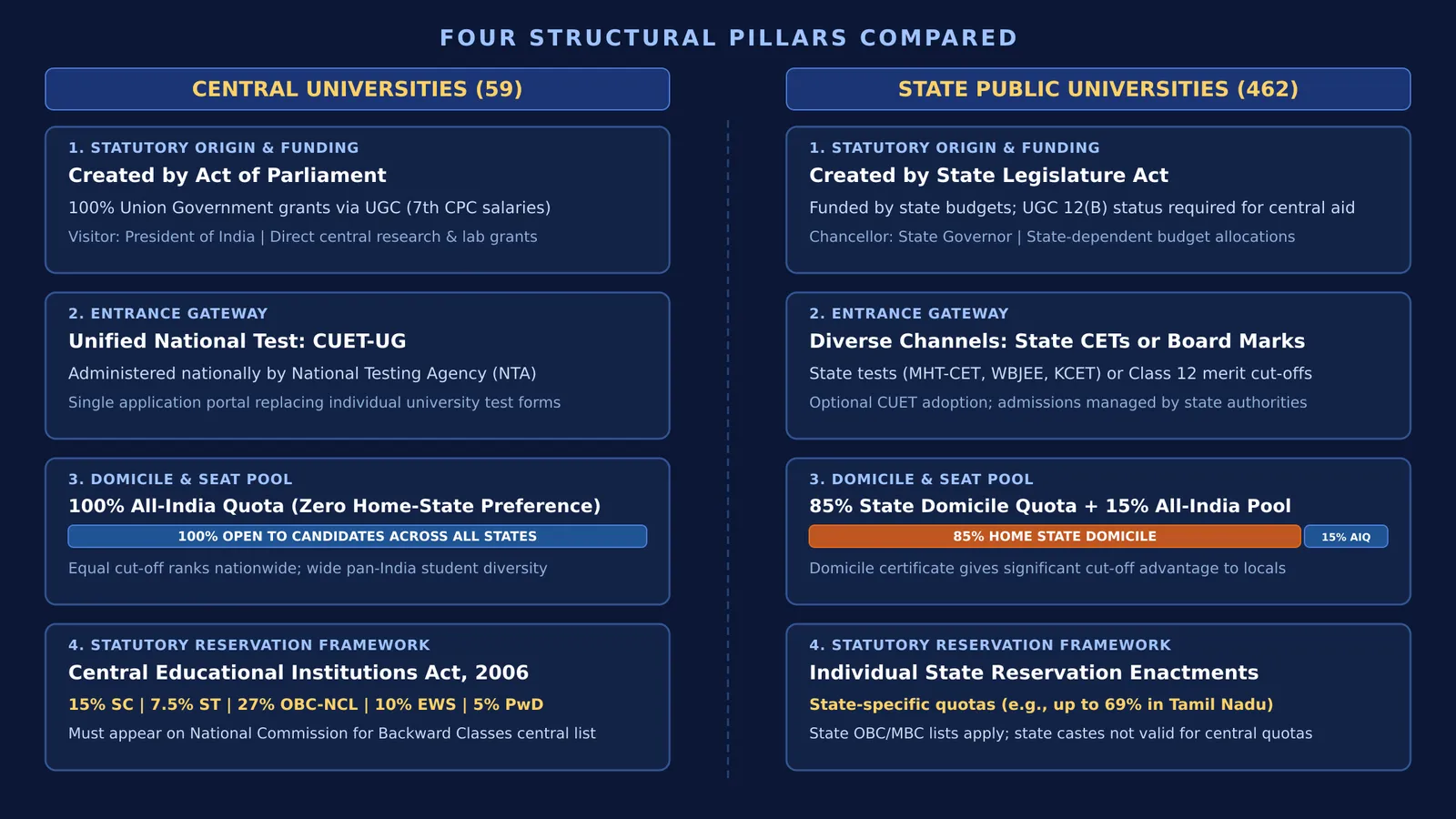
A Central University is established by an Act of Parliament under the Ministry of Education, whereas a State University is established by an Act of a State Legislature. According to the Ministry of Education's AISHE report, India has 1,213 universities, including 59 Central Universities and 462 State Public Universities. The President of India serves as Visitor for central universities, while the state Governor serves as Chancellor for state universities.
Funding marks the deepest division between both systems. Central Universities receive 100% of their operational and capital grants from the Union Government through the University Grants Commission (UGC), funding faculty salaries under the 7th Central Pay Commission, research equipment, and digital libraries. State universities rely primarily on state budget allocations. A state university receives central development grants only if it meets Section 12B norms of the UGC Act, 1956. When state budgets tighten, state institutions often struggle with hiring freezes and delayed maintenance.
How do admission routes and entrance exams compare?
Undergraduate admissions for Central Universities are unified through the Common University Entrance Test (CUET-UG), administered by the National Testing Agency (NTA). CUET-UG replaces separate campus forms with a single test covering languages, domain subjects, and general aptitude. For science students, understanding how CUET UG for science students aligns with board exams ensures your subject combinations meet university eligibility criteria.
State Universities maintain varied entrance paths. While some adopt CUET-UG, many conduct state Common Entrance Tests (such as MHT-CET, WBJEE, or KCET) or allocate seats directly on Class 12 board marks. Preparing across multiple testing patterns requires clear conceptual mastery. The Fermi Concept Library maps every concept in physics, chemistry, biology, mathematics and computing to help students master core ideas. When practicing domain numericals, the Fermi Problem Library offers worked problems with a step-by-step solver that explains the reasoning rather than printing an answer.
How do reservation and domicile quotas affect your seat chances?
Reservation policies differ significantly between central and state institutions. Central Universities follow the Central Educational Institutions (Reservation in Admission) Act, 2006, reserving 15% of seats for Scheduled Castes (SC), 7.5% for Scheduled Tribes (ST), and 27% for Other Backward Classes (OBC-NCL). Central institutions also provide 10% reservation for Economically Weaker Sections (EWS) and 5% horizontal reservation for Persons with Disabilities (PwD). Crucially, 100% of seats in central universities are All-India Quota seats with no home-state preference.
State Universities follow state reservation statutes and prioritize local residents. Most state universities reserve 85% of their seats for state domicile applicants, leaving 15% open to students from other states. Total reserved quotas vary by state, reaching up to 69% in Tamil Nadu. Crucially, category lists do not always match. For central admission, your caste must appear on the National Commission for Backward Classes Central OBC List. If your community is recognized only on a state list, you must apply as an Unreserved candidate in central universities.
What is the difference in fees, hostels, and campus facilities?
Central funding keeps tuition in Central Universities exceptionally affordable. Annual tuition for standard undergraduate degrees at institutions like Delhi University or Banaras Hindu University usually ranges between ₹3,000 and ₹15,000. Campus hostels are heavily subsidized, though allotted on competitive merit-cum-distance criteria.
State universities offer subsidized tuition for regular seats, but many run self-financed courses charging ₹35,000 to over ₹1,50,000 annually. Affiliation scale is another contrast: the AISHE survey reports over 45,000 colleges across India, mostly affiliated with state public universities. Central universities are largely compact residential campuses with centralized laboratories. For students considering an out-of-state campus, our guide on moving cities for coaching or college provides a framework to assess hostel living.
A student checklist: how to choose between central and state universities
Use this five-point checklist to decide between central and state options:
Domicile advantage: If your entrance score is near the cut-off, a state university's home-state quota provides a higher statistical probability of admission than an all-India pool.
Category verification: Confirm your caste appears on the central NCBC list before counting on reserved seats in central counselling, and secure an updated income certificate.
Accreditation check: Verify that your target state department holds Section 12B UGC recognition and valid NAAC grading to ensure access to central scholarships and fellowships.
Total cost comparison: Calculate total four-year costs, including tuition, examination fees, and private accommodation if university hostels are full.
Campus culture and career fit: Central universities offer pan-India peer diversity suited for national exams and research, while state universities build strong local alumni networks. Whichever you select, review what changes in your first semester at college to adapt quickly to college-level academics.


