

On this page
When students tell their parents or teachers they love physics, the typical reaction is often hesitation: "Will you only be able to teach, or should you just study computer science instead?" That hesitation rests on a fundamental misconception about what the discipline actually teaches. Physics is not merely an academic topic about swinging pendulums, falling apples, and inclined planes; it is rigorous training in mathematical modeling, precise experimental measurement, and solving highly unstructured problems from first principles. When high-tech industries encounter complex challenges where standard software templates or routine engineering formulas fail to provide an answer, they actively recruit people who understand the physical reality underneath the data.
What jobs can you do with a physics degree?
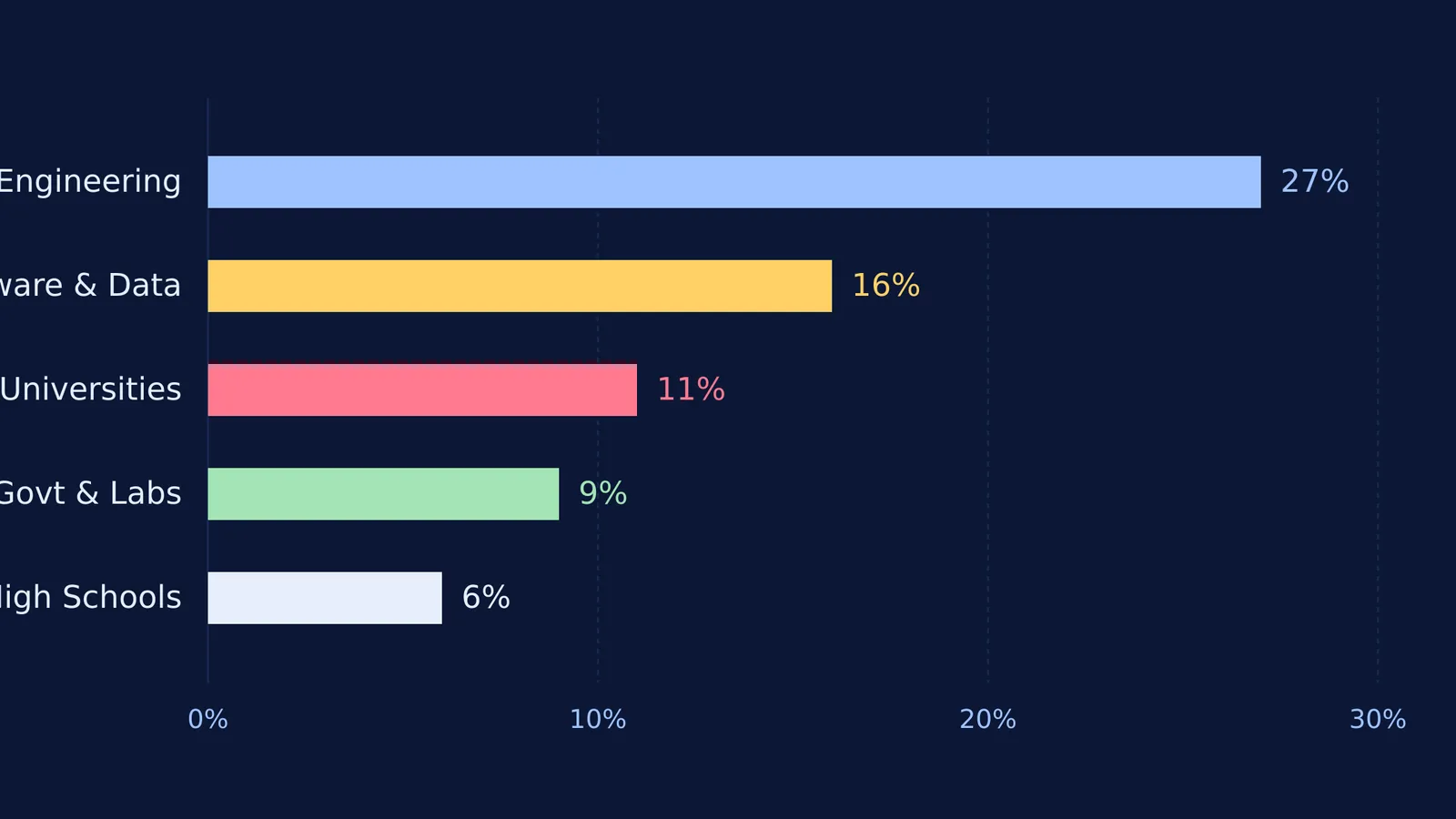
Physics graduates work across private industry, national laboratories, technology companies, and research institutes. Employment data from the American Institute of Physics (AIP) shows that approximately 60% of physics bachelor's recipients who enter the workforce secure positions in the private sector. Within private industry, engineering represents the largest destination, accounting for roughly 27% of employed graduates, followed by computer software and data analysis at 16%. In addition, the median starting salary for physics graduates entering private-sector STEM roles reaches $75,000.
International data confirms this demand. A labour-market study by the Institute of Physics (IOP) found that 1.85 million jobs in the UK and Ireland—about 1 in 20 roles—rely on physics skills. Demand for physical scientists grew by 40% over a decade, and two-thirds of physics-based businesses reported delaying innovation due to skill shortages. High-tech firms consistently seek people who bridge physical principles and mathematical computation.
How do you transition into engineering and instrumentation?
Most physics graduates in the workforce do not hold the title "physicist"; they work as optical engineers, systems engineers, semiconductor process specialists, and instrumentation designers. In hardware technology, every physical device is governed by thermodynamics, quantum mechanics, and electrodynamics. For example, semiconductor fabrication requires physics graduates to model thin-film deposition and bandgap mechanics, while sensor design relies directly on wave optics.
Another established trajectory is medical physics. Certified medical physicists calibrate linear accelerators, plan radiation therapy, and monitor radiation safety in hospitals. In India, the Bhabha Atomic Research Centre (BARC) conducts the Post-M.Sc. Diploma in Radiological Physics (DipRP) through the Homi Bhabha National Institute, qualifying physics postgraduates as certified Medical Physicists and Radiological Safety Officers under Atomic Energy Regulatory Board (AERB) standards.
Developing physical intuition before building hardware is essential; the Fermi Simulation Lab provides interactive simulations for the ideas that are easier to see than to read.
Why do data science and quantitative finance hire physicists?
Quantitative finance, climate modeling, and machine learning represent some of the fastest-growing destinations for physics graduates. A physics degree trains you to take noisy empirical data and extract governing differential equations. The mathematical methods of statistical mechanics—such as random walks, diffusion models, and Monte Carlo algorithms—are identical to the stochastic calculus used on quantitative trading desks.
Tech companies also seek physicists because they understand data generation. While coding bootcamps teach how to call machine learning libraries, physicists understand numerical stability, error propagation, and physical constraints. When evaluating workforce shifts, our analysis of skills that matter more as AI spreads shows that first-principles decomposition remains durable against automated coding tools.
What does an astronomy and fundamental research career require?
If your goal is fundamental discovery—such as mapping astrophysics, developing quantum computing architecture, or understanding cosmology—the path runs through academic research. This journey typically involves a rigorous bachelor's or integrated master's degree (such as a BS-MS from an IISER or NISER), followed by a Ph.D. and several years of postdoctoral fellowships to build a research portfolio.
In India, premier institutes including the Inter-University Centre for Astronomy and Astrophysics (IUCAA), the Tata Institute of Fundamental Research (TIFR), and the Indian Institute of Science (IISc) select research scholars through highly competitive exams like the Joint Entrance Screening Test (JEST) and CSIR-UGC NET. Space agencies like the Indian Space Research Organisation (ISRO) also recruit physicists for crucial roles in satellite instrumentation, mission planning, and orbital dynamics.
How do you choose your physics pathway and prepare early?
Choosing between applied industry, data analytics, and research depends on whether you prefer physical hardware, mathematical theory, or software. Families weighing these options can find practical guidance in our article on talking about STEM careers beyond engineering and medicine.
To structure your preparation, use this four-step planning framework:
Identify your affinity: determine whether you enjoy hands-on electronics and instrumentation, mathematical derivations, or data simulation.
Learn scientific programming early: master Python, NumPy, and scientific libraries alongside your coursework, as virtually all modern physics roles require writing code.
Build project evidence: complete summer research internships, participate in undergraduate laboratory projects, or build computational models.
Target entrance gateways: prepare for structured gateway exams like the IISER Aptitude Test (IAT) or JEE Advanced for undergraduate entry, and IIT JAM or GATE for postgraduate programs.
Mastering competitive exams requires breaking multi-concept problems into structured stages; the Fermi Problem Library offers worked problems with a step-by-step solver that explains the reasoning rather than printing an answer. Mastery comes from deliberate problem-solving, a principle central to Carl Wieman's insights on active learning in physics. When you are ready to study, Fermi's AI tutor works out what you already know and builds a plan for the session.


