

On this page
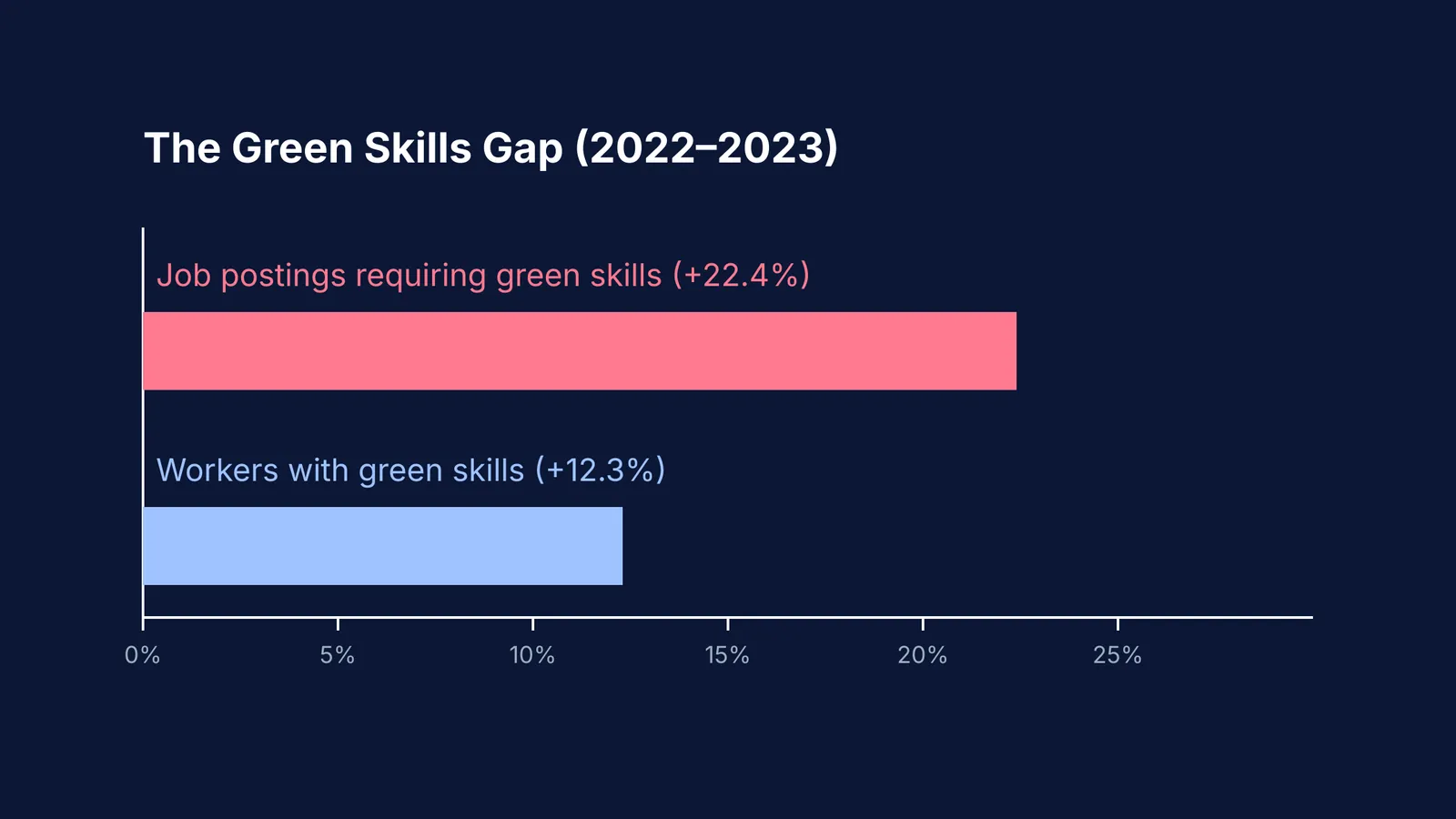
The World Economic Forum reports that the green transition will be one of the most powerful drivers of job growth this decade, creating an estimated 30 million jobs by 2030. Between 2022 and 2023, job postings requiring at least one "green skill" rose by 22.4%, while the share of workers holding those skills grew by only 12.3%. For engineering students, this skills gap is a rare opportunity to enter a rapidly expanding field.
Sustainability engineering is no longer just about meeting compliance checkboxes; it is about redesigning how industries operate from the ground up. The transition to a low-carbon economy relies on engineers who can measure environmental impact, design out waste, and optimize systems for energy efficiency. If you are exploring a career in this field, here are the three major roles companies are hiring for, and the specific skills you need to build while you are still in college.
What does an energy auditor do?
Energy auditors, or energy managers, focus on operational efficiency. They conduct technical assessments of commercial buildings, manufacturing plants, or large infrastructure projects to find out where energy is being wasted. As energy costs rise and carbon taxes become more common, their role is directly tied to a company's financial and environmental health.
An energy auditor analyzes utility bills, inspects HVAC (heating, ventilation, and air conditioning) systems, and reads flow meters. Their primary goal is to recommend physical retrofits and operational changes that reduce a facility's carbon footprint while saving money over time.
Skills to build: You need a strong grip on thermodynamics and fluid mechanics. If you find these concepts hard to picture, you can use the Fermi Simulation Lab to see how heat and pressure changes affect a physical system. Practically, auditors rely on energy simulation software like EnergyPlus or eQUEST, and data analysis tools like MATLAB or Power BI to model energy flows. Getting certified, such as becoming a Certified Energy Manager (CEM), is often a key step in this career path after you graduate.
How does environmental reporting and ESG work?
Environmental, Social, and Governance (ESG) reporting is how companies measure and disclose their impact on the planet. With new regulations like the EU's Corporate Sustainability Reporting Directive (CSRD) making this mandatory for large firms, Environmental Consultants and ESG Analysts are in high demand across the globe.
Engineers in this role spend their time on carbon accounting. The global standard for this is the GHG Protocol, which divides greenhouse gas emissions into three distinct buckets:
Scope 1 (Direct): Emissions from sources the company directly owns, like factory boilers or a fleet of delivery trucks.
Scope 2 (Indirect Energy): Emissions from the power plants that generate the electricity, steam, or heat the company buys.
Scope 3 (Value Chain): All other indirect emissions, from the extraction of raw materials upstream to how customers use the final product downstream.
Skills to build: You must understand regulatory frameworks and how to collect and verify complex datasets. This role is heavily data-driven, requiring excellent spreadsheet skills and the ability to translate technical findings into clear reports for business leaders. You also need a keen eye for detail to ensure compliance with international standards.
What is sustainable design and Life Cycle Assessment (LCA)?
Sustainable Design Engineers focus on the physical product itself. Instead of the traditional "take-make-dispose" model, they design for the Circular Economy. This means creating products that are durable, modular, and easy to recycle at the end of their useful life.
To measure whether a new design is actually better for the environment, engineers use a Life Cycle Assessment (LCA). An LCA evaluates the total environmental impact of a product from "cradle to grave"—looking at the energy and water used to extract raw materials, manufacture the item, distribute it, use it, and finally dispose of it.
Skills to build: You need systems thinking to see how a change in one stage (like using a lighter but less recyclable material) affects the whole lifecycle. Familiarity with the ISO 14040 standards for LCA and software like SimaPro or openLCA is essential. Because LCA involves complex, multi-step calculations, making sure your foundational math is flawless is critical. If you are prone to calculation errors, studying worked examples in the Fermi Problem Library can help you build a more disciplined approach to problem-solving.
How can you prepare while in college?
You do not need to wait until graduation to start building these skills. Much like when you are talking about STEM careers or planning to improve your CGPA, looking ahead makes a significant difference.
Master the fundamentals: Your core engineering classes matter deeply. If you are struggling with the physics behind energy systems in your first semester at science or engineering college, use Fermi's AI tutor to work out what you already know and build a plan to close the gaps.
Learn a specialized tool: Pick one industry-standard software package—whether it is AutoCAD for design, openLCA for lifecycle modeling, or Python for data analysis—and build a student project around it. Demonstrating practical ability will set you apart from other candidates.
Think in systems: Sustainability is never about one isolated component. Practice looking at how energy, water, and materials flow through a complete system, from start to finish. Join a student sustainability club or work on a campus greening initiative to apply these ideas in the real world.


