

On this page
The JEE Main 2027 information bulletin lists calculators, log tables and slide rules among barred items, and the NEET-UG 2026 information bulletin bars calculators and log tables too. The same bulletins set NEET-UG 2026 at 180 questions in 180 minutes and JEE Main 2027 Paper 1 at 75 questions in 3 hours. Fast arithmetic gives you minutes back for thinking, and most of it comes from a few anchors, three identities and estimating first.
Which numbers should you memorise for JEE and NEET?
Learn these until you can write them from memory:
Squares from 1 to 30 and cubes from 1 to 12.
√2 ≈ 1.414, √3 ≈ 1.732, √5 ≈ 2.236.
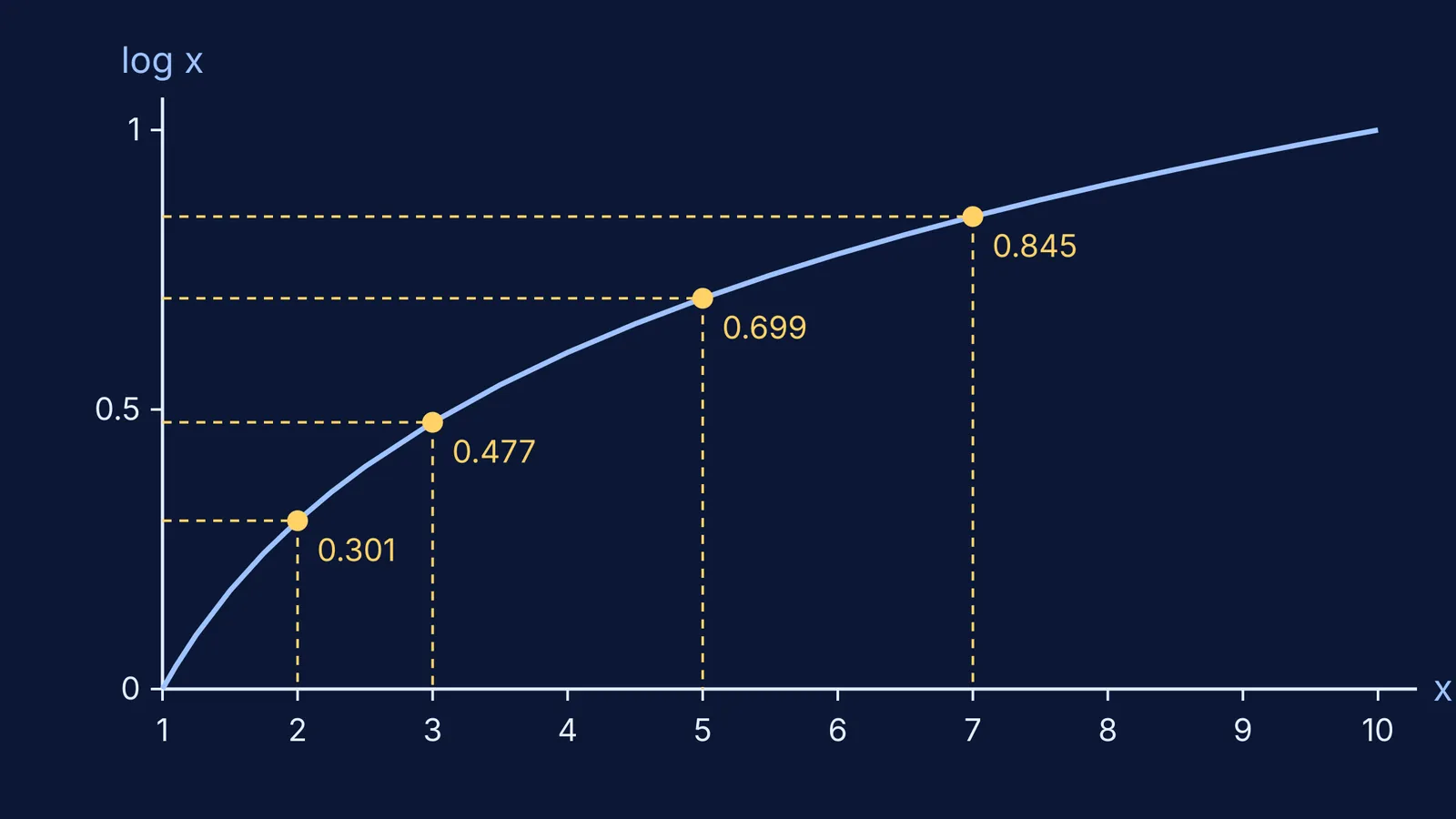
log 2 ≈ 0.301, log 3 ≈ 0.477, log 7 ≈ 0.845, and log 5 = 1 − log 2 ≈ 0.699.
ln x ≈ 2.303 log x, used in the Nernst equation and first-order kinetics.
1/7 ≈ 0.143, 1/8 = 0.125, 1/9 ≈ 0.111.
When a question gives its own constants (g = 10, or log 2 = 0.3), use them, as the JEE Main bulletin advises.
How do you do squares and square roots in your head?
Near 50: (50 + a)² = 2500 + 100a + a². So 53² = 2500 + 300 + 9 = 2809.
Near 100: (100 − a)² = 10000 − 200a + a². So 97² = 10000 − 600 + 9 = 9409.
Ending in 5: multiply the leading digit by the next number up, then write 25. So 65² is 6 × 7 = 42, then 25: 4225.
For roots, start from the nearest perfect square and add a correction: √(a² + d) ≈ a + d/(2a). So √50 ≈ 7 + 1/14 ≈ 7.071 (true value 7.0711). The same idea drives our guide to small-angle and binomial approximations for JEE physics.
How do you handle logs, pH and powers of ten without a log table?
Break the number into factors you know. log 48 = log(16 × 3) = 4(0.301) + 0.477 = 1.681. For pH, split the digits from the power: if [H⁺] = 2 × 10⁻³ M, pH = 3 − 0.301 = 2.70.
For ratios, cancel before you multiply and keep powers of ten in their own column. Worked example, the energy of a 440 nm photon, E = hc/λ:
Write it out: (6.6 × 10⁻³⁴ × 3 × 10⁸) / (4.4 × 10⁻⁷).
Digits: spot that 6.6/4.4 = 1.5, so 1.5 × 3 = 4.5.
Powers: −34 + 8 + 7 = −19.
Answer: 4.5 × 10⁻¹⁹ J, with no long multiplication.
How do you use the answer options to estimate?
If the options differ by a power of ten or a factor of 2 or more, round every number to one significant figure. In the photon example, 7 × 3 / 4 ≈ 5 is enough to pick 4.5 × 10⁻¹⁹ J over 4.5 × 10⁻¹⁸ J or 2.2 × 10⁻¹⁹ J.
If two options share the power of ten and first digit, estimate to rule out the rest, then calculate exactly.
If options differ in sign or units, check those first; they cost no arithmetic.
The JEE Main bulletin says numerical-value answers should be rounded off to the nearest integer, so work precisely enough to round correctly.
To fit this into a whole paper, use our two-pass time management plan for JEE and NEET and this routine for checking answers in the last 10 minutes.
What does a 10-minute daily drill look like?
Mix problem types rather than doing twenty squares in a row. In a study in Instructional Science, Doug Rohrer and Kelli Taylor had 18 undergraduates practise finding the volumes of four unfamiliar solids, either blocked by type or mixed. A week after the last practice session the mixed group scored 63% on the test and the blocked group 20%, even though the blocked group had done better during practice (89% against 60%). The authors suggest mixing taught students to pick the right formula for each problem, not just apply it. It was a small study, so treat it as a hint, not a guarantee.
A drill for the start of each study session:
Minutes 0–2: write your anchors from memory. Circle any you missed.
Minutes 2–6: eight mixed calculations: a square, a root, a log, a pH, a powers-of-ten ratio, a fraction to decimal, and two of your choice, in a new order each day.
Minutes 6–9: three past-paper or mock questions. Estimate first and write down the option you expect.
Minutes 9–10: check, and note each slip in one line: what went wrong and the fix.
If you keep using the wrong method, work a few examples in the Fermi Problem Library, where a step-by-step solver explains the reasoning rather than printing an answer. If the gap is the idea itself, such as what a logarithm means, the Fermi Concept Library gives each concept its own lesson.
Start tonight: write your anchor list from memory and see what is missing.


