

On this page
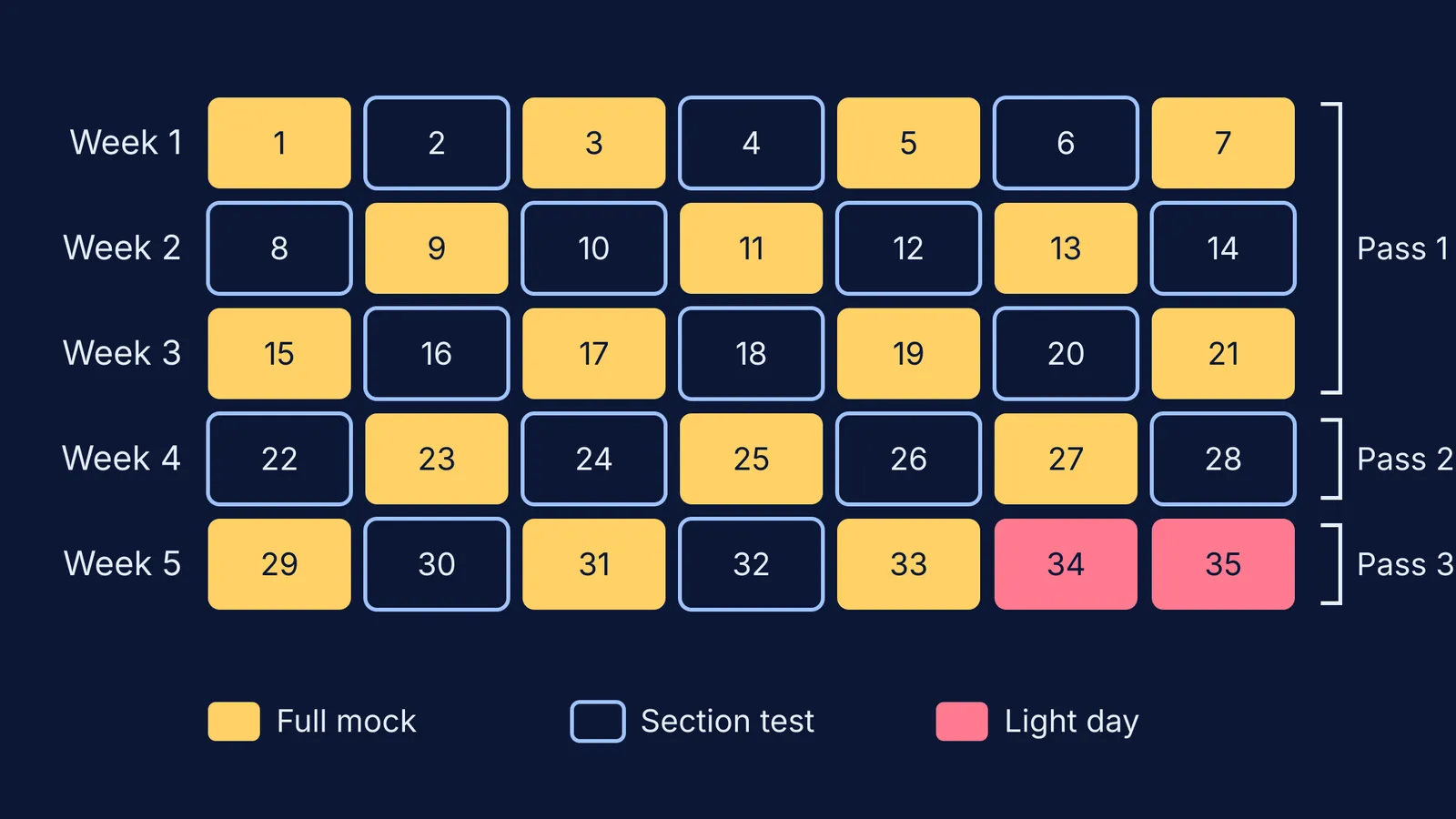
Your last board paper is done and NEET-UG is a few weeks away. It is a different exam: no long answers and no step marks, just multiple-choice questions against the clock. The calendar above shows this plan for a 35-day gap; stretch or squeeze it to fit yours.
What changes between the boards and NEET?
The National Testing Agency's NEET (UG) 2026 Information Bulletin sets out the pattern. NEET (UG) 2026 had 180 compulsory questions in 180 minutes: 45 in physics, 45 in chemistry and 90 in biology (botany and zoology), for 720 marks. A correct answer earns 4 marks, a wrong answer loses 1, and an unanswered question scores 0. Dates and rules can change from year to year, so check the official NEET site for your year's bulletin.
Two things follow. Biology is half the paper, so NCERT biology gets the most hours. And speed with accuracy, not writing, is now the skill, so you practise it every day.
Why take a mock every day?
Testing yourself is a way to learn, not only to measure. In a 2006 study by Henry Roediger and Jeffrey Karpicke, students who took recall tests on prose passages remembered substantially more a week later than students who restudied the passages the same number of times. A 2013 review led by John Dunlosky compared ten study techniques and gave its highest rating to two: practice testing and distributed (spaced) practice.
A full three-hour paper every day leaves no time to fix what it shows you, so alternate:
Odd days: a full 180-question mock, sat at the same time as the real paper (the 2026 bulletin set 2:00 to 5:00 pm), then an hour of analysis.
Even days: a 45-question section test, rotating physics, chemistry, botany and zoology, at the real paper's pace of one minute per question.
Then use our 60-minute routine for analysing a mock test to sort every lost mark.
How should you revise NCERT biology in the last weeks?
Read it three times, each pass shorter than the last:
Pass 1 (weeks 1 to 3): every chapter of Class 11 and 12 NCERT biology, line by line, including diagrams, tables and boxed examples. Split the chapters evenly across the 21 days and mark any line a mock caught you on.
Pass 2 (week 4): only the lines you marked, plus your mock error log.
Pass 3 (week 5): diagrams, tables and lists only. Recall each from memory first, then check.
Returning to the same lines a week or two apart is the spaced practice the Dunlosky review rated highly. For how to read the text closely, see why NCERT textbooks matter for NEET and how to study them.
How do you fix physics in a few weeks?
Don't restart chapters. Give physics two hours a day:
Solve about 30 mixed questions from different chapters. The Dunlosky review rated this kind of interleaved practice moderately useful.
Label each wrong answer: concept, formula, calculation or misread.
Rework every wrong answer the next morning without looking at the solution.
Strong in biology but weak in physics? Read NEET physics for students who are strong in biology. When a mistake is a wrong method rather than a slip, the Fermi Problem Library has worked problems with a step-by-step solver that explains the reasoning rather than printing an answer. When a whole idea is shaky, the Fermi Concept Library gives each concept in physics, chemistry and biology its own lesson.
What does one day of the plan look like?
On a full-mock day:
7:00 to 10:00 am: NCERT biology, current pass
10:30 am to 12:30 pm: physics mixed set and error log
2:00 to 5:00 pm: full mock
5:30 to 6:30 pm: mock analysis
7:30 to 8:30 pm: chemistry
Same bedtime every night
On a section-test day, spend the rest of the afternoon slot on the weakest chapter in your error log. On the last two days, revise only your Pass 3 notes, read NTA's admit card and dress-code notices for your year, and keep your normal bedtime.
What can parents do in these weeks?
Keep the house routine steady: meals, quiet hours and the 2:00 pm mock slot. Instead of asking for the score, ask: "What did your error log show today, and what are you fixing tomorrow?"
Some nerves are normal. If you notice lasting sleep loss, low mood or panic that does not ease, talk to a doctor or counsellor. India's Tele MANAS helpline, 14416, is toll-free and runs 24/7.
Tonight, write the date of your last board paper and NEET's date on one sheet, count the days, and fill in your own calendar.


