

On this page
The BITSAT iteration process is the seat allotment system used by BITS Pilani to fill undergraduate engineering and science seats across its three campuses (Pilani, Goa, and Hyderabad). Unlike joint counselling systems, BITS conducts its own independent rounds based on your BITSAT score and the preference list you submit.
Understanding how these iterations work, and the rules around the waitlist fee, can help you make informed decisions during the high-pressure admission window.
How do BITSAT iterations work?
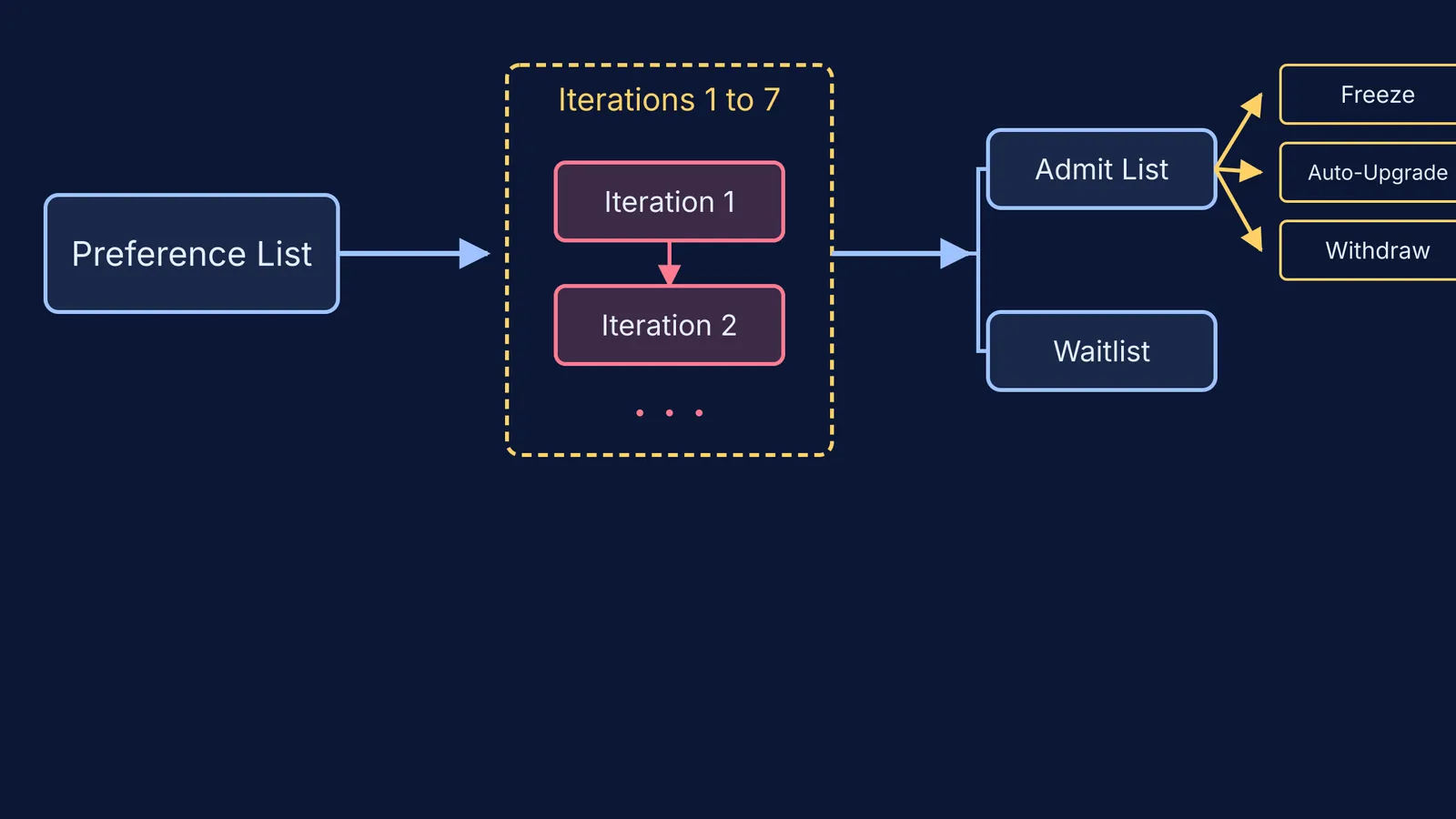
An iteration is simply a round of seat allotment. BITS typically conducts six to seven iterations, sometimes extending further if seats remain vacant (Source).
In each iteration, the system looks at your BITSAT score, your Class 12 marks (as a tie-breaker), and the ranked list of campus and branch combinations you submitted. If your score meets the cut-off for one of your choices, you are allotted a seat. If not, you are placed on a waitlist.
A crucial feature of this system is automatic upgradation. If you are allotted your fifth preference in Iteration 1 and you accept it by paying the admission fee, you are automatically considered for your first four preferences in subsequent rounds as other students withdraw to join different colleges.
What is the waitlist process and fee?
If you do not receive an allotment in the first iteration but your score is competitive, you will be placed on the waitlist. To remain on this list and be considered for future rounds, you must pay an advance admission fee.
For recent cycles, this advance fee was approximately ₹45,000 to ₹60,000 (Source). This acts as a deposit to confirm your genuine interest in a seat.
If you are eventually allotted a seat, this amount is adjusted against your first-semester tuition fees.
If you remain on the waitlist through all iterations and never receive an offer, the full amount (minus a small processing fee) is refunded automatically to your bank account.
If you are offered a seat but choose to withdraw later, a portion of this fee may be forfeited depending on the official withdrawal timeline.
Freeze, auto-upgrade and withdraw: What are your options?
Once you are allotted a seat, you must choose how to proceed:
Accept and Freeze: You accept the allotted seat and lock it. You will not be considered for any further upgrades in subsequent iterations, even if vacancies arise.
Accept and Upgrade: You accept the current seat, pay the required advance fee, but remain in the pool. If a vacancy arises in a branch or campus higher up on your preference list, you will automatically be upgraded in the next iteration.
Withdraw: You decline the seat and exit the counselling process entirely.
Missing the fee payment deadline for an allotted seat results in automatic cancellation, and you are removed from all future iterations entirely.
How to choose between campuses and branches?
Deciding the order of your preference list is the most important step before Iteration 1. Once the submission window closes, this list cannot be changed. Many students struggle with choosing between a preferred branch at a newer campus versus a lower-preference branch at the main Pilani campus.
Rather than guessing which branch you might like, you can test your aptitude for different subjects before filling out your preferences. For example, Fermi's AI tutor can work out what you already know and build a plan for the session across various science topics, giving you a taste of university-level concepts.
If you are unsure whether you prefer the theoretical depth of physics or the applied logic of engineering, try working through a few advanced problems. The Fermi Problem Library offers worked problems with a step-by-step solver that explains the reasoning rather than printing an answer. Seeing which types of problems you enjoy solving can help clarify your branch preferences before you lock them in.
A checklist for filling your preference form
Before you submit your final choices, use this framework to ensure you have covered all bases:
Rank strictly by preference, not probability: Always put the branch and campus you want most at the top, regardless of whether you think your score is high enough. The iteration system will automatically work its way down your list.
Exclude unacceptable options: Never include a branch or campus you are absolutely unwilling to attend. If you are allotted that seat and reject it, you exit the process.
Consider the dual degree option: If you are open to studying a master's in science alongside a bachelor's in engineering, include the M.Sc. dual degree programmes in your list. They often have slightly lower cut-offs than single engineering degrees.
Prepare the funds early: Ensure you have the waitlist or advance fee ready in your bank account before the Iteration 1 results are announced, as the payment window is typically only a few days.
For more guidance on balancing competitive exams, read our guide on BITSAT basics for JEE aspirants and understand the differences in our breakdown of JEE Main vs JEE Advanced.


