

On this page
A common mistake before school: opening a new chapter at 6 am, reading four pages half-awake, and leaving with nothing that sticks. A short morning slot is good at one job, and it is not first-time learning. It is pulling out of memory what you learned the day before.
Why use the morning for recall rather than new topics?
Retrieval practice means recalling information from memory without looking, such as writing down everything you remember from a chapter before checking your notes. In a 2006 study by Henry Roediger and Jeffrey Karpicke, students who took recall tests on prose passages remembered substantially more after two days and after one week than students who spent the time rereading. Rereading won only on a test five minutes later, even though it made students more confident that they would remember.
Sleep between sessions helps too. In a 2016 study in Psychological Science, 40 participants practised foreign vocabulary in two sessions 12 hours apart. Those who learned in the evening, slept, and relearned the next morning needed half as much practice as those who did both sessions in one day, and remembered more one week and six months later. It was a small study using word lists, so treat it as a strong hint, not a law.
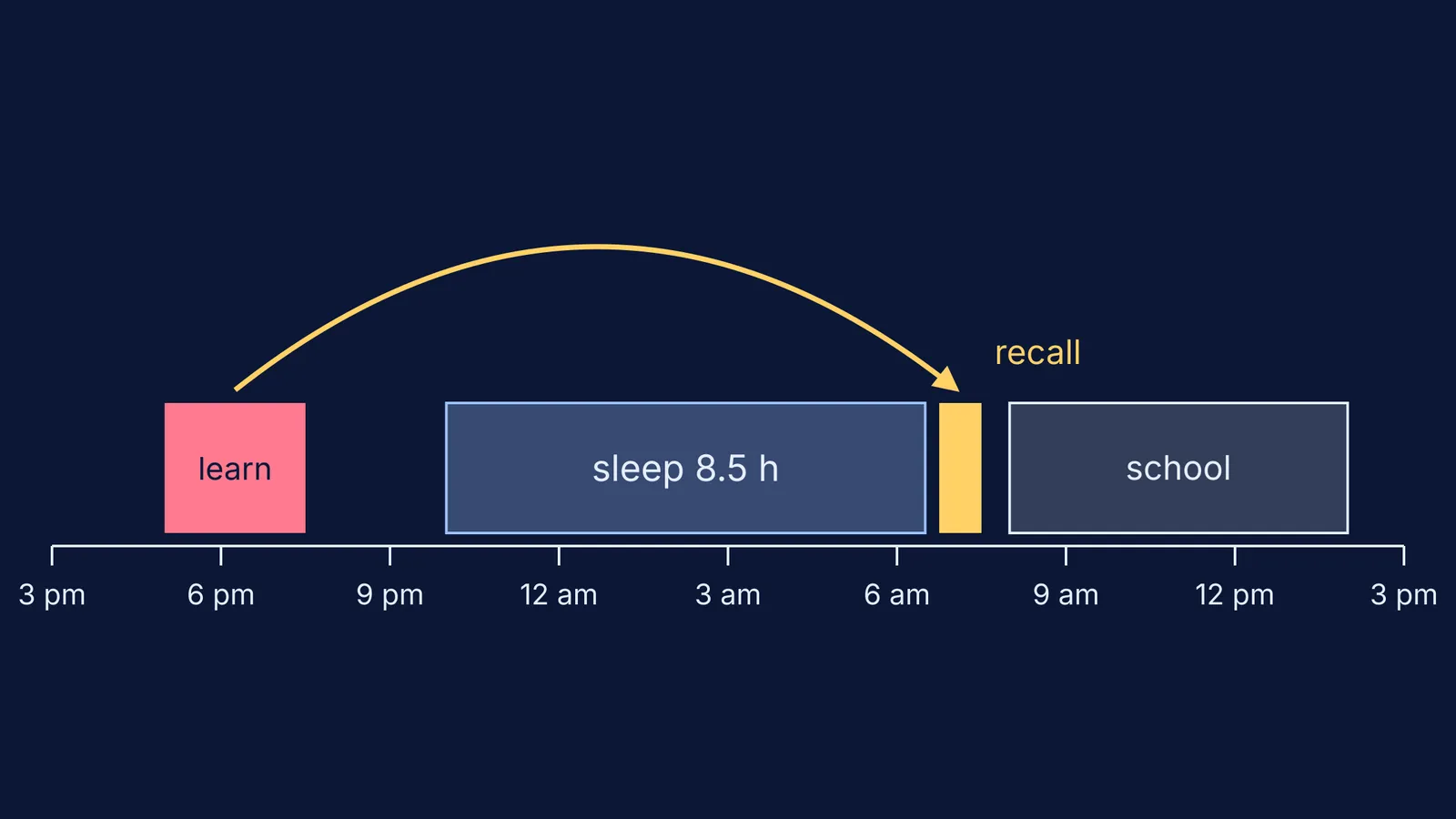
Together they suggest a simple routine: learn in the evening, recall in the morning.
What should I study in the morning before school?
Pick two or three of these. Each one makes you produce an answer before you look.
Blank-page recall (10 to 15 minutes): write everything you remember from yesterday's class or last night's chapter, then mark the gaps against your notes in another colour.
Problem redo (15 to 20 minutes): solve two or three problems from last night without looking at your earlier working.
Diagram from memory (10 minutes): draw and label the human heart, a ray diagram or a circuit, then compare with the textbook.
Flashcard round (10 minutes): formulas, named reactions, NCERT biology terms, mixing in cards from last week.
A worked example: one 45-minute slot
Say you are in Class 11, preparing for JEE, and last night you studied friction.
6:45 to 7:00. Blank page on the laws of friction and the angle of repose. Your notes show two gaps.
7:00 to 7:20. Redo three friction problems from last night. One goes wrong at the free-body diagram.
7:20 to 7:30. Flashcards from last week's mole concept chapter.
Write the two gaps and the wrong problem on a sticky note for tonight.
The morning found the mistakes while there is still an evening to fix them. For older chapters, our 4-week spaced revision schedule shows how to fit them into short sessions like this.
What should I leave for the evening?
New chapters and first readings of hard derivations.
Long problem sets and full mock tests, which need unbroken hours.
The fixes from your morning sticky note.
That last item is where the evening earns its time. When a morning redo goes wrong, you need to see where the method broke. The Fermi Problem Library has worked problems with a step-by-step solver that explains the reasoning rather than printing an answer. If the gap is a concept rather than a method, the Fermi Concept Library gives each concept in physics, chemistry, biology and mathematics its own lesson.
How early should a teenager wake up to study?
Not so early that sleep pays for it. The American Academy of Sleep Medicine consensus statement says teenagers aged 13 to 18 should sleep 8 to 10 hours per 24 hours on a regular basis.
Teenage body clocks also run late. In a survey of about 25,000 people by Till Roenneberg and colleagues, natural sleep timing got steadily later through adolescence and peaked at around age 20. A 4:30 am alarm fights that clock.
So count backwards. If you wake at 6 am and need 8.5 hours of sleep, lights go out at 9:30 pm. If that is not realistic, take a 20-minute slot instead of 45. For more on fitting study to your body clock, read what chronotype research says about morning or night study.
For the bedtime side, see how much sleep teenagers need and how parents can help. Then tomorrow morning, try one blank page on whatever you study tonight.


