

On this page
Most engineers and science postgraduates who dream of a career in nuclear research aim for the Bhabha Atomic Research Centre (BARC). The Department of Atomic Energy (DAE) hires its Scientific Officers through a unique model: you do not apply directly for a job, but rather for a place in one of their Training Schools.
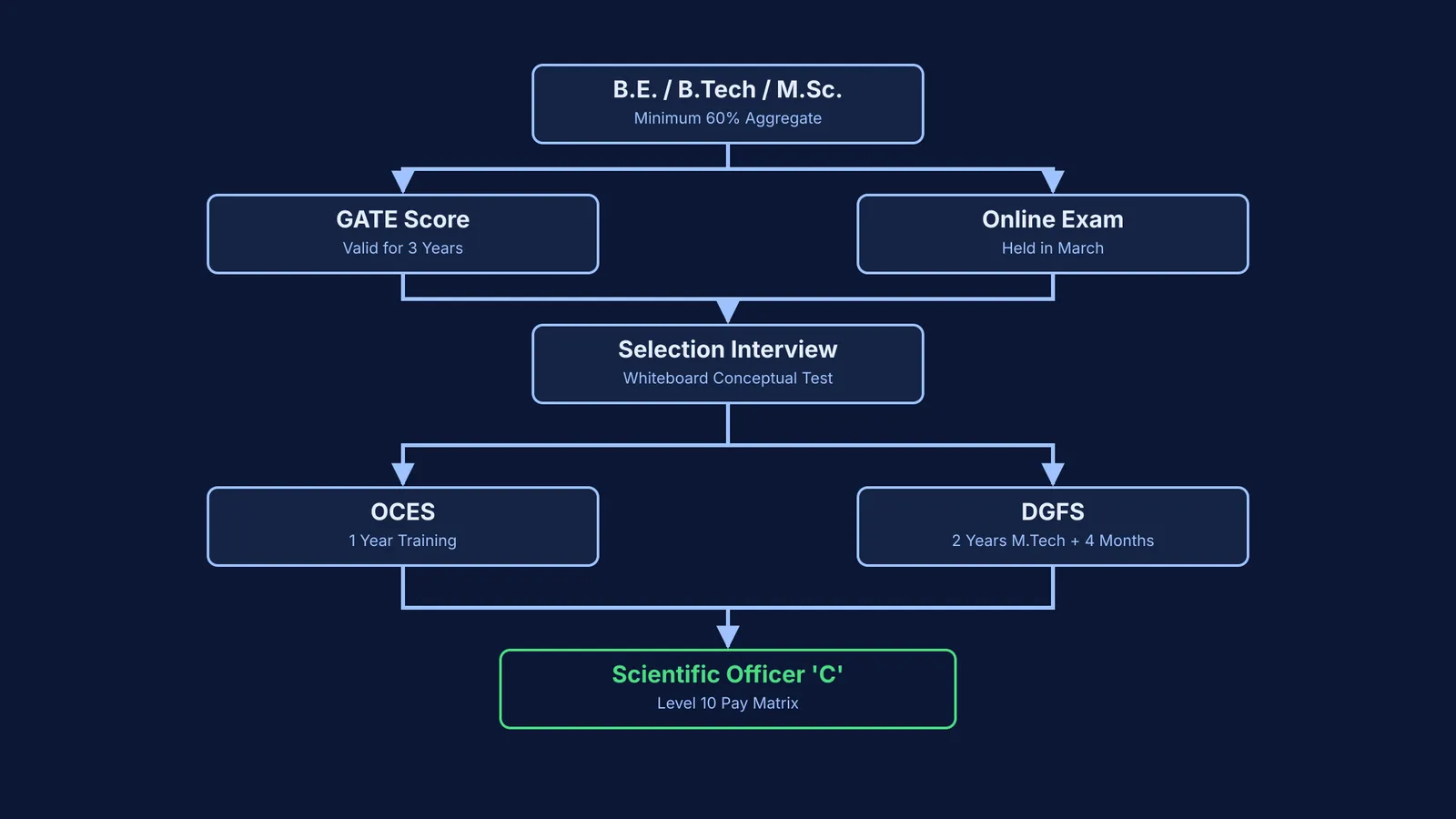
There are two parallel paths for this: the Orientation Course for Engineering Graduates and Science Postgraduates (OCES) and the DAE Graduate Fellowship Scheme (DGFS). If you make it through the selection process, you undergo intensive training before being appointed as a Scientific Officer in a DAE unit.
What are the OCES and DGFS programs?
OCES is a one-year training program held at various BARC Training Schools across India, including Mumbai, Kalpakkam, and Hyderabad. OCES trainees receive a monthly stipend of ₹74,000 and a one-time book allowance of ₹30,000 during their training.
DGFS is a two-year scheme for engineers who have secured admission to an M.Tech. or M.Chem.Engg. at select premier institutes like the IITs. The DAE pays your tuition fees, gives you the same monthly stipend, and provides an annual contingency grant of ₹60,000. After finishing your degree, you undergo a four-month orientation at BARC before joining the DAE.
How do you get shortlisted for the interview?
To be eligible, you need a B.E., B.Tech, or an M.Sc. in relevant disciplines (such as Physics, Chemistry, or Mechanical Engineering) with a minimum of 60% aggregate marks. If you meet the educational criteria, there are two main ways to reach the interview stage:
A valid GATE score: You can apply using your GATE score from the current or previous two years (for example, GATE 2023, 2024, or 2025 for the 2025 recruitment cycle). Shortlisting is based on a discipline-specific cut-off.
The BARC Online Examination: If you did not write GATE, or if your score is borderline, you can take a computer-based technical test held in March.
The most critical thing to know about the screening stage is that it is strictly a qualifying round. Once you receive your interview call letter, your GATE score or online test marks carry no further weight.
What is the BARC interview actually like?
The BARC technical interview is unlike a standard corporate placement or PSU interview. It is widely considered one of the deepest conceptual tests in India, typically lasting an hour with a panel of senior scientists.
There is no fixed syllabus. Instead, the panel will usually ask you to name your favourite subjects within your discipline. For the rest of the hour, you will stand at a whiteboard and solve problems, derive formulas, and explain physical phenomena from first principles.
The panel looks for physical intuition rather than rote memory. If you are a physics student, they will not ask you to recite Maxwell's equations; they will ask you to explain the behaviour of fields at boundaries. If you are an engineer, they might start with Bernoulli's equation and push you into boundary layer theory. They will relentlessly ask "why?" after every statement you make.
If you are preparing for this level of conceptual depth, the Fermi Concept Library offers every concept in physics, chemistry, biology, mathematics and computing, each with its own lesson and its place in the map, to help you close gaps in your fundamentals. Furthermore, since the panel expects you to solve analytical problems step by step, the Fermi Problem Library has worked problems with a step-by-step solver that explains the reasoning rather than printing an answer.
How should you prepare for the whiteboard test?
To succeed in the BARC interview, you need a specific preparation strategy that goes beyond standard exam prep:
Select your subjects carefully: Choose subjects where you understand the physical meaning behind the equations. If you pick thermodynamics, you must be able to explain the work in an irreversible expansion using a P-V diagram.
Practice on a vertical surface: Thinking while standing at a whiteboard is different from writing in a notebook. Buy a cheap whiteboard and practice deriving standard results, such as the energy bands in conductors and insulators, while explaining your steps out loud.
Master the "Why": The panel will push you until you reach the limit of your knowledge. Do not try to bluff. When you get stuck, state your logical assumptions and ask if you are on the right track.
What happens after the training?
Upon successfully completing the OCES or DGFS program, you are appointed as a Scientific Officer 'C' (a Group A Gazetted Officer) in Level 10 of the 7th Central Pay Commission Pay Matrix.
Your starting basic pay is ₹56,100, but OCES trainees usually earn two to three advance increments based on their performance in the Training School. With these increments, along with Dearness Allowance (DA), House Rent Allowance (HRA), and Transport Allowance (TA), your gross monthly emoluments in a city like Mumbai currently reach approximately ₹1,34,000.
You might be posted at BARC in Mumbai, the Indira Gandhi Centre for Atomic Research (IGCAR) in Kalpakkam, the Raja Ramanna Centre for Advanced Technology (RRCAT) in Indore, or other DAE units. You will be required to execute a bond to serve the department for at least three years, beginning a stable and highly respected career in national scientific research.


