

On this page
College offers unlimited opportunities but strictly limited time. The shift from a structured high school day to the high autonomy of a university campus often leads students to overcommit. Between classes, labs, part-time jobs, and student societies, the schedule quickly fills up, leaving little room for actual studying or adequate rest.
This time squeeze has real academic costs. According to the American College Health Association's Spring 2024 survey of over 79,000 undergraduates, 41.7% of students reported that stress negatively impacted their academic performance in a class or delayed their degree progress. When your schedule is overloaded, it is impossible to give your coursework the deep, uninterrupted focus it requires.
Why does the 168-hour week always win?
The first step in managing your responsibilities is accepting the hard math of your schedule. There are exactly 168 hours in a week.
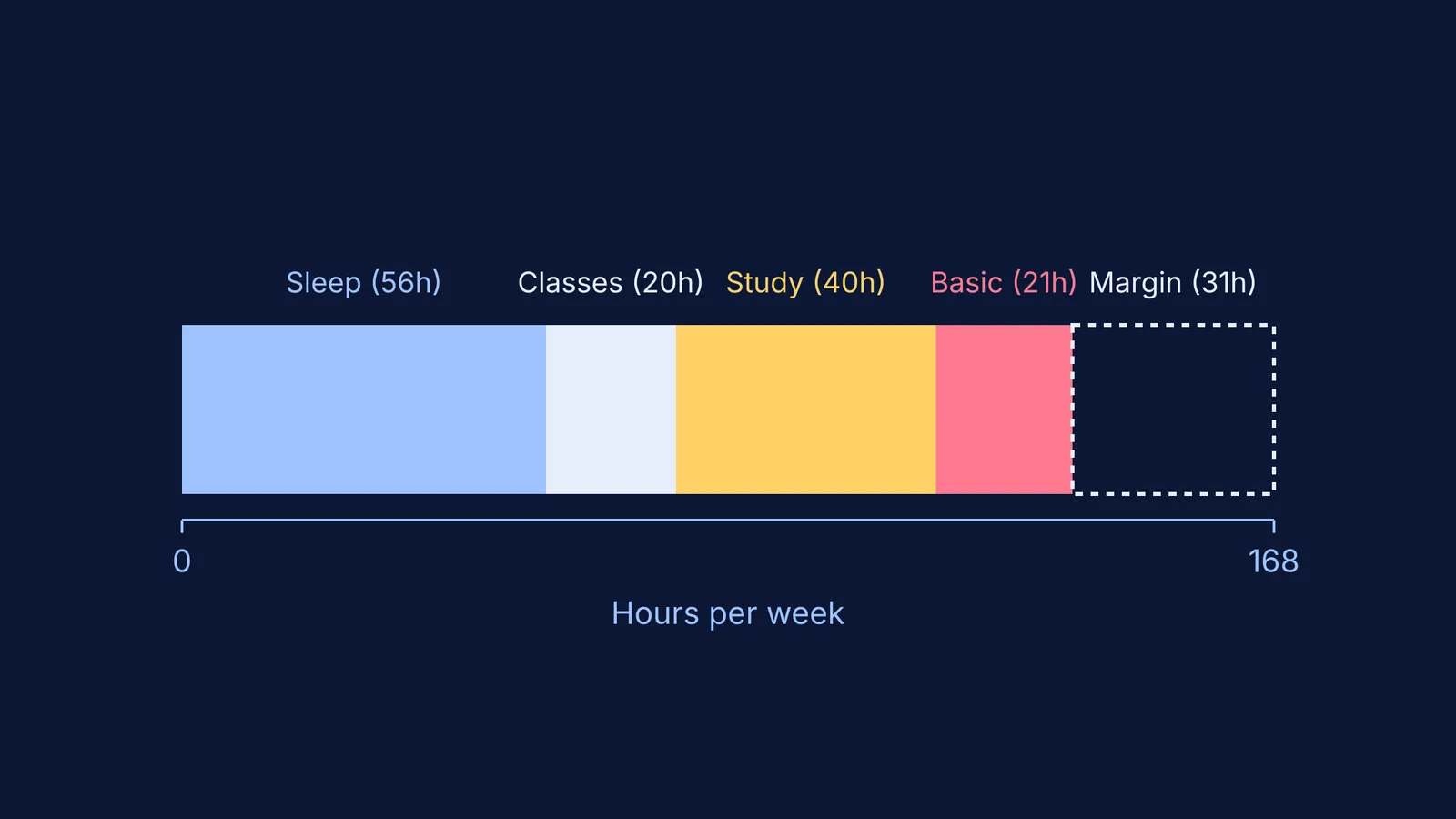
If you sleep eight hours a night (56 hours), spend 20 hours in lectures and practicals, and study for 40 hours (following the standard university rule of two hours of study for every hour in class), you have already committed 116 hours. Add another 21 hours for basic human needs like eating, showering, and commuting.
You have now spent 137 hours, leaving a margin of just 31 hours for the entire week. That is about four and a half hours a day for friends, hobbies, clubs, and downtime. If you take on a 20-hour part-time job and a 15-hour society role, that margin vanishes entirely. When the math does not add up, sleep and study time are usually the first to be sacrificed, driving stress levels higher.
When your study hours are strictly limited, efficiency matters. Instead of spending an hour stuck on a single concept, Fermi's AI tutor can work out what you already know and build a plan for the session, so you sit down to a clear next step.
How do you manage your current commitments?
When exam season approaches, you cannot maintain a peak level of involvement in every area of your life. You need a triage system to actively reduce your load before you burn out. Use the 3-D framework to sort your responsibilities:
Drop: Look at your list of commitments and ask, "What happens if I stop doing this right now?" If the answer is "nothing major," drop it entirely. This might mean stepping down from a committee role you do not enjoy or dropping a recreational club.
Delegate: Identify tasks you can share with others. If you usually cook for your flatmates, ask to rotate the responsibility. If you commute, arrange a carpool to win back some reading time on the bus.
Delay: Move non-urgent tasks until after the exam period. Postpone the launch of a side project, tell your friends you will catch up after midterms, or delay a major room reorganization.
How do you say no to new demands?
The hardest part of managing responsibilities is refusing new ones. Friends, professors, and society presidents will continually ask for your help, and saying no can feel incredibly uncomfortable.
The trick is to decline the request without rejecting the person. Use a clear, pre-planned script so you do not have to invent an excuse on the spot. Here are three ways to say no firmly and politely:
"I am at absolute capacity with my coursework this semester, so I cannot take this on."
"I would love to help, but I have a strict rule against adding any new projects during exam season."
"I cannot commit to the weekly meetings, but I can review the final document for you next weekend."
How do you protect your academic focus?
If you are preparing for competitive exams like JEE or NEET alongside your regular classes, time is even tighter. Overcommitting is a common reason why some JEE aspirants plateau despite studying every day, as they spread their energy across too many minor tasks instead of focusing on deep problem-solving.
To maintain your performance, you must aggressively protect your study blocks. Treat them as non-negotiable appointments, just like a paid job or a doctor's visit. Building a study routine that lasts requires you to accept that you cannot do everything. Saying no to a good opportunity is often the only way to say yes to a great academic outcome.


