On this page
When choosing a college in India, you will often see them described as either "autonomous" or "affiliated". Both types are connected to a parent university, such as Delhi University, Mumbai University, or Anna University. The difference lies in how much control the college has over what you learn, how you are tested, and how quickly your syllabus adapts to new developments. Understanding this difference is an important part of your college search, especially if you are targeting fast-moving fields like engineering, computer science, or modern biology.
What is an autonomous college vs affiliated college?
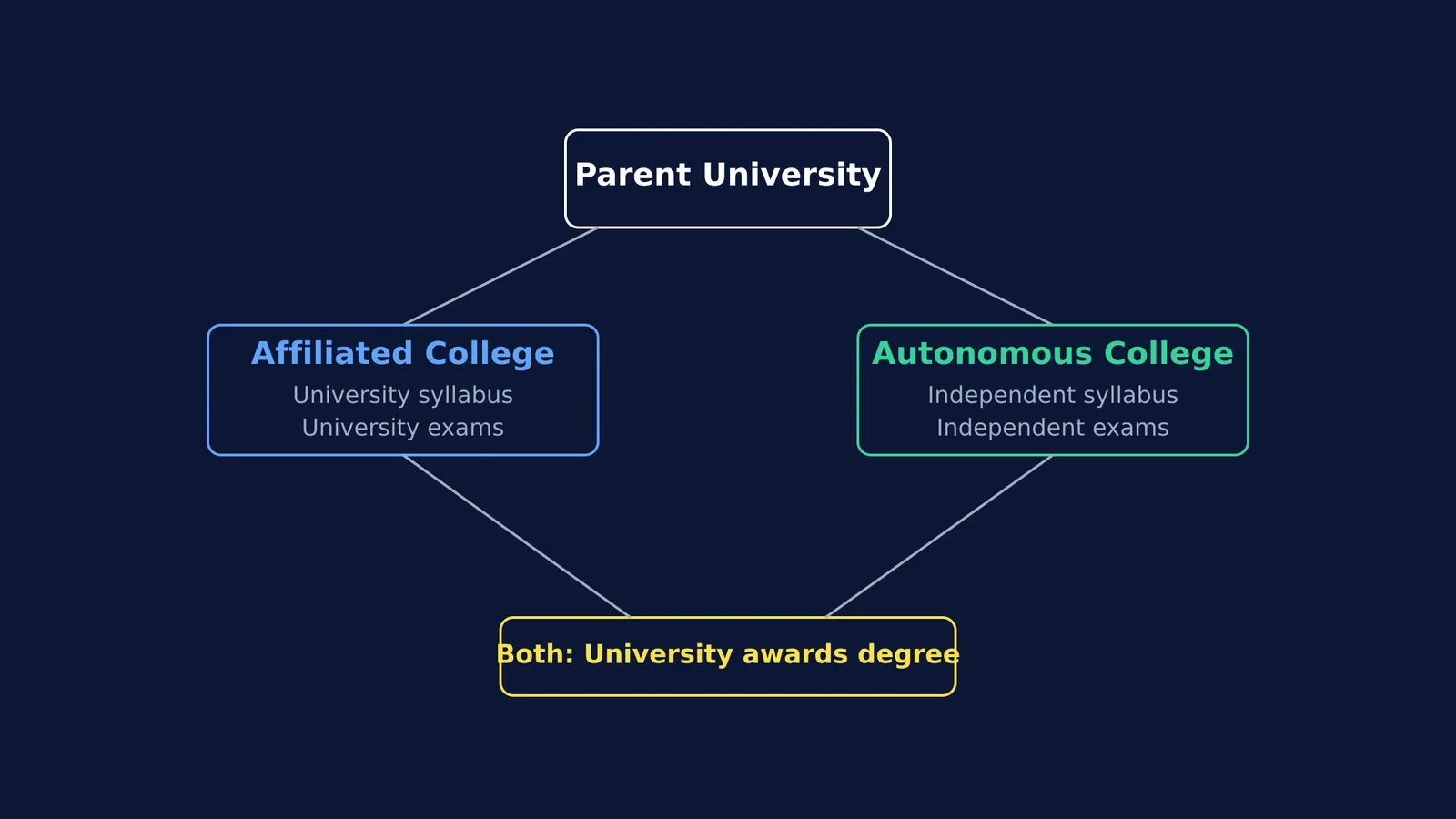
An affiliated college must strictly follow the rules of its parent university. It teaches the exact syllabus prescribed by the university, and its students take a common final exam set by that university at the same time as students in many other affiliated colleges. The college acts primarily as a teaching centre, while all major academic decisions are made centrally by the university board.
An autonomous college is granted special status by the University Grants Commission to run its own academic affairs. According to the UGC's 2023 regulations-Regulations,-2023.pdf), autonomous colleges are given this status to encourage higher standards and innovation in education. This status is typically granted for an initial period of 10 years based on the college's accreditation scores, such as those from NAAC or NBA. During this period, the college has the independence to shape its own academic environment, although it remains accountable to the UGC and the parent university for maintaining quality.
Who sets the syllabus and conducts exams?
This is the most practical difference for students during their daily college life. In an affiliated college, changing an outdated syllabus requires the entire university to agree. This involves committees, proposals, and approvals across multiple levels, which can take several years. As a result, students might find themselves studying older technologies or methods.
In an autonomous college, the institution can update its curriculum and introduce new courses, including certificates and diplomas, without asking the university for permission every time. This means autonomous colleges can adapt faster to new industry trends, such as adding artificial intelligence or data science electives to their computer science programs. They can also invite industry experts to help design courses that match what employers are actually looking for.
Autonomous colleges also have the freedom to conduct their own examinations and evaluate students internally. They can design their own grading systems and choose how to test students. For example, they might use more continuous assessments, projects, and practical lab work rather than relying heavily on one massive end-of-year written exam.
If you are wondering how these internal marks affect your final grade, read our guide on how much mid-semester exams matter in college. Because they evaluate their own papers on campus, autonomous colleges also declare results much faster than affiliated colleges, where centralized checking for thousands of students can take months.
Does an autonomous college give its own degree?
No, this is a common point of confusion for students and parents. While autonomous colleges run their own classes, design their syllabus, and conduct their own tests, they do not have the legal power to award degrees independently.
According to the same UGC 2023 guidelines, the parent university remains the sole degree-awarding authority. When you graduate from an autonomous college, your final degree certificate is issued by the parent university. However, the certificate will have the name of the autonomous college prominently printed on it alongside the university's name.
This degree holds exactly the same legal validity for government jobs, UPSC examinations, or applying for higher studies abroad as a degree from any standard affiliated college under that same university. You do not lose out on the prestige or recognition of the parent university by attending an autonomous college.
Which type of college is better for you?
Choosing between the two depends on what you want from your degree and your preferred learning style.
If you prefer a standardized, time-tested syllabus and lower tuition fees (as fees are often strictly regulated by the state), an affiliated college might suit you. It offers a predictable structure, and you know exactly what will be covered by looking at the university's central syllabus. However, you will have to wait for the university to update its courses, and exam schedules can sometimes be delayed due to logistical challenges across many colleges.
If you want a modern syllabus that adapts to current job markets, an autonomous college is usually the better choice. Because they can set their own curriculum, their engineering and science programs are often more up to date. This can be a major advantage when you learn how to get a job off campus as a fresher in India. You will also experience a faster exam and result cycle, which is helpful if you need your final marksheets quickly for job joining dates or postgraduate admissions.
If you find yourself stuck trying to master new engineering or science concepts, Fermi's AI tutor can help you build a plan for your study sessions. It works out what you already know and guides you step-by-step through university-level concepts, teaching you how to solve the problems rather than just giving you the answers.
Checklist for verifying a college's status:
Search for the college on the UGC's official list of autonomous colleges.
Check their NAAC or NBA accreditation score on their official website.
Look at their syllabus page: does it say "prescribed by" a specific university, or is it updated independently?
Ask current students how fast their semester results are declared compared to the parent university's timeline.