

On this page
The Atal Tinkering Lab (ATL) is likely the most advanced workspace in your school. Instead of just reading about circuits, forces, or programming on a screen, the lab is designed for building physical prototypes. Whether you are interested in engineering, design, or solving local community problems, the lab provides the hardware to turn your ideas into working models.
Active learning—where you build and test things yourself—is widely shown to improve long-term understanding. By working with real components, you practice learning by doing, discovering how textbook theories hold up when they meet real-world friction, resistance, and gravity. For instance, calculating the torque of a motor in a physics exam is very different from watching a robot struggle to climb a ramp because its motor is too weak.
What equipment is in an Atal Tinkering Lab?
To ensure schools have what they need to innovate, the Atal Innovation Mission's equipment guidelines provide tools for electronics, robotics, 3D modelling, and mechanical prototyping. This includes:
Electronics and Robotics: Microcontrollers, motors, breadboards, and sensors for light, temperature, and motion. These are the brains and senses of most automated projects, allowing students to program logic into their hardware.
Rapid Prototyping Tools: 3D printers allow you to design custom plastic parts, brackets, and enclosures for your prototypes. This teaches the basics of computer-aided design (CAD) and spatial reasoning.
Mechanical and Measurement Tools: Standard hand tools, drills, soldering stations, multimeters, and vernier calipers help you physically assemble and measure your creations. Learning to use a multimeter to check for a short circuit is a fundamental skill for any budding engineer.
Power and Safety: Rechargeable batteries, power supplies, safety goggles, and first-aid kits ensure the workspace remains powered and secure.
How do you start an ATL project?
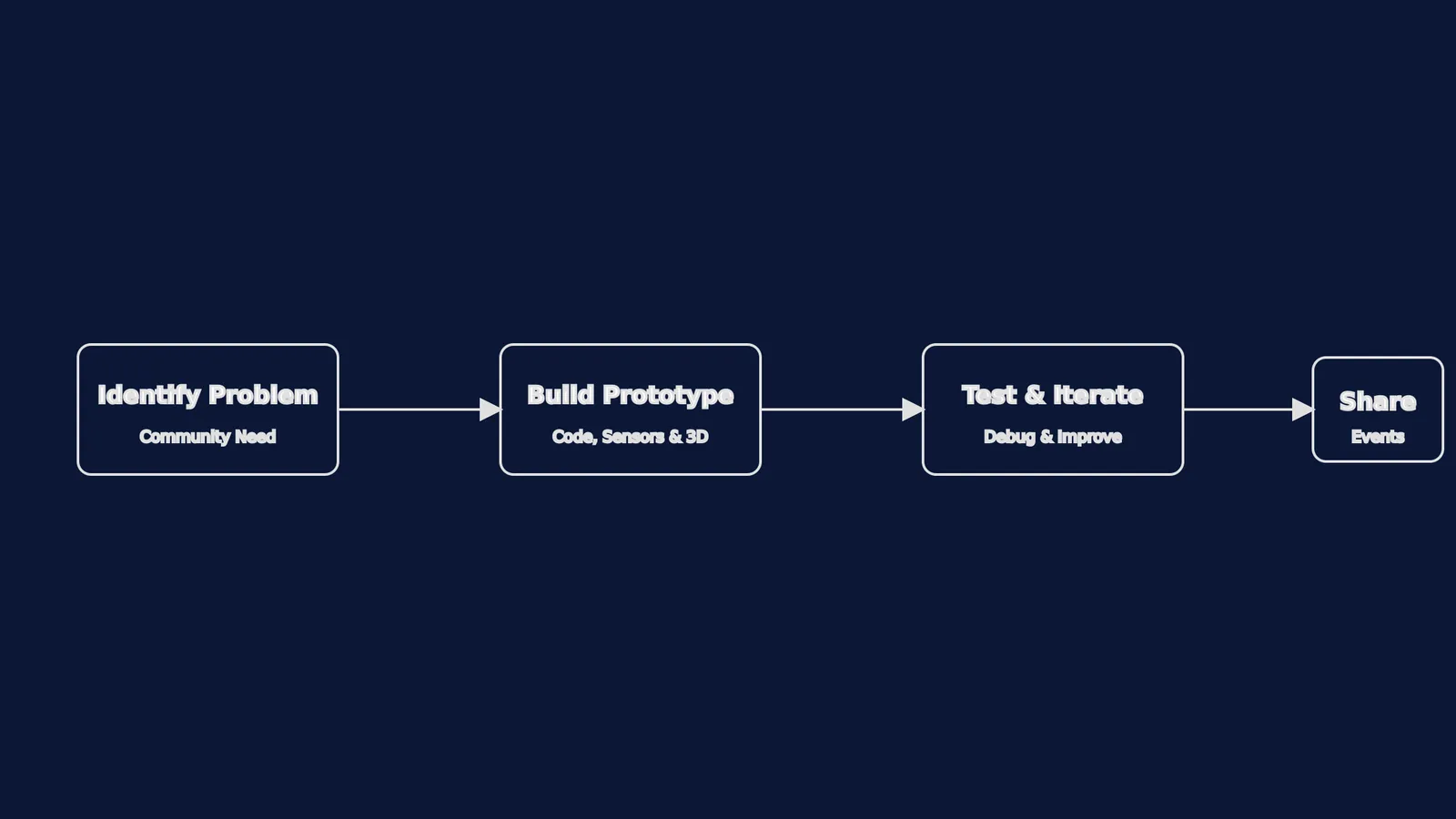
When you walk into a room full of unfamiliar equipment, it is easy to feel overwhelmed. The best way to begin is by picking a real-world problem you want to solve, rather than just picking up a sensor and wondering what it does. Common project themes include agriculture (like automated irrigation systems), healthcare (like touchless sanitizers), and environmental monitoring (like smart air quality meters).
Once you have an idea, break it down. If you want to build a smart dustbin, you will need an ultrasonic distance sensor to detect a hand, a servo motor to open the lid, and a microcontroller to link them. Before wiring up the real components and risking a blown fuse, you can use the Fermi Simulation Lab to model the electrical circuits and understand the physics behind how the currents will flow.
As you start writing code or assembling parts, you will inevitably hit roadblocks. A sensor might give strange readings, or a loop of code might not trigger. When this happens, ask your lab mentor for guidance or use Fermi's AI tutor to help you reason through the logic of your circuit or debug your code. The tutor is designed to check your understanding as it goes, rather than just handing you the final answer. Discussing your problems aloud—or learning by teaching your peers what you just figured out—solidifies your own understanding of the concepts.
What are the major ATL events and challenges?
The ultimate goal of the tinkering lab is not just to build things for yourself, but to solve problems for others and share your solutions. Throughout the year, the Atal Innovation Mission runs several national events where you can showcase your work, receive feedback, and learn from other students across India.
The largest of these is the ATL Marathon, a national innovation challenge where teams identify community problems and develop working prototypes. This competition tests not just your technical skills, but your ability to document your process and present your ideas clearly. Top teams often receive further funding and internships to develop their ideas into market-ready products.
Another major event is ATL Tinkerpreneur, a summer bootcamp focused on digital entrepreneurship. It teaches students how to turn a prototype into a viable business venture, covering skills like market research, creating a business model, and pitching to investors.
By taking advantage of these tools and challenges, you go from passively consuming information to actively building things that help you learn, preparing yourself for future careers in science, engineering, or design.


