

On this page
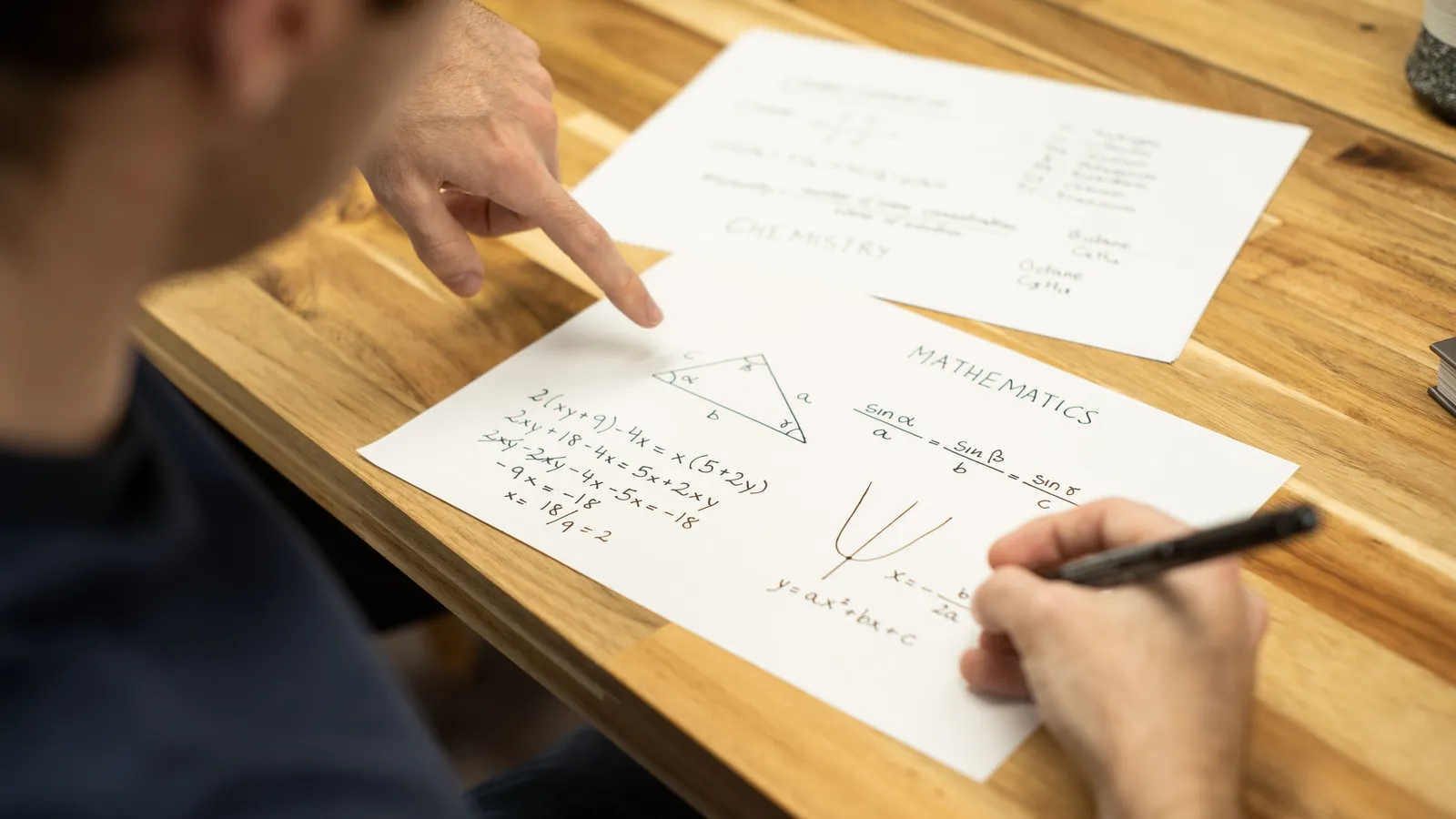
You have finished a set of practice questions, a few answers look shaky, and the key gives only the final number. The trick is to ask in a way a busy teacher can say yes to in five minutes.
Why not hand your teacher the whole notebook?
Because a pile of extra pages tends to come back with ticks and crosses rather than explanations, and marking is already a strain. In the OECD’s TALIS 2024 survey, 40% of lower secondary teachers across OECD systems said too much marking was a source of stress, according to ACER’s summary of the TALIS 2024 results.
Ticks also tell you little. A 2020 meta-analysis of 435 studies by Wisniewski, Zierer and Hattie found an average effect of feedback on learning of d = 0.48. In the same review, high-information feedback, which tells you about the task, the method and how to improve, had a much larger effect (d = 0.99) than corrective feedback (d = 0.46). Two answers with a real comment are likely worth more than twenty with a tick.
Which two answers should you choose?
First check what you can yourself: compare with the key, redo the question once without looking, and test the units. Then pick:
One answer you got wrong and cannot see why. You have looked for the error and not found it. This is where a teacher’s eye saves you an hour.
One answer you got right but do not trust. Maybe you guessed a step, used a shortcut you half remember, or wrote a long board-style answer and want to know whether it covers the points.
Skip answers where the book’s solution already shows your mistake. Our piece on why making mistakes helps you learn explains why the wrong answer is worth the most.
What should you ask your teacher, exactly?
Ask about the work, not about yourself. Kluger and DeNisi’s 1996 meta-analysis of 607 effect sizes found that feedback improved performance on average, but over one third of feedback interventions made performance worse. Their analysis suggests feedback helps less as attention moves away from the task and towards the self. “Is line 3 right?” keeps attention on the task. “Am I bad at physics?” does not.
A good request has three parts: what you did, where you think the problem is, and one question.
If your school allows messages, send a clear photo of each answer with the three parts typed out, not just “is this right?”
What does a specific question look like?
The question: a ball is thrown at 20 m/s at 30° above the horizontal; find its maximum height, taking g = 10 m/s². You wrote H = u² sin θ / 2g = 400 × 0.5 / 20 = 10 m. The key says 5 m.
Vague: “Sir, I got this wrong, can you check?”
Specific: “I got 10 m and the key says 5 m. I used H = u² sin θ / 2g. Is the formula wrong, or did I go wrong putting in the numbers?”
The specific version lets your teacher answer in one sentence: the height comes from the vertical velocity u sin θ, and that whole term is squared, so the formula has sin²θ. With sin² 30° = 0.25, H = 400 × 0.25 / 20 = 5 m. You can confirm it another way: the vertical velocity is 10 m/s, and 10² / (2 × 10) = 5 m.
What do you do with the feedback?
Act on it the same day, while the comment is fresh:
Redo the question on a blank page without looking at the correction.
Try one similar question to check the fix holds.
Add one line to your mistakes list, such as “forgot to square sin θ in maximum height”.
Next time you see your teacher, say in one sentence: “I redid the one you checked and got it.”
That last step shows your teacher the five minutes were worth it, which makes the next yes easier. It is also the core of formative assessment, where feedback counts only when it changes what you do next; we cover the research in our piece on Black and Wiliam’s Inside the Black Box and feedback that helps.
What if your teacher is too busy?
Accept it without fuss and ask when a better time would be: before school, after a lesson, or in a doubt-clearing period. Meanwhile, narrow the question down yourself. The Fermi Problem Library has worked problems with a step-by-step solver that explains the reasoning rather than printing an answer, so you can compare your steps line by line and arrive with a sharper question. Our guide to asking better questions in class has more ways to phrase what you are stuck on.
This week, pick your two answers and write your three-part question.


