

On this page
When you look at a centuries-old painting or a fragile marble monument, you are not just seeing history—you are seeing chemistry in action. Pigments degrade, varnishes yellow, and stone reacts with the atmosphere over time. The vibrant colours that an artist originally laid down can shift dramatically, turning bright blues into muddy greens or darkening brilliant whites.
For students who love science but are drawn to the humanities, a career as an art conservation scientist offers a unique path. It applies analytical chemistry and material science to understand and preserve our shared cultural heritage. While hands-on conservators do the physical restoration work—such as painstakingly cleaning a canvas—conservation scientists run the laboratories that diagnose the artwork's "disease" and test safe, effective treatments.
What does an art conservation scientist do?
Unlike an art historian who studies the meaning, historical context, and cultural impact of a piece, a conservation scientist studies its physical makeup at the molecular level. Their daily work revolves around identifying unknown materials, understanding the pathways of chemical degradation, and developing entirely new treatment methods that will not harm the original object.
When a museum acquires a new piece, the scientist must often determine if the materials actually match the claimed time period. They use chemical analysis to map out the microscopic layers of paint, identify the type of organic binder (like egg tempera, animal glue, or linseed oil), and verify the specific pigments the artist used. This can even help authenticate a painting or uncover hidden layers beneath the visible surface.
They also study how environmental factors—such as relative humidity, ultraviolet light, and air pollution—cause long-term chemical decay. For example, they track how historical lead white pigment darkens over time as it reacts with atmospheric sulphur to form black lead sulfide, and they figure out how to safely reverse or halt that reaction without bleaching the surrounding paint.
How did chemistry save the Taj Mahal?
One of the most visible examples of conservation science in India is the ongoing treatment of the Taj Mahal. The brilliant white marble, which is primarily composed of calcium carbonate, is highly susceptible to yellowing and structural staining from air pollution, vehicle emissions, and acid rain.
The Archaeological Survey of India (ASI) uses a specialised "mud pack" treatment to clean the monument safely without damaging the delicate stone. The primary ingredient is Fuller's Earth (locally known as *Multani Mitti*), a lime-rich clay with exceptionally high absorbent properties.
Scientists ensure the clay paste is entirely pH-neutral so it does not etch the calcium carbonate marble. As the wet paste dries over two to three days, capillary action draws out particulate matter, including the black and brown carbon deposited by fossil fuels and biomass burning. The dried clay flakes off, carrying the trapped pollutants with it, and the residue is simply washed away with distilled water. This non-invasive method successfully avoids the mechanical scrubbing or harsh chemical solvents that would permanently damage the historical stone.
Why is non-destructive testing essential?
Because artworks and ancient artifacts are completely irreplaceable, a core rule of modern conservation science is to avoid destroying or altering the object in any way. Scientists rely heavily on non-destructive testing (NDT) to get their answers safely.
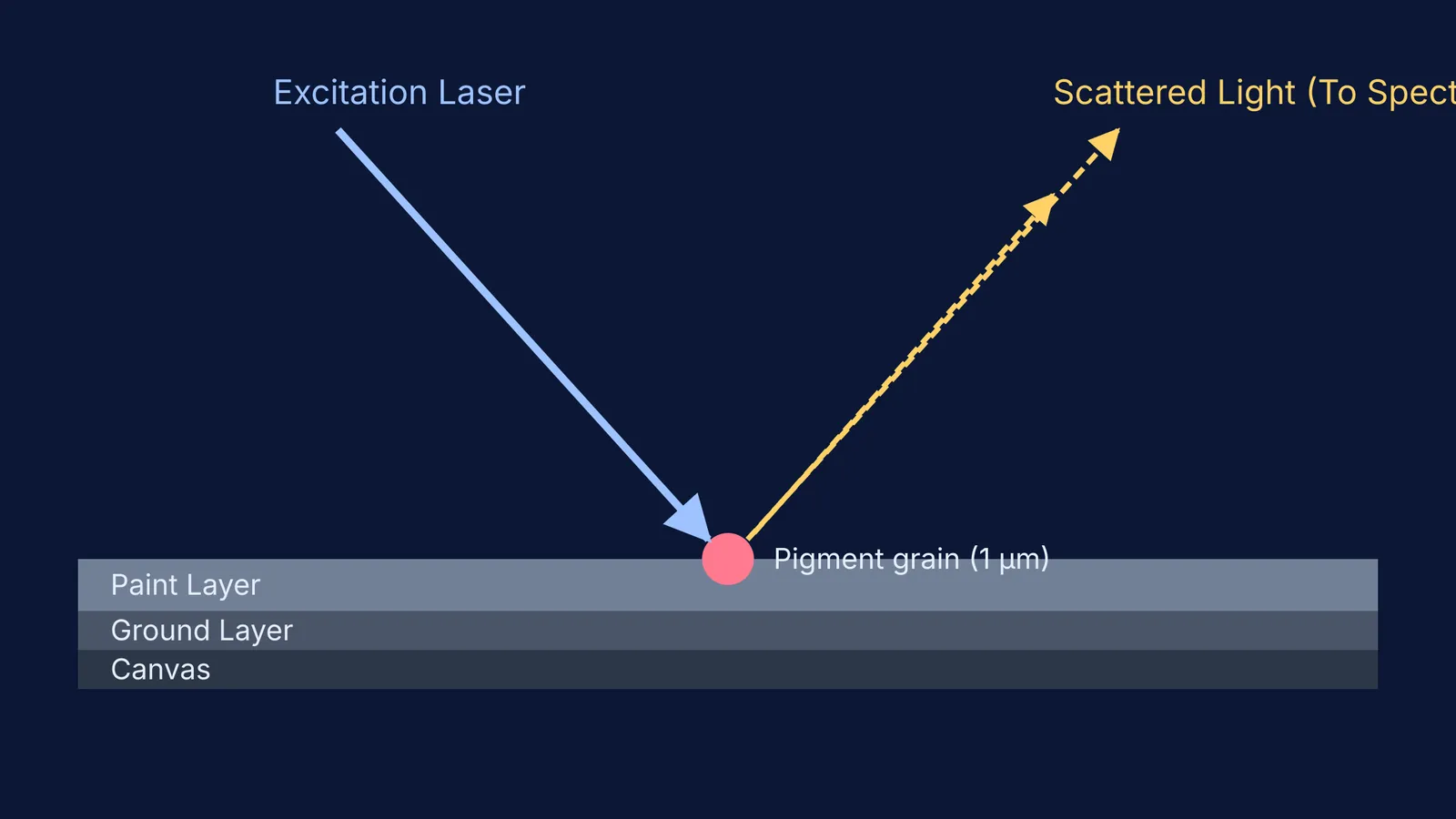
Raman spectroscopy is a cornerstone technique for this type of analysis. By firing a laser at a microscopic pigment grain—sometimes as small as 1 µm—and measuring the scattered light, scientists can identify the exact molecular structure of the pigment. This allows them to distinguish between historical pigments and modern synthetic replacements, such as titanium dioxide, without ever taking a physical sample from the painting.
How do you train for this career in India?
Becoming an art conservation scientist requires a strong, rigorous foundation in the physical sciences. Most professionals working in this highly specialized field hold a master's degree or a PhD in a relevant scientific discipline.
To start, you typically need a bachelor's degree in a science subject like Chemistry, Physics, or Materials Science. You must be deeply comfortable with analytical chemistry, organic chemistry, and statistics, as you will spend a lot of time analysing complex data from advanced scientific instruments. For a refresher on the basics of inorganic reactions, you can review Extracting metals for Class 10.
In India, institutions like the National Museum Institute (NMI) offer specialized postgraduate programmes such as an M.A. in Conservation. To be eligible for these master's programmes, candidates usually need a science background at the undergraduate level, or at least at the high school level if they come from a humanities background. The selection process typically involves a rigorous written entrance examination followed by a personal interview.
Internationally, competition for graduate programs is intense. Successful applicants often have extensive supervised internship experience in a museum or conservation laboratory setting, demonstrating both their scientific capability and their dedication to cultural heritage.
What is a practical plan for chemistry students?
If you are a high school student interested in this fascinating intersection of art and science, here is how you can start preparing today:
Focus on chemistry and physics: These are your core tools. Pay special attention to organic chemistry (solvents, binders, polymers) and optics (how light interacts with matter).
Take an art or history elective: Understanding how artists work, and the historical context of their materials, is just as important as knowing the chemical formulas.
Look for laboratory experience: Any experience working with analytical instruments (like microscopes, chromatographs or spectrometers) is extremely valuable, even if it is not in an art setting.
Use interactive tools: When learning complex chemical reactions, the Fermi Simulation Lab lets you run simulated chemistry and physics experiments to see the concepts in action.
A career in art conservation science proves that chemistry is not just about beakers and industrial plants; it is a vital, hands-on tool for keeping human history alive for the next generation.


