

On this page
For a 16-year-old considering a five-year architecture degree, the career often looks like a life of sketching sweeping concepts and directing builders on site. The reality of the profession, however, is heavily technical and administrative.
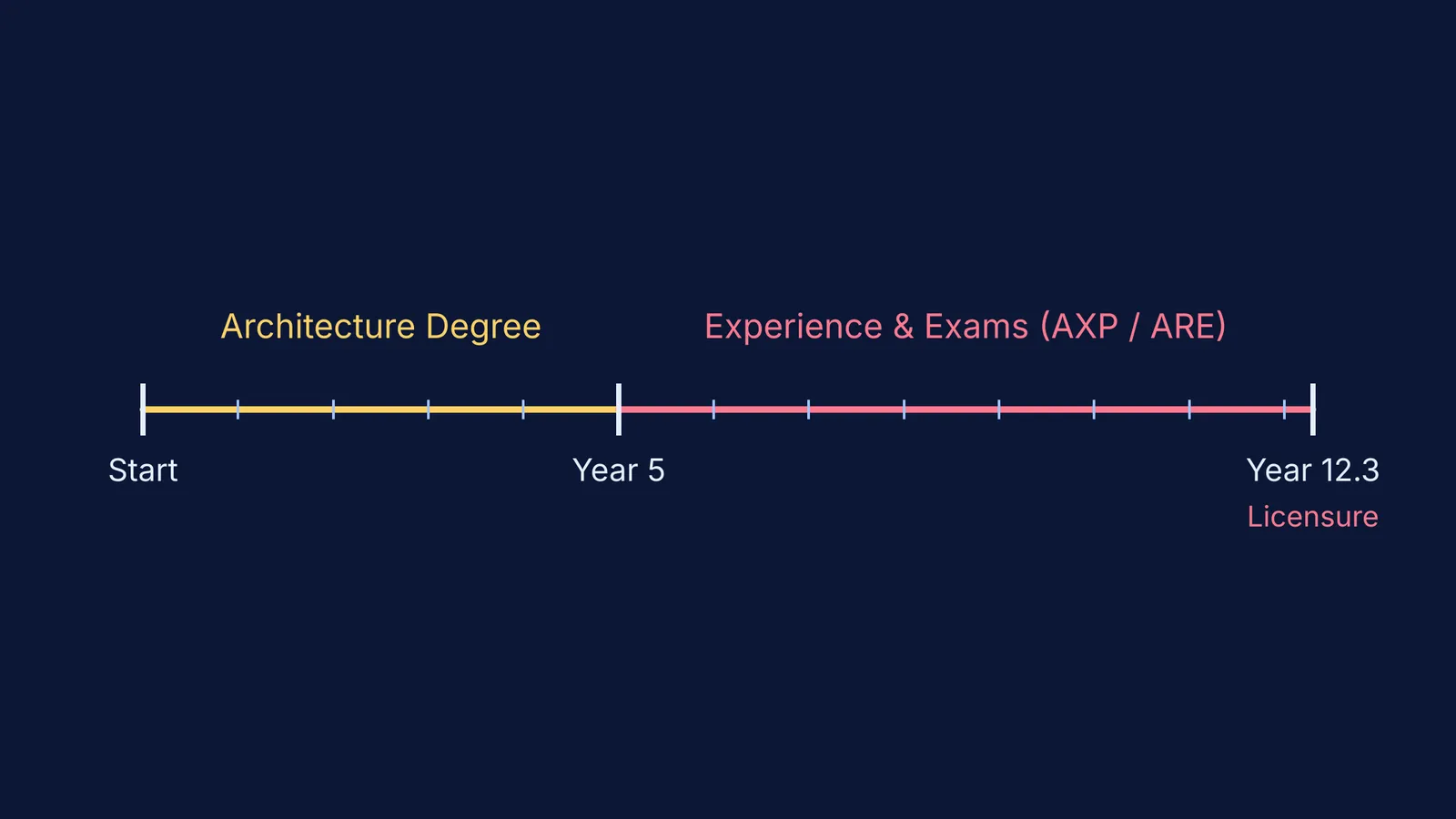
According to the National Council of Architectural Registration Boards (NCARB), the average time to become a fully licensed architect in the US is 12.3 years, counting education and professional experience. Understanding what happens in those years—and what fills a typical Tuesday—is the best way to decide if the path is for you.
What do architects actually do daily?
While design is the most visible part of architecture, it takes up a minority of the working week. In your early career, you will spend the vast majority of your time doing digital drafting. You will use software like Revit or AutoCAD to turn conceptual sketches into rigorous, millimetre-accurate construction documents.
As you advance, the job shifts from drawing to managing. You have to ensure that structural, electrical and plumbing systems fit inside your design without violating building codes, meaning you will spend a significant portion of your week on administrative or coordination tasks rather than deep design work. Furthermore, the American Institute of Architects' 2024 firm survey found that 48% of firm billings now come from renovations, rehabilitations, additions, and historic preservation, meaning you are just as likely to be fixing an existing structure as you are to be designing a new one.
How much time is spent on site visits vs drawing?
Site visits are the part of the job that feels most like building, but they make up a surprisingly small slice of the week for most architects.
During the schematic design and documentation phases, which can take months, an architect might not visit the site at all. Once construction begins, project architects typically visit the site once a week or once every fortnight to check progress and solve field issues. The rest of the week is spent in the office adjusting drawings, answering emails from contractors, and researching materials.
What physics and maths do you need for architecture?
You cannot design a building if you do not understand how it stands up. A five-year architecture degree requires a strong foundation in physics and mathematics, particularly mechanics and geometry.
You need to understand forces, vectors, load distribution, and static equilibrium. (For a taste of this, see how a rod stretches under its own weight.) If you are struggling to picture how forces act on a beam or a column, the Fermi Concept Library contains every concept in physics, chemistry, biology, mathematics and computing, each with its own lesson and its place in the map.
When you move on to calculating bending moments or resolving structural loads, you need reliable mathematical methods. If you hit a wall while practising these calculations, the Fermi Problem Library has worked problems with a step-by-step solver that explains the reasoning rather than printing an answer. (It can also help with foundational mechanics, such as finding the contact force between blocks pushed together.)
Is a five-year architecture degree right for you?
If you are trying to decide whether to commit to architecture, test the waters before you apply:
Check your tolerance for screen time: Are you comfortable spending hours a day in front of a computer doing highly detailed, repetitive digital modelling?
Review the physics: Look at a first-year university syllabus for structural mechanics. Are you prepared to pass those modules?
Talk to a junior architect: Try to find someone who graduated in the last three years. Ask them what they did at work yesterday. It will almost certainly involve drafting, emails and spreadsheets.
Learn a CAD tool: Download a free or student version of SketchUp or AutoCAD. Try to draw an accurate floor plan of your own bedroom. If you enjoy the precision of that process, architecture might be the right fit.


