On this page
When you apply to a university outside India or seek a work visa, the foreign government needs to know your educational certificates are genuine. They cannot easily verify a degree issued by a local Indian university on their own. To solve this, countries use an international certification system called an apostille.
An apostille is a sticker attached to your original document by the Ministry of External Affairs (MEA), proving its authenticity. As of 2026, there are 130 contracting states in the Hague Apostille Convention, meaning an apostille issued in India is legally valid in all of them, including the USA, UK, Canada and most European nations.
Why do some countries need an apostille?
Before the 1961 Hague Convention, getting a document recognised abroad required "legalisation". This was a lengthy chain where a local notary, a state department, the national foreign ministry, and finally the destination country's embassy all had to stamp the document.
The convention replaced this chain with a single certificate: the apostille. If the country you are going to is a member, the embassy does not need to verify the document again. This saves students significant time and paperwork during the visa process.
However, countries that are not members of the convention, such as the UAE or Qatar, still require the traditional, multi-step embassy legalisation process. Always check your destination country's exact policy before starting.
What is the process for educational documents?
In India, the Ministry of External Affairs does not accept documents directly from students. You must submit your original degree or transcript through one of their designated outsourced agencies, which handle the logistics.
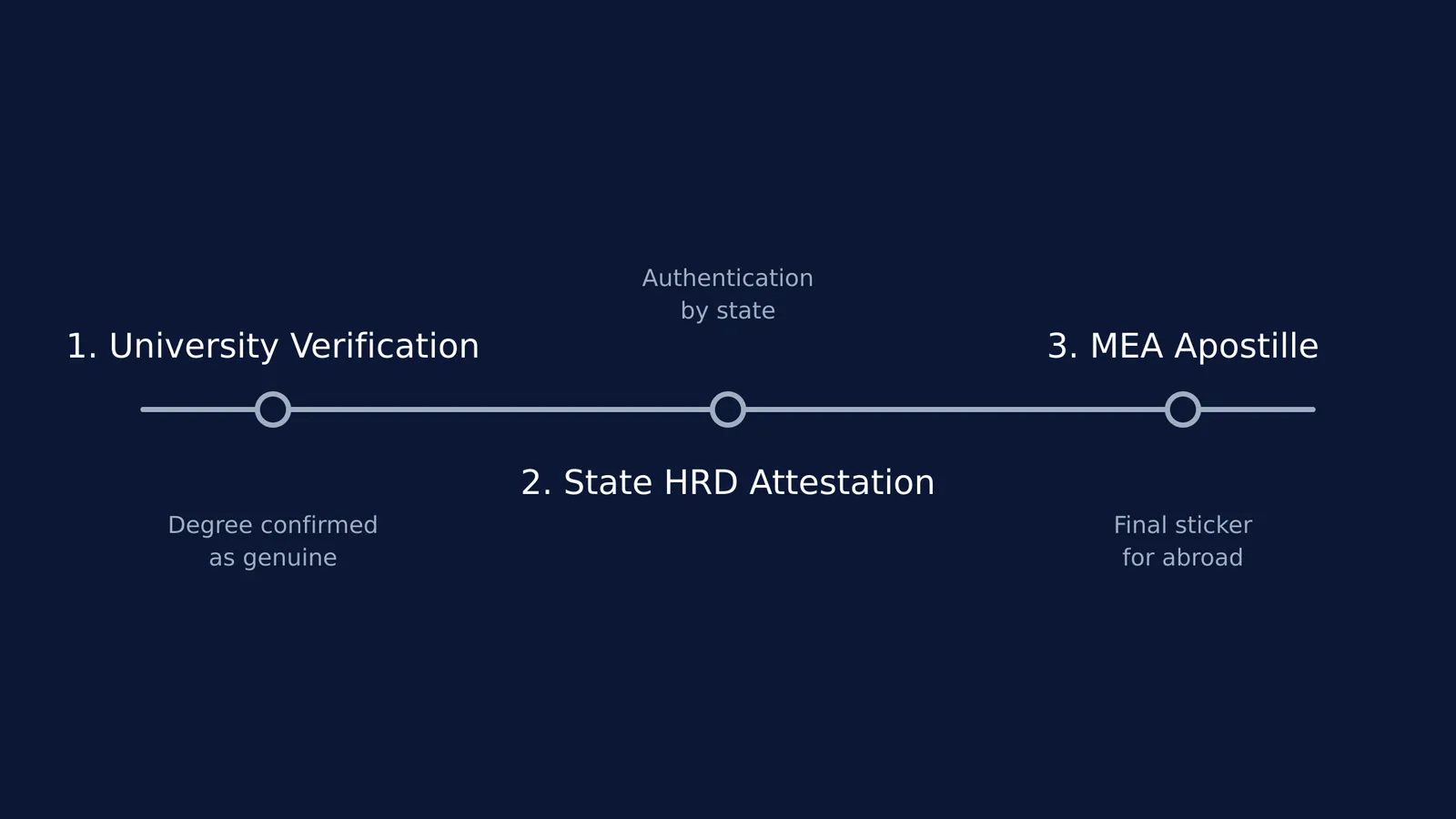
However, the MEA cannot place an apostille on a document they have not verified. Educational documents must go through a pre-authentication route before they ever reach the MEA:
University Verification: The issuing university first confirms that the degree or transcript is genuine.
State HRD Attestation: The document is then attested by the Higher Education Department (often called the State HRD) of the state where it was issued. Some countries strictly require this state-level authentication for educational documents.
MEA Apostille: Finally, the outsourced agency submits the state-verified document to the MEA, which affixes the apostille sticker directly to the back.
Because the sticker goes directly on the original document, it cannot be laminated. If your degree is laminated, the agency will have to carefully remove the plastic film before processing it, which can sometimes damage older certificates if not done professionally.
How long does it take and what does it cost?
While the MEA itself takes only a few days to issue the apostille once a document is received, the pre-authentication steps make the overall timeline much longer. Going through the standard State HRD route often takes several weeks, depending on how quickly your university responds to verification requests.
There is a faster alternative called the SDM (Sub-Divisional Magistrate) route in Delhi, which bypasses the State HRD and takes less time. However, certain countries like Italy and Austria do not accept the SDM route for educational documents, so you must always check your destination university's exact requirements.
The government fee for the MEA apostille sticker is just ₹50 per document. However, you will also pay the outsourced agency an additional fee for their service, scanning and logistics. Recently, the government has also expanded the e-Sanad portal, which allows for the online verification and digital apostille of certain documents, though many foreign universities still ask for physical stickers.
A checklist for your documents
Before you submit anything to an agency, verify these details to avoid delays:
Check the country: Confirm if your destination is one of the member countries of the Hague Convention. If not, you need full embassy legalisation.
Remove lamination: The sticker goes on the back of the original document. If it is laminated, have the plastic carefully removed by a professional.
Keep copies: Scan your original degree and your passport (front and back) before handing them over to an agency.
Verify the route: Ask your university abroad if they accept the faster SDM route, or if they strictly require State HRD attestation.
Planning for your first semester abroad
If you are heading into your first semester at science or engineering college in an unfamiliar country, you will want your documents sorted early so you can focus on academics. Leaving this to the last minute can delay your visa application and cause unnecessary stress.
While you are waiting for your apostilled documents and catching up on prerequisites, you can use the Fermi Concept Library to fill any gaps in your mathematics or physics knowledge before classes begin. Getting the paperwork out of the way means you can focus entirely on how to improve your CGPA once the term starts.