

On this page
What does amateur radio involve?
Ham radio is not just about talking; it is about building the station yourself. Operators construct their own antennas, experiment with electronics, and learn how weather and solar flares affect electromagnetic waves. You can bounce signals off the Moon, talk to astronauts on the International Space Station, or communicate with a researcher in Antarctica without the internet.
Because you are working directly with transmitters and receivers, you need to understand the energy density and intensity of an EM wave, standing wave ratio (SWR), and resonance. For a student preparing for engineering entrance exams, this makes abstract textbook concepts tangible.
Can students get an amateur radio licence in India?
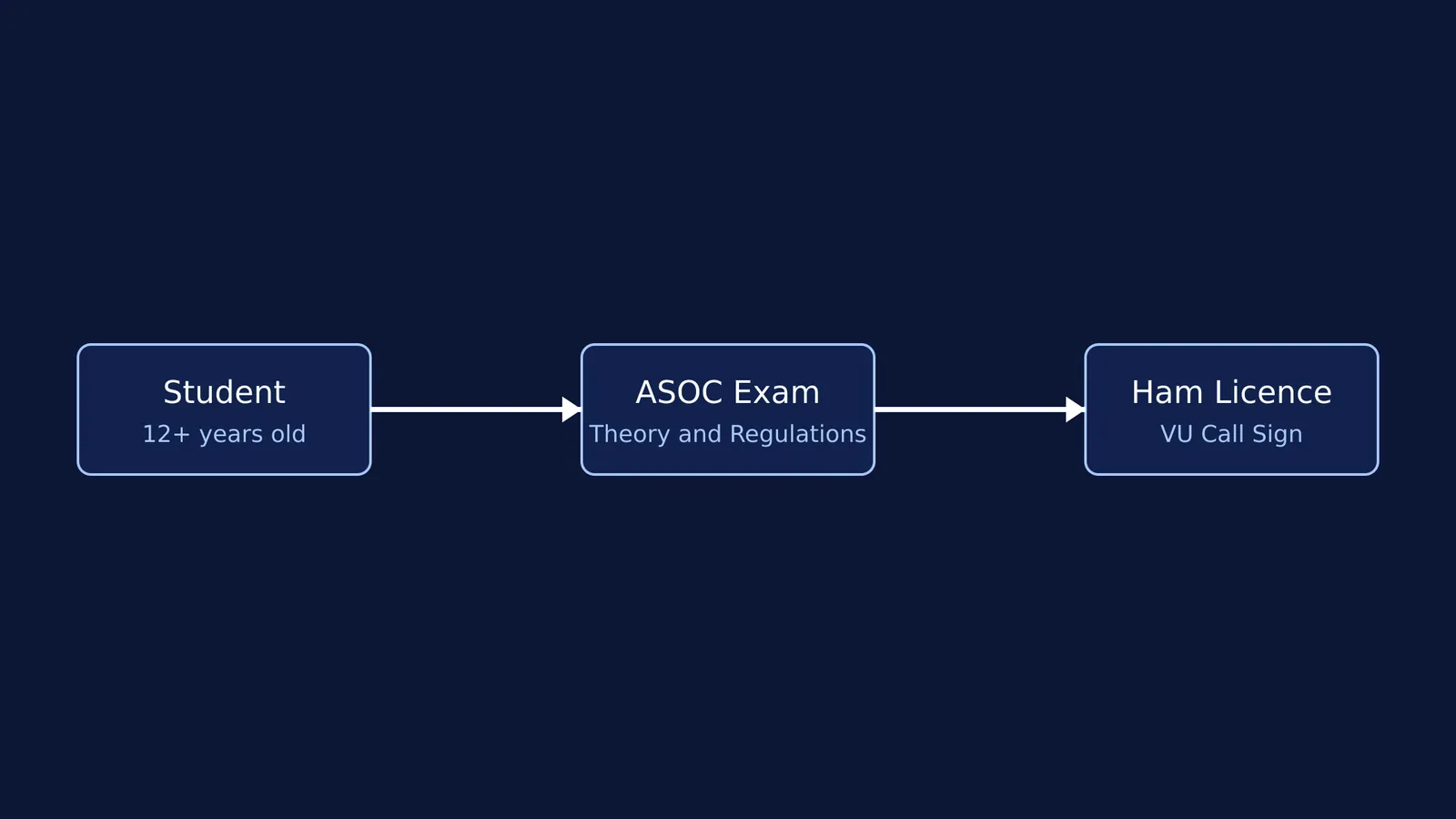
Yes. Any Indian citizen aged 12 or above is eligible to apply for an Amateur Station Operator’s Certificate (ASOC) via the Saral Sanchar portal.
The examination is conducted by the Wireless Planning and Coordination (WPC) Wing of the Department of Telecommunications (DoT). There are two primary categories you can apply for:
Restricted Grade: The entry-level licence. It requires passing a written exam with two parts: Radio Theory and Practice, and Radio Regulations. It limits your transmission power to 50 W on HF bands and 10 W on VHF and UHF bands.
General Grade: The advanced licence. You must pass the written exam and a practical Morse code test at 8 words per minute. This permits higher transmission power (up to 400 W on HF bands) and global communication.
If you are a minor (12 to 18 years old), you must provide a No Objection Certificate (NOC) signed by your parent or guardian when applying.
How does the ionosphere bounce signals around the Earth?
One of the central concepts in the ASOC syllabus—and in the Class 12 physics curriculum—is radio wave propagation. How does a straight-line radio wave reach the other side of a curved Earth?
The answer lies in the ionosphere—whose layers were first proved by Edward Appleton—a region of the upper atmosphere roughly 50 km to 400 km high where solar radiation strips electrons from gas molecules. These free electrons refract (bend) high-frequency radio waves back to the ground. According to space weather data from the Bureau of Meteorology, the ionosphere is split into distinct layers that behave differently:
The D Layer (50 to 90 km): Active only during the day. Because the air here is relatively dense, free electrons frequently collide with gas molecules, absorbing the energy of lower-frequency waves (like the 80-metre band) rather than reflecting them.
The E Layer (90 to 140 km): Capable of reflecting signals for "short-skip" communication up to about 2,000 km.
The F Layers (above 140 km): During the day, this splits into the F1 and F2 layers. The F2 layer is the highest and most heavily ionised, making it the primary mirror for long-distance communication. It allows higher frequencies (like the 20-metre band) to skip across oceans.
At night, the D and E layers fade, and the F layers merge. Without the D layer absorbing energy, lower frequencies can finally reach the F layer, which is why certain ham bands suddenly "open up" for long distances after dark.
If these wave behaviours are hard to picture from a textbook, the Fermi Simulation Lab provides interactive simulations for the ideas that are easier to see than to read, such as how waves reflect and attenuate at different atmospheric densities. For the underlying mathematics of electromagnetic waves, the Fermi Concept Library covers every concept in physics, chemistry, biology, mathematics and computing, each with its own lesson and its place in the map.
How do you apply and sit the ASOC exam?
The WPC Wing has moved the entire licensing process online. Here is the standard path to getting your call sign:
Register online: Create an account on the Saral Sanchar portal.
Submit the application: Fill out the ASOC exam form. You will need to upload a recent photograph, proof of date of birth, and a character certificate signed by a Gazetted Officer.
Pay the exam fee: The exam fee is ₹100 per grade, paid through the Bharatkosh portal.
Take the exam: Tests are held periodically at Wireless Monitoring Stations (WMS) across India.
Claim the licence: Once you pass, you apply for the actual licence and receive your unique call sign (which starts with VU2 or VU3 in India). A lifetime licence (valid until age 80) costs ₹2,000, while a 20-year licence costs ₹1,000.
Getting a ham radio licence requires patience, as the application and exam scheduling can take time. However, the reward is a lifetime qualification that teaches you exactly how the physical world communicates.


