

On this page
What is the All India Quota?
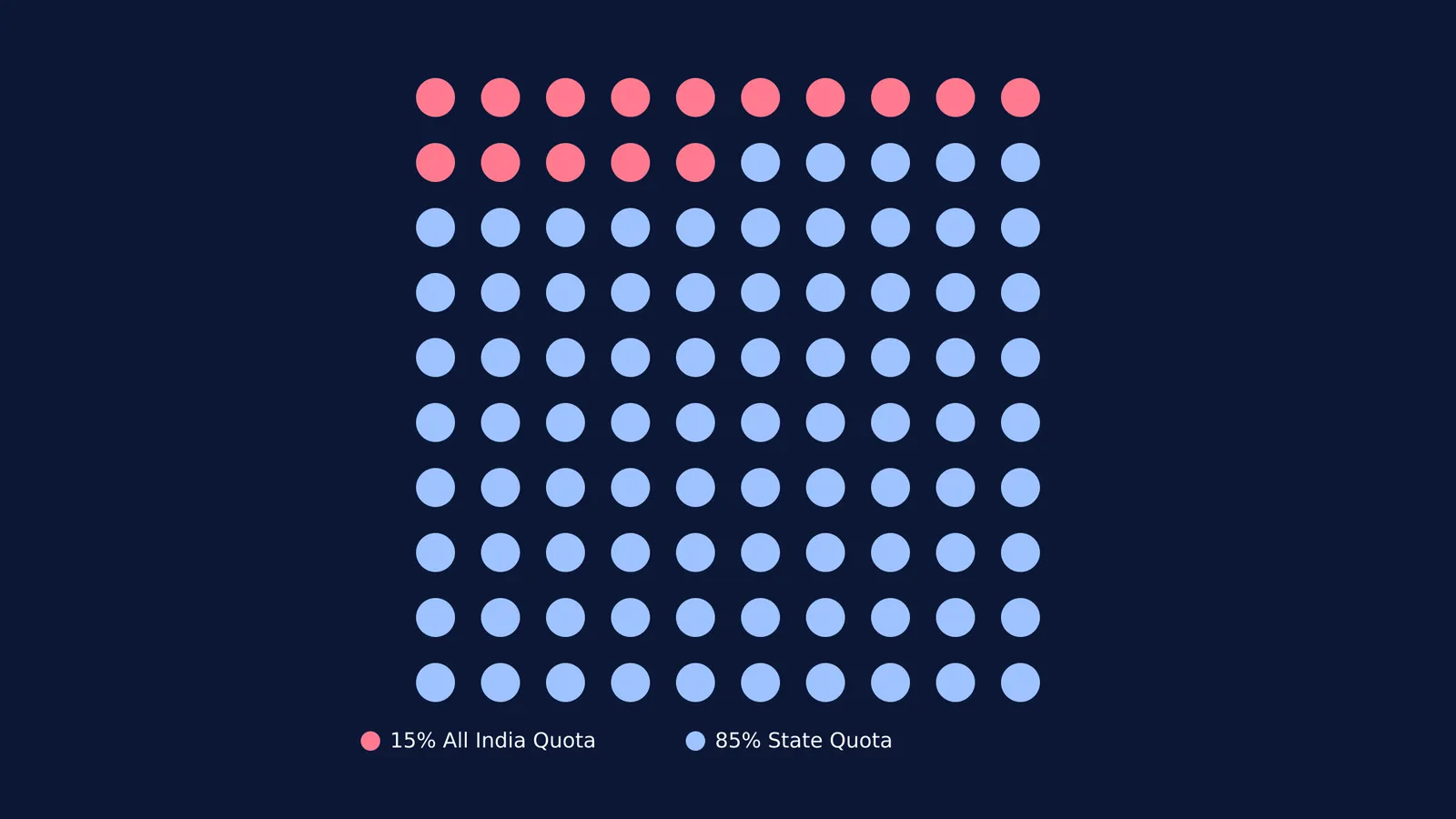
The All India Quota (AIQ) is a national pool that includes 15% of all seats in state-run government medical and dental colleges across India. The Medical Counselling Committee (MCC) manages these admissions centrally.
The AIQ was created by the Supreme Court of India in 1986 to ensure that students from any state could study in top medical colleges elsewhere on a fair merit basis. This means a candidate from Kerala can compete for an AIQ seat in a government college in Gujarat without needing a local domicile certificate. By opening up state borders, the system allows the highest-scoring students to access the best infrastructure nationwide.
For 2026, the National Medical Commission (NMC) reports there are 1,40,664 MBBS seats across 839 colleges in India. While this total includes both private and government colleges, the 15% AIQ rule applies strictly to state government colleges. However, the MCC also centrally fills 100% of the seats in central institutions like all 20 AIIMS campuses, JIPMER, Banaras Hindu University (BHU), and Aligarh Muslim University (AMU).
The AIQ follows the central government's reservation policy. Out of the national pool, 15% of the seats are reserved for Scheduled Castes (SC), 7.5% for Scheduled Tribes (ST), 27% for Other Backward Classes (OBC), and 10% for the Economically Weaker Section (EWS), according to the MCC. An additional 5% horizontal reservation is applied for Persons with Benchmark Disabilities (PwBD).
What is the State Quota?
The remaining 85% of seats in state government medical colleges fall under the State Quota, administered locally after the MCC deductions. These seats, along with 100% of the seats in private medical colleges and state-run universities, are managed by the respective state's own counselling authority.
Unlike the AIQ, State Quota seats require a valid domicile certificate. You must be a recognized resident of the state, or have completed a specific number of years of your schooling there, to be eligible. The exact rules for proving domicile vary significantly; for instance, Maharashtra requires a dedicated domicile certificate, while Delhi relies on where the student completed their Class 11 and 12 schooling.
The reservation rules for these seats also follow state-specific policies rather than central norms, meaning the percentages for various categories can look very different from state to state.
Why do All India Quota cut-offs tend to be higher?
Because the All India Quota draws the top scorers from the entire country, its closing ranks are usually much tighter than those for the State Quota, as seen in historical MCC allotment data. For example, a college might close its AIQ admissions at a national rank of 5,000 but continue accepting local State Quota students up to a rank of 12,000.
If you live in a state with extremely high local competition—such as Delhi, Rajasthan, or Uttar Pradesh—your state cut-off might actually be higher than the national average. In this scenario, applying through the All India Quota gives you a lifeline: you can use your strong national rank to secure a seat in a state with less local competition, such as Tamil Nadu or Karnataka, rather than missing out entirely at home.
Securing a seat in the highly competitive national pool requires a strong rank, which means fixing any wrong-method mistakes in your physics and chemistry calculations early on. The Fermi Problem Library has worked problems with a step-by-step solver that explains the reasoning rather than printing an answer.
How do you apply for both quotas?
The admissions process requires entirely separate registrations. You will apply on the MCC portal for the All India Quota and on your state's designated medical admissions website for the State Quota. You must pay separate registration fees and security deposits for both.
The MCC typically conducts four rounds of counselling: Round 1, Round 2, a Mop-up Round, and a Stray Vacancy Round. If you are allotted an AIQ seat in Round 1, you can often accept it but request an upgrade in Round 2. Meanwhile, you can monitor your state's merit list, which usually runs its own rounds in parallel.
It is crucial to read the MCC Information Bulletin and your state's rules regarding security deposits. The schedule is designed so that students eventually have to commit to one track. If you accept a seat in one quota and fail to report, or try to hold seats in both past a certain deadline, you risk forfeiting your deposit or being barred from further rounds. By understanding the timelines of both, you can safely navigate the system and secure your preferred college.
Read next:


