

On this page
When you live in the UAE, Saudi Arabia or elsewhere in the Gulf, applying to Indian engineering and medical colleges requires more than just preparing for entrance exams. You also have to navigate quotas, verify documents and pick the right exam centres.
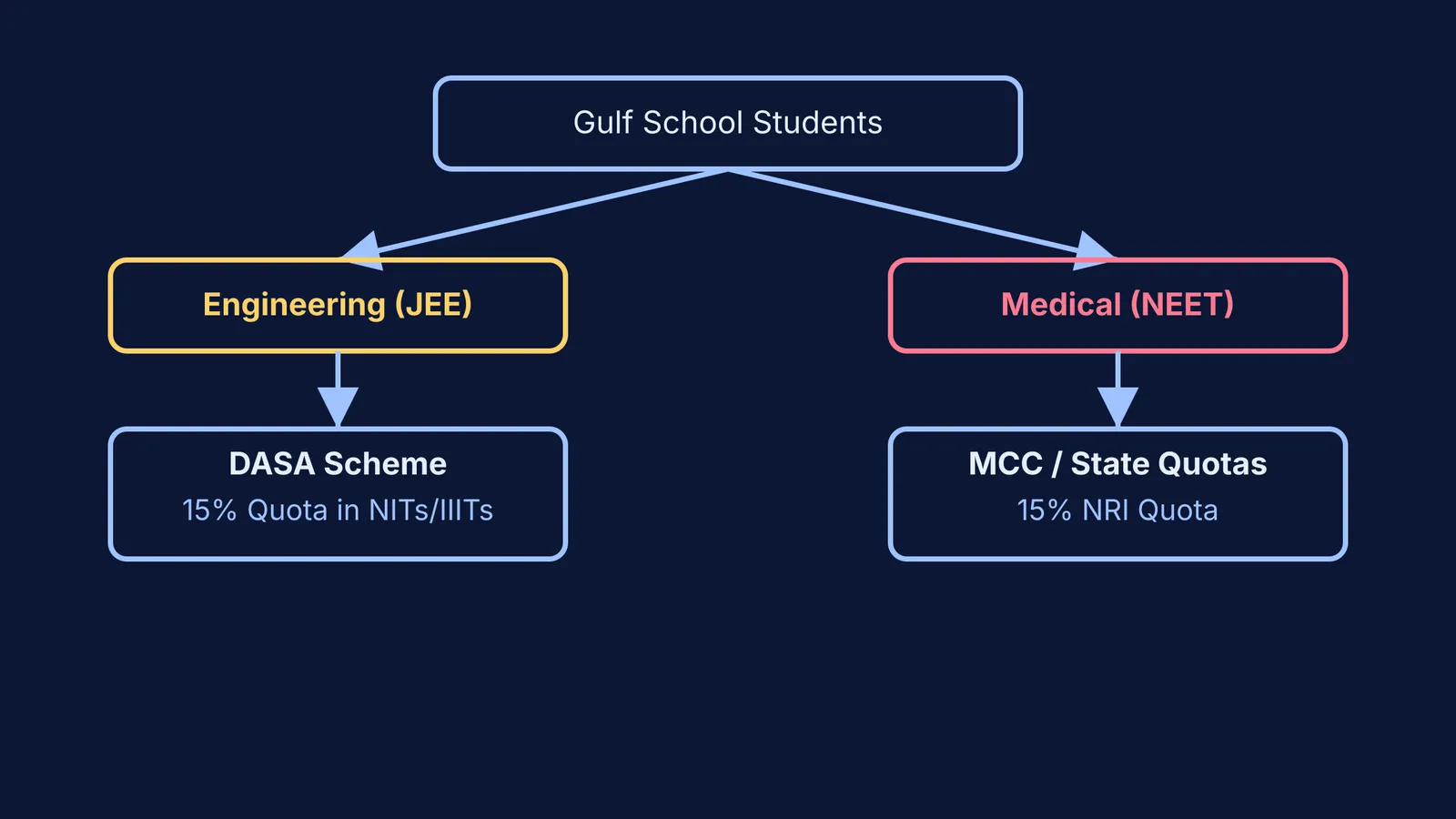
If you are writing JEE Main or NEET, there are specific routes—like the DASA scheme and state NRI quotas—that reserve seats for you. Here is how they work.
What are the engineering admission routes under DASA and CIWG?
If your goal is a National Institute of Technology (NIT), an Indian Institute of Information Technology (IIIT) or another centrally funded technical institute, your primary route is the Direct Admission of Students Abroad (DASA) scheme. This scheme reserves 15% of supernumerary seats for foreign nationals and NRIs.
Within DASA, there is a special category for the Children of Indian Workers in the Gulf (CIWG). It reserves 5% of the total seats (which is one-third of the DASA quota) specifically for students whose parents work in the UAE, Saudi Arabia, Qatar, Oman, Kuwait, Bahrain, Iraq or Iran.
The biggest advantage of the CIWG category is the cost. While standard DASA students pay around $8,000 per year, CIWG students pay the same tuition fee as Indian domestic students, which is ₹1,25,000 per annum. To be eligible, you must have completed your Class 11 and 12 abroad, and you must hold a valid JEE Main rank.
You must still meet the standard academic criteria, such as the 75 percent board marks rule for NIT and IIIT admission, which means you need at least 75% aggregate marks (or a 7.5 CGPA) in your Class 12 exams.
How does the NRI quota for medicine work?
For medical aspirants writing NEET, the path is slightly different. The Medical Counselling Committee (MCC) conducts centralised counselling for deemed universities across India, where 15% of seats are reserved for NRIs.
Additionally, many state counselling authorities reserve a portion of seats in private medical colleges for NRIs. While government medical colleges rarely offer NRI seats, states like Rajasthan and Gujarat do have small NRI quotas in their state-run institutions. You still need to meet the standard NEET UG eligibility, including age and subject requirements.
Where can you write the JEE and NEET exams in the Gulf?
You do not necessarily have to fly to India to write your entrance exams. These options allow you to focus on your preparation instead of travel logistics.
For the NEET UG 2024 exam, the National Testing Agency (NTA) added 14 international cities to its list of exam centres. Nine of these cities were in Gulf countries: Dubai, Abu Dhabi, Sharjah, Kuwait City, Doha, Muscat, Manama, Riyadh, and Dammam. JEE Main is also conducted in these same Gulf cities, allowing engineering aspirants to write the computer-based test closer to home.
If you decide to change your centre from an Indian city to a Gulf city after registering, the NTA usually allows this during the application correction window, provided you pay the differential fee. Knowing who can sit JEE Main and tracking the exam centre list on the NTA website early helps avoid last-minute travel.
When practising for these exams, the Fermi Problem Library has worked problems with a step-by-step solver that explains the reasoning rather than printing an answer. If the Indian syllabus covers topics your school did not, Fermi's AI tutor can work out what you already know and build a plan for the session, so you sit down to a clear next step.
What documents do you need to arrange early?
Proving your NRI or CIWG status requires specific paperwork. A simple checklist to start early:
Passports and Visas: Copies of the student's and the parent's Indian passports, along with valid residence visas (like an Iqama in Saudi Arabia or an Emirates ID in the UAE).
Employment Certificate: For CIWG, you need a certificate from the parent's employer in the Gulf, printed on company letterhead.
Equivalence Certificate: If you studied under a foreign curriculum (like the British or American system) rather than CBSE, you must obtain an equivalence certificate from the Association of Indian Universities (AIU).
These documents are essential to verify that you genuinely reside in the Gulf and are eligible for the fee waivers and seat reservations discussed above.


