

On this page
Taking a gap year to prepare for competitive entrance exams is a common path for students in India. If you have taken a drop year (or are planning to), you might wonder if it affects your eligibility for top colleges or if you need special documentation. The short answer is that engineering and medical colleges fully accept gap-year students, but there are strict rules about how many times you can attempt the exams.
Is a gap year allowed for engineering admission?
Yes, a gap year is permitted for engineering admissions across India, including at IITs, NITs, and IIITs. Taking time off after Class 12 does not disqualify you from securing a seat in these institutions.
However, your eligibility is tied directly to the number of consecutive attempts allowed for the Joint Entrance Examination (JEE), rather than the gap itself. The clock starts ticking the year you pass your Class 12 board exams.
How many gap years can you take?
The rules for taking a drop year depend on whether you are aiming for JEE Main or JEE Advanced.
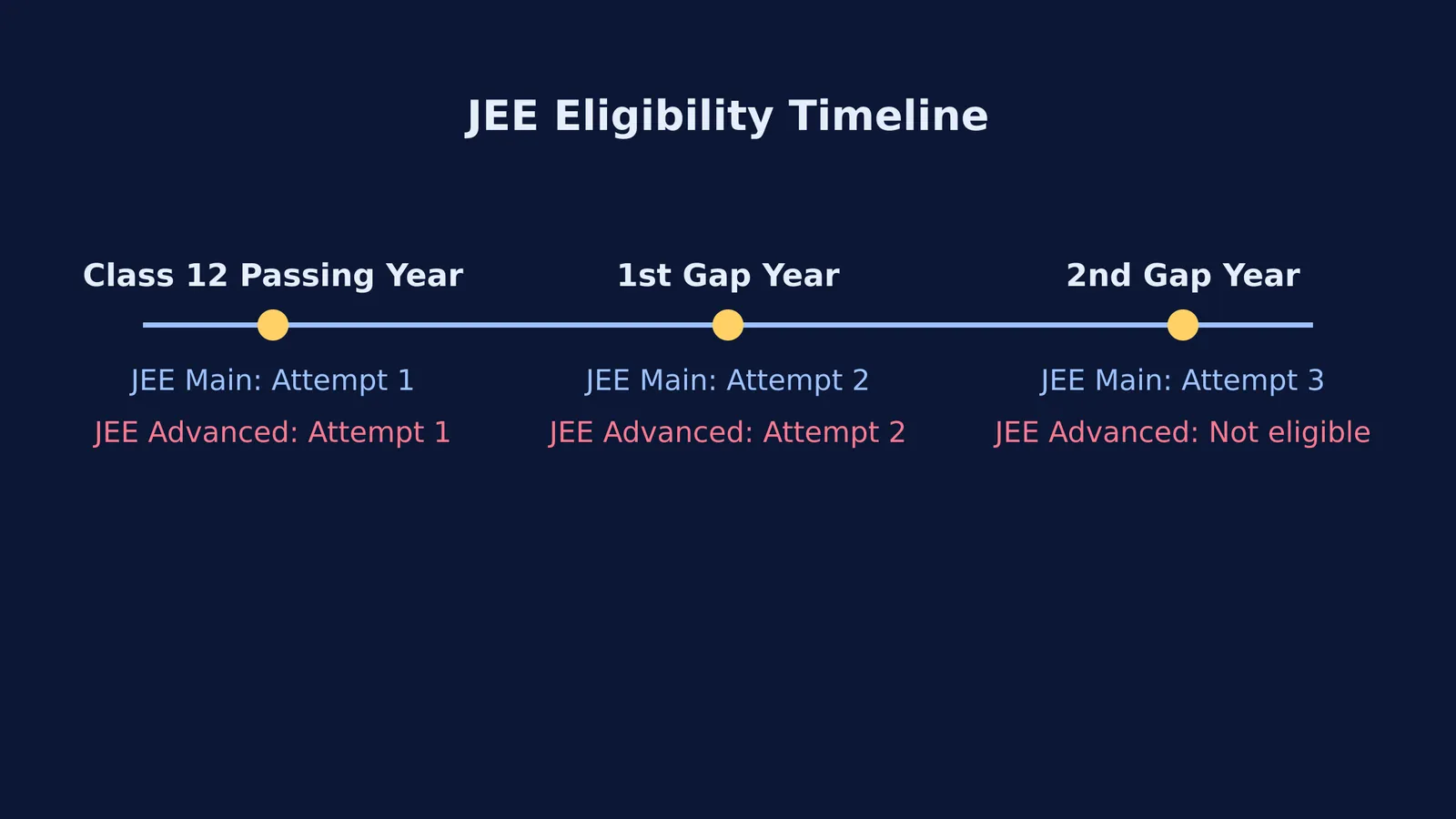
JEE Main (for NITs, IIITs, and GFTIs): You are allowed to attempt JEE Main for three consecutive years NTA JEE Main Website. This means you can take the exam in the year you pass Class 12, plus two subsequent gap years. For example, if you passed Class 12 in 2024, you are eligible for JEE Main in 2024, 2025, and 2026.
JEE Advanced (for IITs): The limit is stricter for IIT admissions. You can attempt JEE Advanced a maximum of two times in two consecutive years JEE Advanced Eligibility. If you passed Class 12 in 2024, your final chance to write JEE Advanced is 2025. A second gap year makes you ineligible for the IITs.
If you are using your drop year to fix conceptual gaps and tackle harder questions, you might find the Fermi Problem Library helpful. It features worked problems with a step-by-step solver that explains the reasoning rather than printing an answer.
What is a Gap Certificate?
A Gap Certificate (often called a Gap Affidavit) is a legal document used to explain why there is a break in your continuous education.
It serves as a formal declaration that during your drop year, you were preparing for exams (or dealing with health or personal circumstances) and were not enrolled in another degree course or involved in unlawful activities.
You do not need this certificate to register for or write the JEE or NEET exams. It is only required later, during the JoSAA/CSAB counselling process or when you physically report to your allotted college for admission.
How to get a Gap Certificate
Creating the document is a standard legal procedure. Here is a practical checklist for getting one:
Visit a notary public: Go to your local district court or a registered notary.
Buy stamp paper: Purchase a non-judicial stamp paper. The required denomination varies slightly by state, so the notary can advise you on the appropriate value.
Draft the affidavit: The notary will type out a standard declaration. It must include your full name, your parent's name, the year you passed Class 12, the name of your school or board, the exact duration of the gap, and the reason (for example, preparation for competitive exams).
Sign and seal: You will sign the document in front of the notary, who will then add their official seal and signature.
Keep your original Class 12 marksheet, a government ID (like Aadhaar), and your school leaving certificate handy, as the notary may ask to see them.
Do medical admissions have different rules?
Yes, the rules for medical admissions through the National Eligibility cum Entrance Test (NEET-UG) are much more relaxed regarding gap years.
Currently, there is no upper age limit to appear for NEET, and there is no cap on the number of times you can attempt the exam NTA NEET Website. You can take multiple gap years to prepare for medical college without losing your eligibility. Just like engineering students, you will still need to provide a notarised Gap Certificate during state or all-India medical counselling to explain the break in your studies.
Taking a gap year requires discipline and a solid routine. If you ever sit down to study and do not know where to start, Fermi's AI tutor works out what you already know, builds a plan for the session, and teaches through it — writing on a board, drawing the figure, running the simulation, and checking understanding as it goes.


