

On this page
Most fights between parents and teenagers are not about big things. In a study of 102 children in classes 5 to 12 and their parents, families generally agreed that their conflicts were over "the mundane, everyday details of family life" (Smetana, Child Development, 1989). A weekly family meeting moves those arguments out of the corridor at 10 pm and into a set time when everyone is calm and gets a turn.
Why should teenagers get a real say?
A 2025 meta-analysis in American Psychologist pooled data from 126,423 participants and found that parental autonomy support was linked with higher child well-being (r = 0.30) (Bradshaw et al., 2025). In the same analysis, psychologically controlling parenting was linked with more child ill-being (r = 0.26). The authors report that these links held across regions, across more and less hierarchical cultures, and across ages and sexes.
These are correlations, so they do not prove that a meeting improves anyone's well-being. But the model the authors tested describes supportive settings as ones that nurture choice, responsibility and connection with others, and a short weekly meeting is a simple way to build all three into an ordinary week.
How do you run a 20-minute family meeting with teenagers?
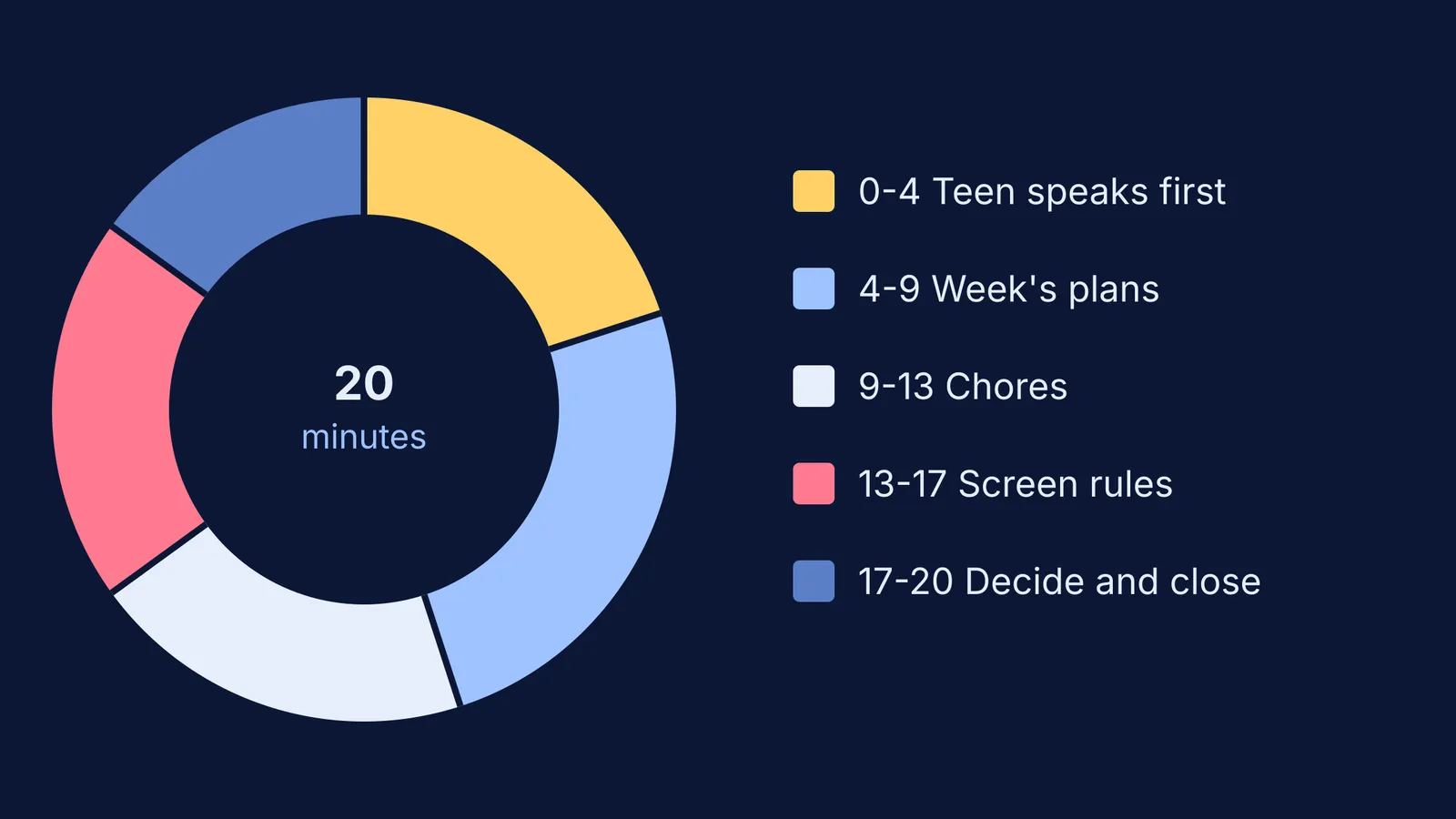
Same day, same time, same place. Sunday evening after dinner works for many families. Set a timer and keep to this agenda:
Minutes 0-4: the teenager goes first. One thing that went well this week, then anything they want to raise. Nobody interrupts.
Minutes 4-9: the week ahead. Tests, coaching timings, birthdays, guests, who needs the car or the laptop when.
Minutes 9-13: chores. Who does what, and anything that slipped last week. Agree on a fix, not a punishment.
Minutes 13-17: screens. One screen question per week, not the whole rulebook.
Minutes 17-20: decide and close. Read the decisions aloud, write them on a sheet or the family board for weekly study goals, and end on time.
What ground rules keep it from turning into a lecture?
Agree on these at the first meeting:
Phones face down for 20 minutes, including the parents' phones.
One topic at a time. No bringing up last month's marks.
Each person gets two minutes on a topic before anyone replies.
If it gets heated, park the topic until next week.
Decisions get written down and checked next week, by everyone.
Who decides what in a family meeting?
Sort every item into one of three boxes before you discuss it.
Teen decides: the order they study in, when they do their chores within the agreed day, how their room looks, which weekend activity to pick.
We decide together: weekday screen limits, curfew on weekends, chore swaps, how to split time between coaching and school work.
Parents decide, and explain why: safety, money, health and travel.
Move items from "together" to "teen decides" as trust builds, and say so out loud.
What does a real meeting sound like?
Here is an example from a family with a Class 11 student. The names are made up.
Parent: "Aditi, you're first. Anything you want on the list?"
Aditi: "I want to stay up till 11 on Fridays."
Parent: "That's a 'together' one. What would make it work for you?"
Aditi: "Saturday coaching is at 10, so I'd still get enough sleep."
Parent: "Okay, let's try it for two Fridays and check next week. Now, chores: dishes slipped on Wednesday. What happened?"
Notice what the parent did. They asked before stating a view, agreed to a trial instead of a permanent rule, and named the check-in date.
If the week's plan stalls because your teen does not know where to start on a hard chapter, Fermi's AI tutor can work out what they already know and build a plan for the session.
How do you set screen rules without a fight?
The American Academy of Pediatrics advises parents to discuss media rules with their children, and says plans "should evolve as your child matures and develops" (AAP, HealthyChildren.org). It suggests reviewing the plan at the start of each school year or during summer and holiday breaks. The meeting gives you that review slot every week, so a single rule can be tested, adjusted or dropped. For a fuller written agreement, see our guide to a phone contract with your teenager.
The Tele MANAS helpline below is listed in a Ministry of Health and Family Welfare press release as a toll-free, 24x7 number.
If your teenager has gone quiet at home, start with what to do when your teenager does not talk to you, then try the 20-minute meeting this Sunday.


