

On this page
Sunday is the one day most Class 11 and 12 aspirants control. School is shut, coaching is often off or limited to a test, and the week's leftovers are waiting. Twelve hours of catch-up usually ends in a tired Monday. A better Sunday has two focused blocks and protected time for everything else.
How many hours should a JEE or NEET aspirant study on Sunday?
About four hours of focused work is enough for most weeks, split into one catch-up block and one review block. The rest of the day does real work too.
Sleep comes first. The American Academy of Sleep Medicine says teenagers aged 13 to 18 should sleep 8 to 10 hours per 24 hours on a regular basis (Paruthi et al., 2016). If weekday nights run short, Sunday is when you protect a full night before Monday.
Movement counts as well. WHO recommends that children and adolescents aged 5 to 17 do at least 60 minutes of moderate- to vigorous-intensity physical activity daily (WHO). A cricket match, a cycle ride or a fast walk to the market all count.
What does a balanced Sunday look like?
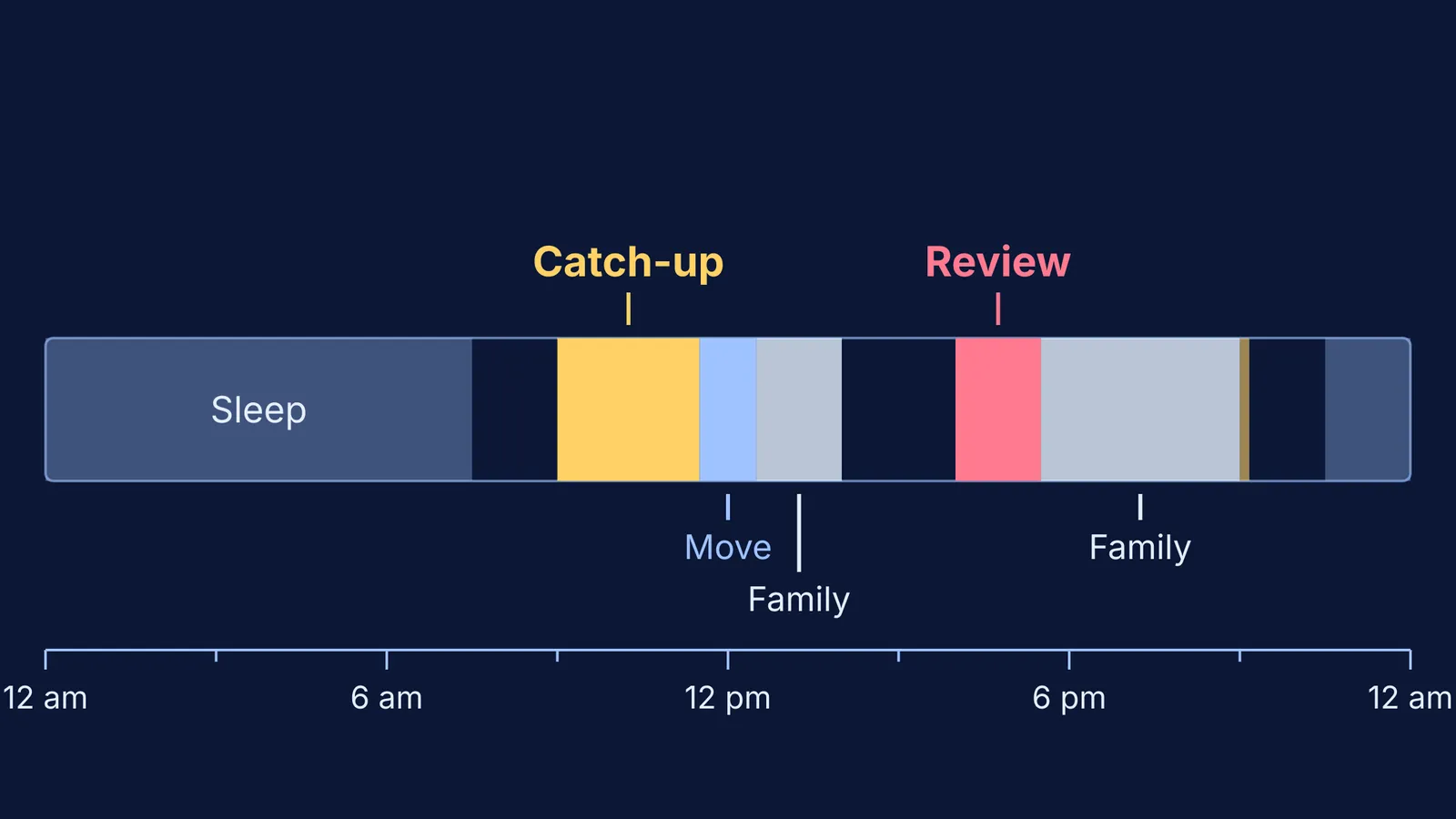
Here is a template. Shift the times to suit your family, but keep the order.
7:30 am: Wake close to your weekday time. Breakfast without a phone.
9:00 to 11:30 am, catch-up block: Finish one backlog item from the week, such as a coaching sheet, notes from a missed lecture, or the NCERT chapter you fell behind on. Choose it on Saturday night so the morning isn't spent deciding.
11:30 am to 12:30 pm, move: Sport, cycling or a walk, outside if you can.
12:30 to 2:00 pm, family lunch: No books at the table.
2:00 to 4:00 pm, free: Nap, read something unrelated, call a friend.
4:00 to 5:30 pm, review block: Test yourself on the week's topics (see below).
5:30 to 9:00 pm, family and free time.
9:00 pm, ten-minute plan: Write down the three things the coming week must hold.
10:30 pm: Lights out, which leaves nine hours before a 7:30 wake-up.
If your coaching holds a weekly test on Sunday morning, take the test in the catch-up slot and use the afternoon review block to go through its mistakes.
If the backlog is so large that you can't tell where to begin, Fermi's AI tutor can work out what you already know and build a plan for the session, so you sit down to a clear next step.
Why review by testing yourself instead of rereading?
In a study of students learning prose passages, those who took recall tests remembered substantially more a week later than those who restudied, even though restudying made students more confident (Roediger and Karpicke, 2006).
Spacing helps too. A meta-analysis covering 317 experiments on distributed practice found that the gap between study sessions affects how much you retain, and that the best gap grows the longer you need to remember something (Cepeda et al., 2006). A Sunday review of topics first met on Monday or Tuesday is a natural spaced session.
A 90-minute review block:
20 minutes, blank-page recall: For each subject, write everything you remember from the week's chapters without opening your notes. Then check, and mark the gaps in a different colour.
50 minutes, redo mistakes: Rework five to eight questions you got wrong this week, from scratch, without looking at the solution.
20 minutes, quick quiz: Test yourself again on the gaps you just marked.
When you redo a wrong question and still can't see where your method breaks, the Fermi Problem Library has a step-by-step solver that explains the reasoning rather than printing an answer.
How can parents help without adding pressure?
Parents shape Sunday more than any timetable does. A few things help:
Agree on the two study blocks on Saturday evening, then leave them alone.
Keep family time free of study talk, including mock test scores.
Plan visits and errands around the blocks, not on top of them.
Notice sleep. If your child is up past midnight on Saturdays, raise it calmly later in the week, not on Sunday morning.
A short script that works on Saturday night: "What's your one catch-up item tomorrow? When is your review block? Everything else is yours."
If your family is weighing a trip this year, read our guide on whether to go on holiday during the JEE or NEET year. Class 12 families can also read how to help your child balance boards and entrance exams, and students who want a Saturday plan too can see how to use the whole weekend for JEE or NEET prep.
If your child seems low or anxious for weeks, or cannot sleep even on a calm Sunday, talk to a doctor or counsellor. Tele MANAS is a free, 24x7 national mental health helpline from the Ministry of Health and Family Welfare, on 14416 or 1800-891-4416 (Tele MANAS details).
This Saturday night, write down one catch-up item and three review topics. That is Sunday planned.


