

On this page
Weekends are the only time Class 10 students can catch up on the week's schoolwork, but expecting them to study for eight hours a day often backfires. When parents and students try to pack too much into a Saturday and Sunday, it leads to exhaustion rather than better grades. A sustainable weekend schedule for a Class 10 student should consciously balance focused revision, necessary rest, family time, and a creative hobby.
How many hours should a Class 10 student study on weekends?
When preparing for board exams or setting the foundation for future competitive exams, it is easy to assume that more hours spent at a desk equal higher marks. However, research into study habits shows a clear point of diminishing returns.
A 2006 meta-analysis of homework research by Harris Cooper and colleagues found that the academic benefits of independent study plateau for high schoolers after 1.5 to 2.5 hours per day (DOI: 10.3102/00346543076001001). Spending four or five hours staring at a textbook on a Sunday afternoon does not yield twice the learning; it mostly increases stress and fatigue.
Instead of measuring the hours spent sitting, focus on what is actually being done. A two-hour block of high-quality, active retrieval practice is plenty. If your teen is confused about where to start, Fermi's AI tutor can work out what they already know and build a plan for the session, so they sit down to a clear next step instead of a blank page. If they need to review specific topics, the Fermi Concept Library allows them to target their exact weak points quickly.
Should teens sleep in on the weekend?
The typical Class 10 student runs a sleep deficit during the week, waking up early for school and staying up late to finish assignments. On Saturday morning, it is tempting to let them sleep until noon to recover.
Catching up on sleep is important, but moderation is key. A 2026 study in the journal *SLEEP* by Sojeong Kim and Melynda Casement analysed data from 1,867 adolescents and found that teens who slept up to two hours longer than their weekday wake time had significantly lower odds of clinical-level anxiety (DOI: 10.1093/sleep/zsag113). The same study noted that sleeping in for more than two hours was linked to elevated anxiety and depressive symptoms.
If your child usually wakes up at 6:30 AM for school, a healthy weekend schedule should have them up by 8:00 AM or 8:30 AM at the latest.
Why do hobbies and family time matter on weekends?
A common mistake during Class 10 is pausing all extracurricular activities to focus entirely on academics. Removing these outlets actually removes a teenager's primary way to decompress.
A 2024 study of over 18,000 adolescents, published in the *Journal of Youth and Adolescence* by Emma Thornton and colleagues, found that teens who regularly participated in a wide range of creative hobbies and activities reported significantly higher wellbeing than those who were activity-free (DOI: 10.1007/s10964-024-01950-7). The researchers concluded that active engagement in hobbies is a protective factor for adolescent mental health.
To support this, protect time in the weekend schedule for things that are not school-related. This could mean dedicating an hour on Saturday afternoon to a musical instrument, painting, or reading a novel. You can also establish a shared routine; our guide to setting up a family quiet hour explains how shared reading time can calm the whole house down.
What does a healthy weekend schedule for Class 10 look like?
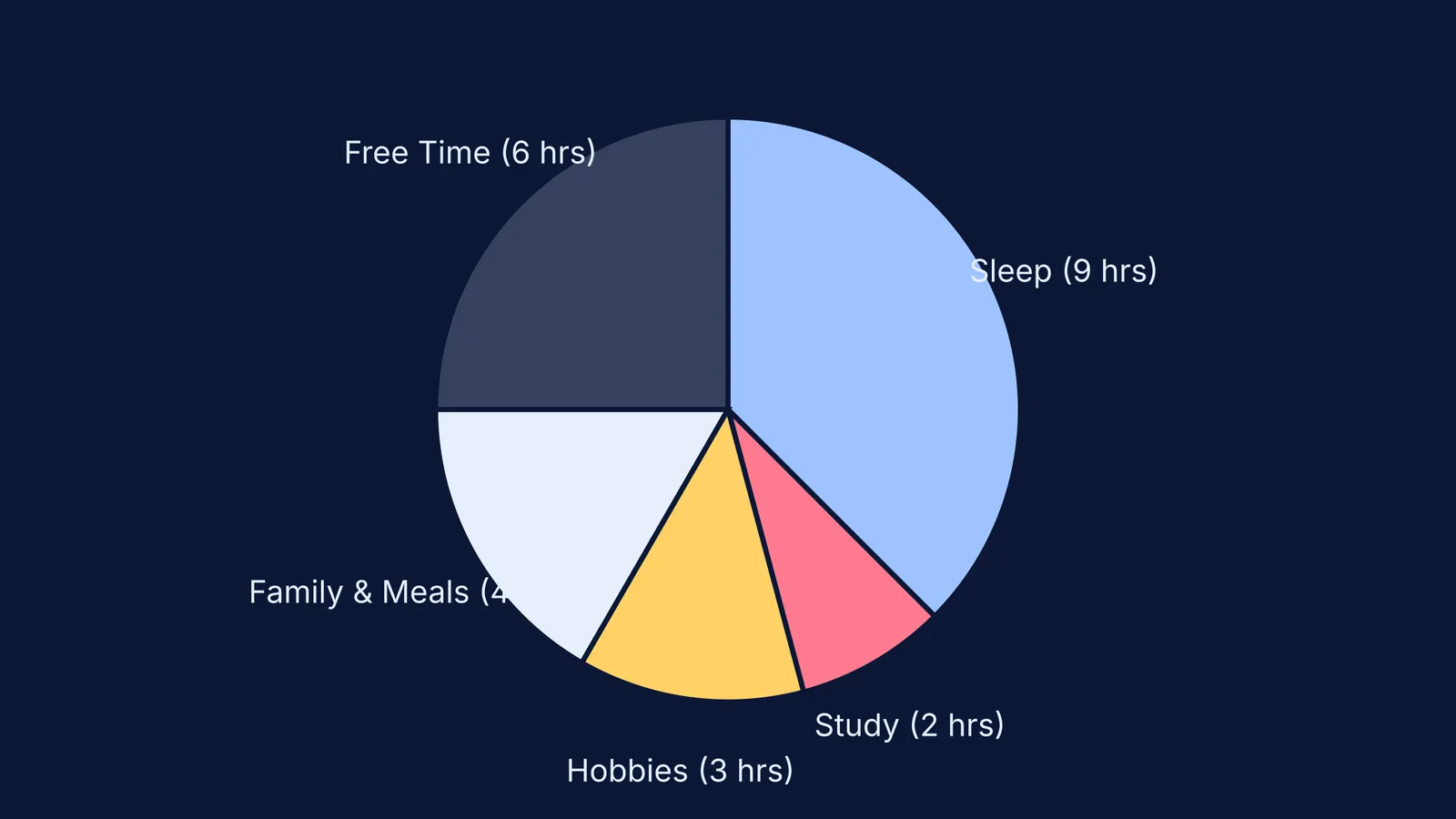
To turn these research findings into a practical routine, here is a balanced framework you can adapt for your teenager's Saturday or Sunday:
8:30 AM: Wake up (allowing up to 2 hours of catch-up sleep).
9:00 AM – 11:00 AM: Focused study block. Use this time for active revision or tackling a difficult assignment when the brain is fresh. Limit this to two hours.
11:00 AM – 1:00 PM: Free time and creative hobbies. Play a sport, draw, or spend time outside.
1:00 PM – 2:00 PM: Lunch with the family.
2:00 PM – 5:00 PM: Unstructured social time or an outing with friends.
5:00 PM – 7:00 PM: Light review or a family quiet hour. If they have a test on Monday, they can use 45 minutes here to review their notes.
7:00 PM onwards: Dinner, relaxation, and winding down for a consistent bedtime.
Building a routine like this ensures that the weekend actually serves its purpose: allowing your teenager to recharge so they can face Monday morning with genuine energy. If you are struggling to make a new routine stick, our guide on how to build a study routine that lasts offers practical strategies for maintaining these habits over the long term.


