

On this page
Many parents want to help out at their child’s school but hesitate, unsure of what they can offer or worried about getting in the teacher's way. Volunteering your time is not only a practical help to the school, but it also signals to your child that you value their education. However, finding the right balance between being an involved parent and an overbearing one takes careful thought.
Does school volunteering actually help students?
It is easy to assume that academic success is mostly about what happens during school hours. However, a 2019 American Psychological Association review of 448 independent studies—encompassing over 480,000 families—found that parental involvement is consistently linked to higher academic achievement, better school engagement, and stronger student motivation. The benefits were found to hold true across different age groups and backgrounds.
The review noted that different types of school-based and home involvement—such as attending school events or discussing school with children—were similarly positively associated with a child's academic adjustment.
Interestingly, the same study showed that direct parental homework assistance was the only type of involvement negatively associated with achievement. Researchers suggest this happens because parents often step in precisely when a child is already struggling, or because the help becomes pressured and creates friction. If you want to know more about this tricky balance, we have explored when to help with homework.
What are the best ways to volunteer?
If you want to get involved, you do not have to commit to a demanding weekly schedule. Schools appreciate a variety of contributions, and varying your involvement can play to your personal strengths:
Career talks: Older students benefit immensely from hearing about real-world professions. Spending an hour explaining what a software engineer, nurse, or graphic designer actually does all day is high-value volunteering that connects classroom learning to the real world.
Reading sessions: For younger years, volunteering to read with small groups helps build early literacy and takes pressure off the class teacher.
Event support: Schools always need extra hands for science fairs, sports days, or annual days. This is a one-off commitment that shows your child you are part of their school community.
Library organisation: Many school libraries rely on parent volunteers to shelve books, manage displays, and help students find materials.
Extracurricular clubs: If you have a background in chess, coding, or drama, offering to assist with an after-school club can bring specialist knowledge into the school that teachers might not have.
How can you offer help without overstepping?
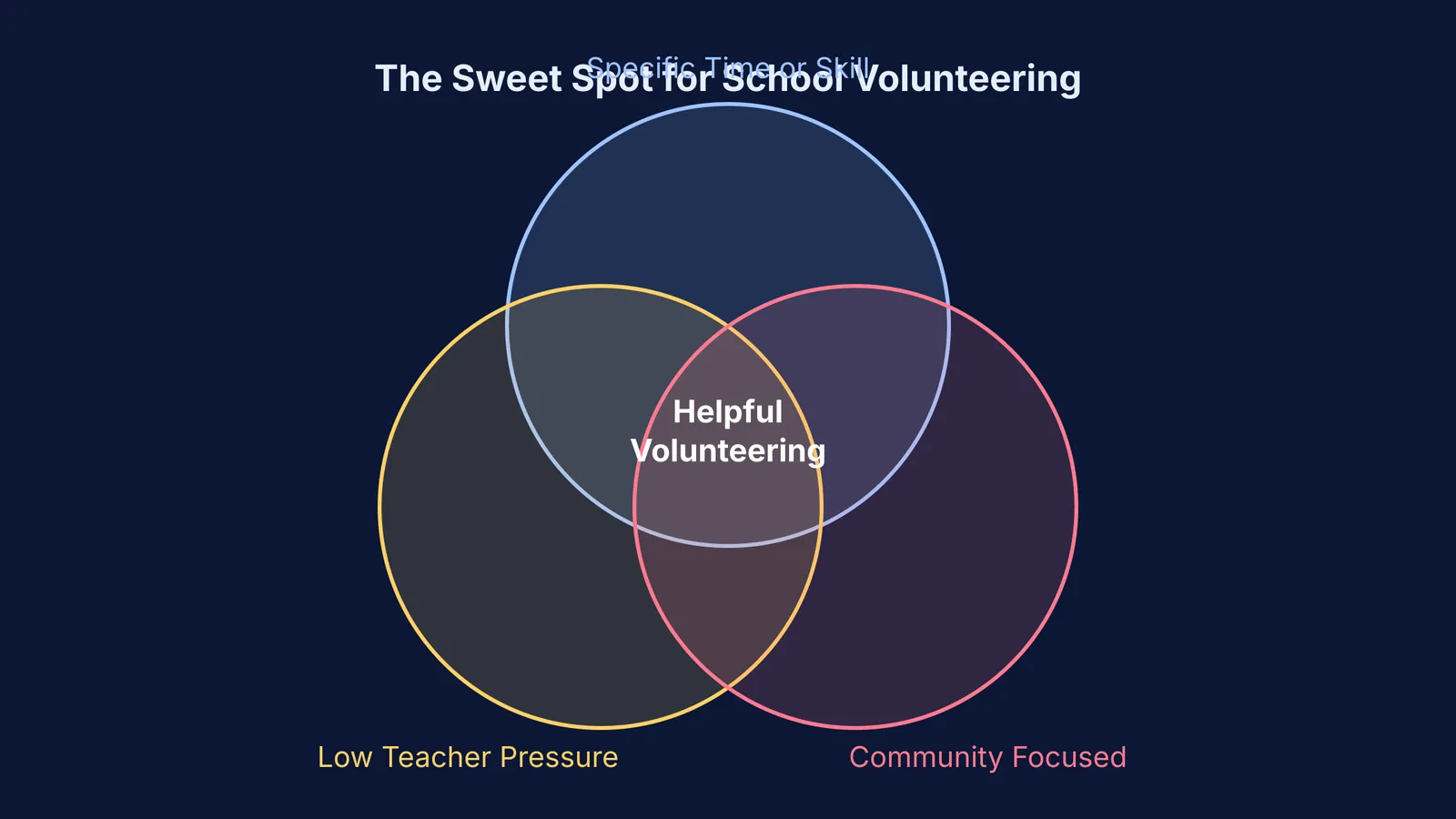
Teachers are extremely busy, and managing volunteers can sometimes feel like an extra job for them. The key to offering help is to be specific, bounded, and low-pressure.
Instead of saying, "Let me know if you need anything," which puts the burden of planning on the teacher, offer a specific block of time or a particular skill. Accept it gracefully if they decline; sometimes, the logistics of integrating a volunteer take more time than the task itself.
When you focus your school involvement on community tasks rather than micromanaging your child's academics, it allows your child to take ownership of their own learning. If you are stepping back from direct academic tutoring, you can still provide the right resources. A student brings a topic, a course, a problem set or a scanned assignment. Fermi works out what they already know, builds a plan for the session, and teaches through it — writing on a board, drawing the figure, running the simulation, and checking understanding as it goes.
What if you cannot volunteer during the day?
Many parents work full-time and simply cannot be at the school during the day. Fortunately, the benefits of parental involvement do not require physical presence in the classroom.
The OECD's PISA 2022 Results found that home-based engagement is powerfully linked to academic success, especially following the disruptions of recent years. Students who regularly ate a main meal with their family, or whose family members spent time talking to them about their school day, scored 16 to 28 points higher in mathematics than those who did not.
Simply taking an active interest in what your child is learning, asking thoughtful parent-teacher meeting questions, and discussing their day over dinner builds the emotional foundation they need to succeed.


