

On this page
Your six-year-old asks the kitchen speaker why the Moon changes shape, gets an answer in two seconds, and runs off happy. Is that learning, or just an answer? Research gives a fairly clear picture. Smart speakers are good at short, settled facts. They struggle with the "why" and "how" questions that matter most for learning, and young children are still learning when to trust them.
What happens when a child asks a smart speaker a question?
The most detailed look comes from a two-week home study by Silvia Lovato, Anne Marie Piper and Ellen Wartella at Northwestern University, published in 2019. Researchers placed a Google Home Mini in the homes of 18 families with a child aged 5 or 6, and analysed the device's logs.
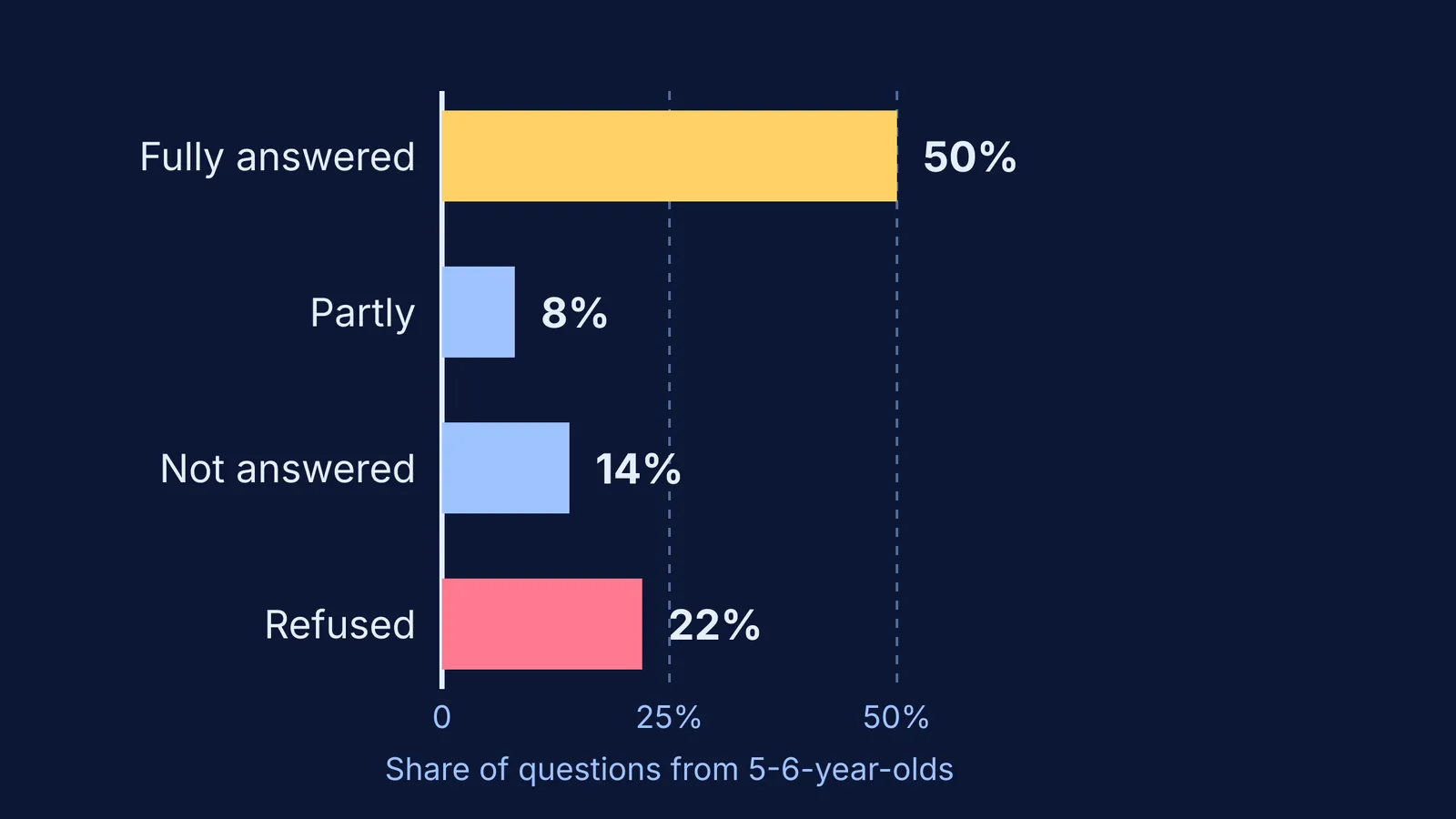
Science and technology was the largest subject of the children's questions, at 24%, followed by culture (history, TV, fantasy, sport) at 21%. The device transcribed the children's speech correctly 89% of the time. Yet only 50% of the children's questions got a full answer; 8% were answered partly, 14% not at all, and 22% were refused, with the speaker saying it could not help.
One child asked, "Do squirrels like pumpkins?" and got a news snippet; the follow-up, "Why do squirrels eat pumpkins if they don't like them?", got "Sorry, I don't know how to help with that." The researchers found "why" and "how" questions particularly hard for the system. Asked whether unicorns exist, the speaker joked, "There are unicorns everywhere"; one mother said she didn't like that because it made unicorns seem real.
Do young children trust what Alexa or Google tells them?
Trust changes with age. In the first of two studies by Lauren Girouard-Hallam and Judith Danovitch, published in Developmental Psychology in 2022, children aged 4-5 and 7-8 heard a new voice assistant and a person answer questions. With increasing age, children trusted the voice assistant more for facts and the human more for personal information. The authors concluded that children's trust in voice assistants varies with age and depends on the type of information.
In plain terms: an eight-year-old starts to sense that a speaker knows the capital of France but not what Nani likes for dinner. Younger children draw that line less clearly, so an adult nearby helps.
What are the limits for homework and learning?
A smart speaker reads you an answer. It does not check what your child already knows, ask a question back, or notice confusion. That matters for homework, because the thinking is the point.
There are also safety and privacy limits. A 2024 University of Cambridge study by Nomisha Kurian recalls that in 2021 Alexa told a 10-year-old to touch a live electrical plug with a coin, and proposes a 28-item framework for child-safe AI. Recordings are a second concern: in 2023 the US Federal Trade Commission and Justice Department charged Amazon with keeping children's Alexa voice recordings, and the proposed order requires a $25 million civil penalty. Our guide to what parents should check in learning apps for privacy in India covers the settings worth looking at.
What house rules work for young users?
Five rules most families can keep:
Speaker in a shared room. The kitchen or living room, not the bedroom, so you hear the questions and answers.
Facts yes, homework thinking no. Spellings, dates, "how many legs does a spider have" are fine. Sums and "explain this chapter" go to a person or a book first.
Check one answer a day together. Ask, "How could we find out if that's right?" and look it up in a book or ask a teacher.
No challenges, dares or secrets. Anything the speaker suggests doing with the body, electricity, fire or water needs a grown-up first.
Review the voice history once a month. Open the device's app with your child, look at what was asked, and delete recordings you don't want kept.
How do you turn a speaker answer into real learning?
Try this script the next time your child asks the speaker a "why" question.
Child: "Hey Google, why is the sky blue?" Say the speaker reads out a sentence about sunlight scattering.
You: "What did it say? Tell me in your own words."
You: "Does that explain why sunsets are orange? What do you think?"
You: "Let's test it. Shine a torch through a glass of water with a few drops of milk, and look from the side and from the end."
The speaker supplied a fact; the conversation did the teaching. For more on this habit, see our guide to encouraging curiosity at home by asking questions instead of answering them.
As children get older and homework moves from facts to reasoning, the question shifts from "Alexa or not?" to "which AI tools, and how?" Our parent's guide to children using ChatGPT for homework sets out rules for that stage. For a teenager stuck on a science idea, the Fermi Concept Library gives each concept in physics, chemistry, biology and mathematics its own lesson, so they read an explanation rather than a one-line answer.


