

On this page
As your child moves into Class 11, the traditional split between science, commerce, and humanities is no longer as rigid. The Central Board of Secondary Education (CBSE) now places a heavy emphasis on vocational learning, offering skill subjects alongside traditional electives. For many students and their parents, this extra option raises questions: what are these subjects, do they distract from core studies, and how do they impact the final marksheet?
If your family is deciding on the right academic combination, our guide on Choosing a stream after Class 10: a guide for families offers a broader overview.
What are CBSE skill subjects?
A skill subject (or vocational subject) is a practical, career-oriented course that students can choose as a fifth compulsory subject or a sixth additional subject. For the 2024-25 academic session, the CBSE curriculum includes 43 skill subjects for Classes 11 and 12 (CBSE Senior Secondary Curriculum). These courses are designed to bridge the gap between school education and the skills needed in the modern workplace.
Every skill subject includes a mandatory "Employability Skills" component, which covers communication, self-management, basic computing (ICT), entrepreneurial skills, and green skills. The remaining part of the syllabus focuses on the specific domain chosen.
Common options include:
Artificial Intelligence (843)
Information Technology (802)
Financial Markets Management (805)
Mass Media Studies (835)
Healthcare (813)
When selecting subjects, students must be mindful of prohibited combinations. For example, a student cannot take *Informatics Practices (065)* or *Computer Science (083)* alongside *Information Technology (802)*, as the syllabuses overlap significantly.
How do skill subjects affect the Class 12 marksheet?
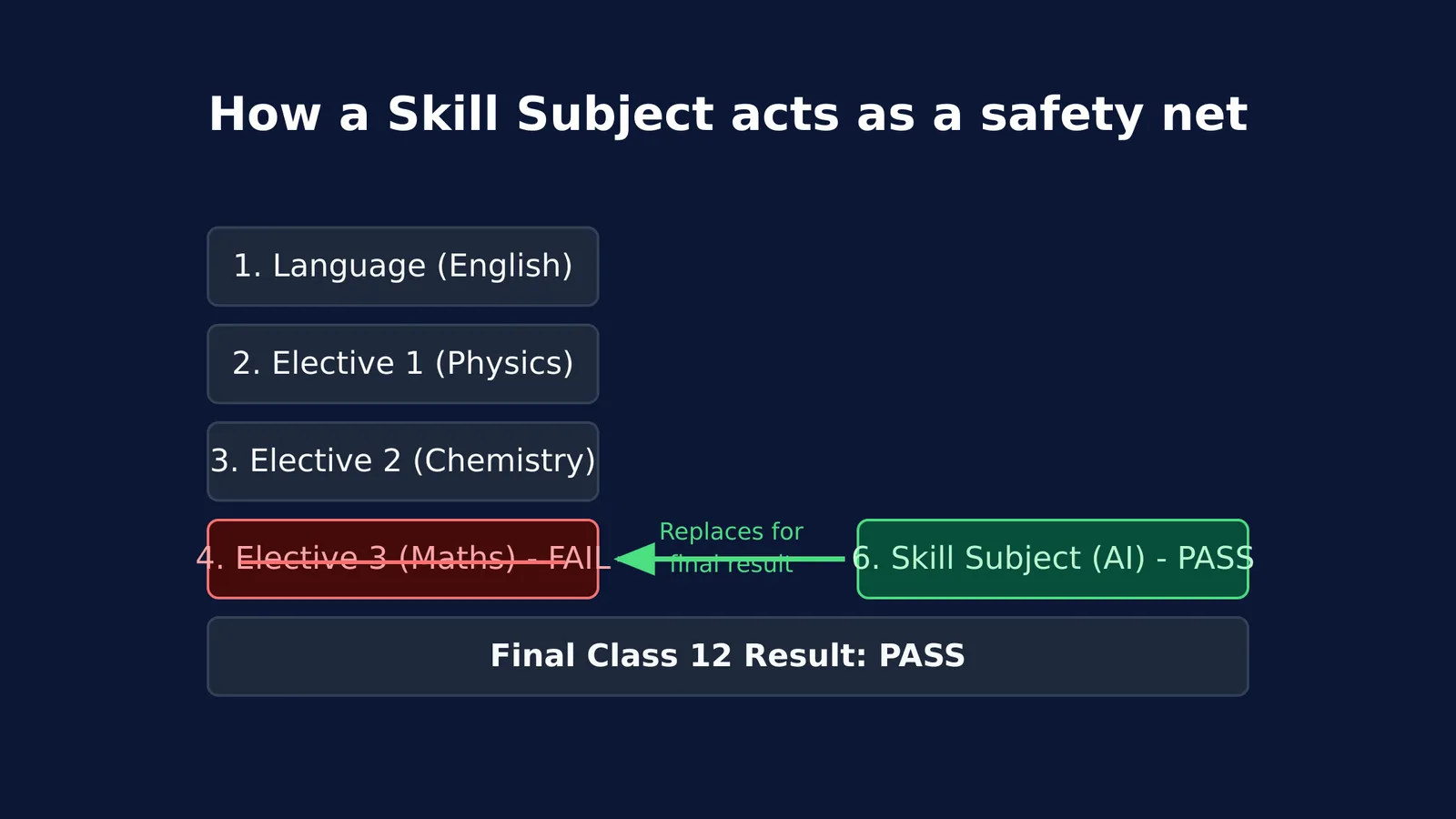
One of the biggest advantages of taking a skill subject as a sixth additional subject is the built-in safety net it provides during the board exams.
According to CBSE rules (CBSE Senior Secondary Curriculum), if a student takes six subjects and fails in any one of the three elective academic subjects (such as Physics, Accountancy, or History), the skill subject automatically replaces it for the purpose of declaring the final result as "PASS". However, a skill subject cannot replace a failed language subject; a failed language can only be replaced by a third language, if the student opted for one.
Even if a student passes all their subjects, the skill subject can still be beneficial. When calculating the "Best of 5" aggregate percentage for college admissions, the marks of the skill subject can replace the lowest-scoring elective subject if the skill subject score is higher. This means a strong performance in Web Applications or Design can genuinely boost a student's overall percentage.
When the final Class 12 marksheet is printed, all six subjects will be listed. The marksheet will display the marks and positional grades (from A1 to E) for the skill subject exactly as it does for the main academic subjects. If a replacement was used to secure a passing grade, the original failed marks of the elective are still visible, but the overall result at the bottom will read "PASS".
Who should consider taking a skill subject?
A skill subject is an excellent choice for a student who wants to explore a specific career path early or who needs a practical counterbalance to theoretical subjects. For instance, a student planning to study engineering might take Artificial Intelligence to build coding experience before college. If your child is uncertain about their path, these subjects offer a low-risk way to test a new field. We discuss this further in our guide on Talking about STEM careers beyond engineering and medicine.
Skill subjects also suit students who find traditional testing highly stressful. Because these subjects often involve significant practical work and project-based assessments, they allow students to score marks through hands-on effort rather than just written exams.
If your child decides to take on an ambitious combination of science and skill subjects, keeping their core concepts strong is essential. Using Fermi's AI tutor can help them study more efficiently by working out what they already know and building a plan for the session. When they hit a wall with their main electives, the Fermi Problem Library provides a step-by-step solver that explains the reasoning rather than printing an answer.
Ultimately, skill subjects are not a distraction; they are a formal recognition by the board that practical skills hold equal value to traditional academic knowledge.


