

On this page
Going to a science city, a planetarium, or a local science museum is a popular way to spend a weekend as a family. These spaces are built to spark curiosity, but their sheer scale can often be overwhelming. If you simply let your children run from one flashing button to the next without a focus, the visit can easily turn into a chaotic playground rather than a learning experience.
To make the most of the visit, parents need to step in as guides. You do not need to be a scientist to do this; you just need to know how to structure their exploration and ask the right questions.
Why does parent interaction matter at a science centre?
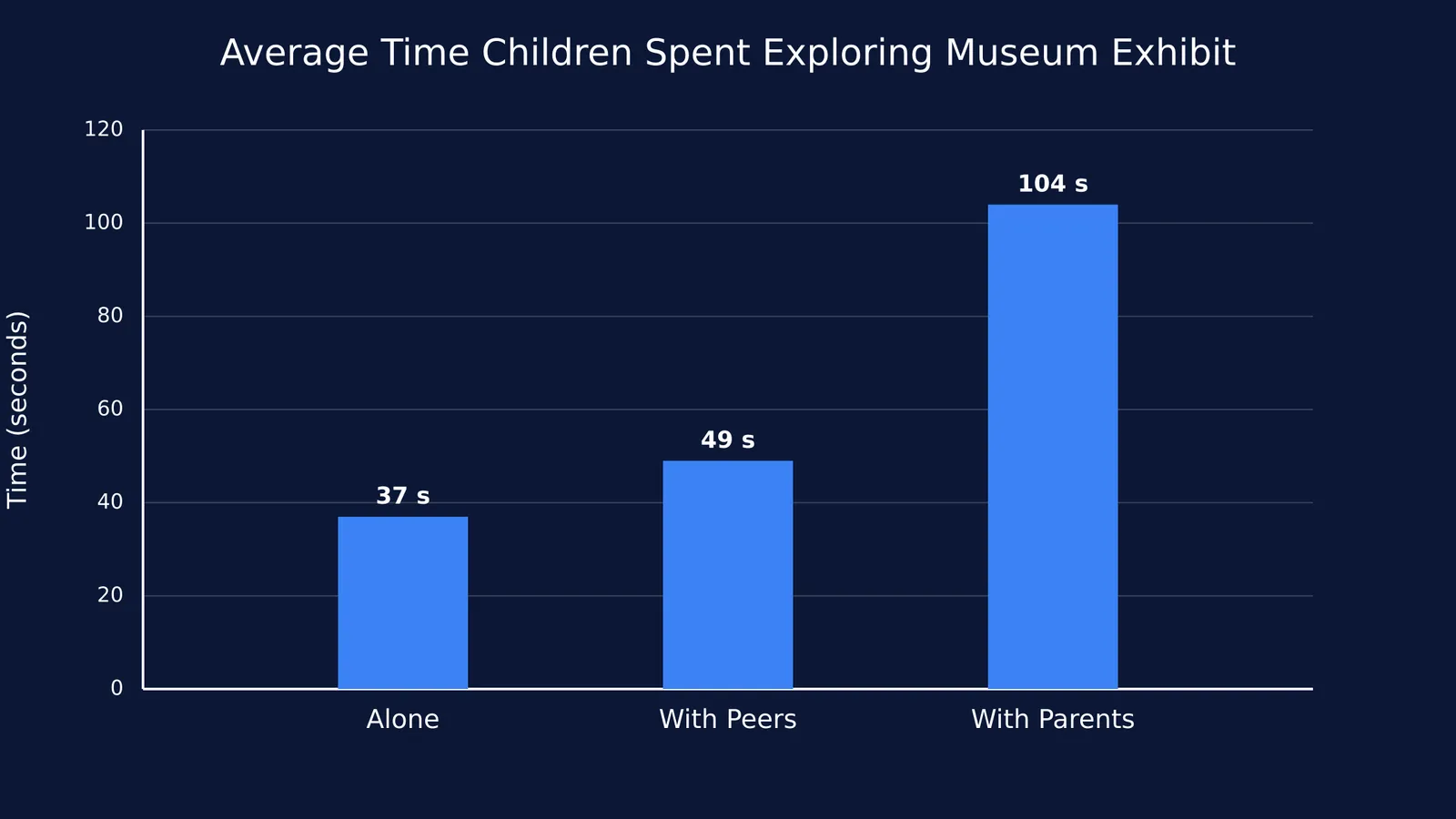
Children are naturally curious, but they often lack the framework to connect a fun activity to a scientific principle. A 2001 study published in *Science Education* by researcher Kevin Crowley and colleagues observed families at a museum zoetrope exhibit. They found that when parents are present and engaged, children explore exhibits longer (averaging 104 seconds compared to 37 seconds when alone), more broadly, and more intensely (DOI: 10.1002/sce.1035).
The study noted that parents naturally act as "explainers," bridging the gap between the exhibit's phenomena and the child's prior knowledge. Similarly, a 1999 study by Mary Gleason and Leona Schauble showed that collaborative interaction between parents and children leads to better experimental design and more powerful causal inferences by the children (DOI: 10.1207/s1532690xci1704_1). Simply put, when you talk through what is happening, your child thinks more like a scientist.
How to pick exhibits by age?
Rather than trying to see every single display, choose a few exhibits that match your child's developmental stage. This prevents fatigue and allows for deeper engagement.
Toddlers and Preschoolers (Ages 3–5): Focus on tactile, cause-and-effect exhibits. Water tables, simple gears, and light tables allow them to see the immediate result of an action. At this age, the goal is simply to observe that actions have predictable reactions.
Primary School (Ages 6–11): Look for exhibits that involve building, balancing, or testing basic physics and biology. These children can understand basic forces, magnetism, and simple anatomical models. Encourage them to predict what will happen before they push a button or pull a lever.
High School and Teens (Ages 12+): Seek out complex exhibits that require formulating hypotheses, such as interactive climate models or genetics displays. If they encounter hard-to-picture concepts that a physical exhibit cannot fully explain, the Fermi Simulation Lab has interactive simulations for the ideas that are easier to see than to read.
What are the best follow-up questions to ask?
The way you talk to your child during and after the visit significantly impacts what they remember. Avoid simple "yes/no" questions or simply reading the plaque aloud.
A 2010 study by Nora Benjamin, Catherine Haden, and Erin Wilkerson found that conversations including "wh-" questions (who, what, where, why, how) and causal explanations are linked to improved memory of the experience and a better understanding of the scientific principles (DOI: 10.1037/a0017822).
Instead of asking, "Did you like that?", try asking, "Why do you think the ball floated in that stream of air?" or "Where else have you seen something move like that?" Even minimal prompts can help. A 2019 study led by Aiyana Willard showed that giving parents simple conversation cards with prompts like, "What do you think will happen if..." significantly increased the quality of explanatory talk at exhibits (DOI: 10.1111/cdev.13232).
How should you plan your next visit?
To turn a chaotic museum trip into a focused learning experience, try this simple framework:
Before you go: Look at the museum map together and pick just 3 to 4 specific exhibits or areas to focus on. Set the expectation that you will spend time exploring these deeply rather than rushing through the whole building.
During the visit: Let your child take the lead in interacting with the exhibit. Step in only to ask a "wh-" question or to connect what they are seeing to something they already know from home or school.
On the way home: Ask them to explain their favourite exhibit to you as if you had not seen it. Having to articulate the mechanism out loud cements the concept in their memory.
For more on building consistency at home, you can read How to build a study routine that lasts longer than a week. If a particular concept caught their interest but they struggled with the underlying theory, Fermi's AI tutor can work out what they already know, build a plan for the session, and teach through it, keeping the curiosity sparked by the museum visit alive.


