

On this page
Changing schools mid-session is a stressful process for any family, but when your child is in high school, it also involves navigating strict board regulations. The Central Board of Secondary Education (CBSE) treats Class 9 and 10 as an integrated two-year course, and it applies the exact same logic to Class 11 and 12. Because of this continuous structure, the rules for transferring depend heavily on whether your child is in the first or second year of these integrated blocks.
Here is what you need to know about planning a mid-session move, understanding what the board requires from you and your new school, and how to help your child settle into their new academic environment.
What are the CBSE transfer rules for Class 9 and 11?
Transfers in Class 9 and 11 are generally allowed with fewer restrictions because students have not yet been registered for their final board examinations. The board officially refers to these shifts—such as a family moving to a new city, a parent changing jobs, or a student changing schools due to the non-availability of desired subjects—as a "natural phenomenon."
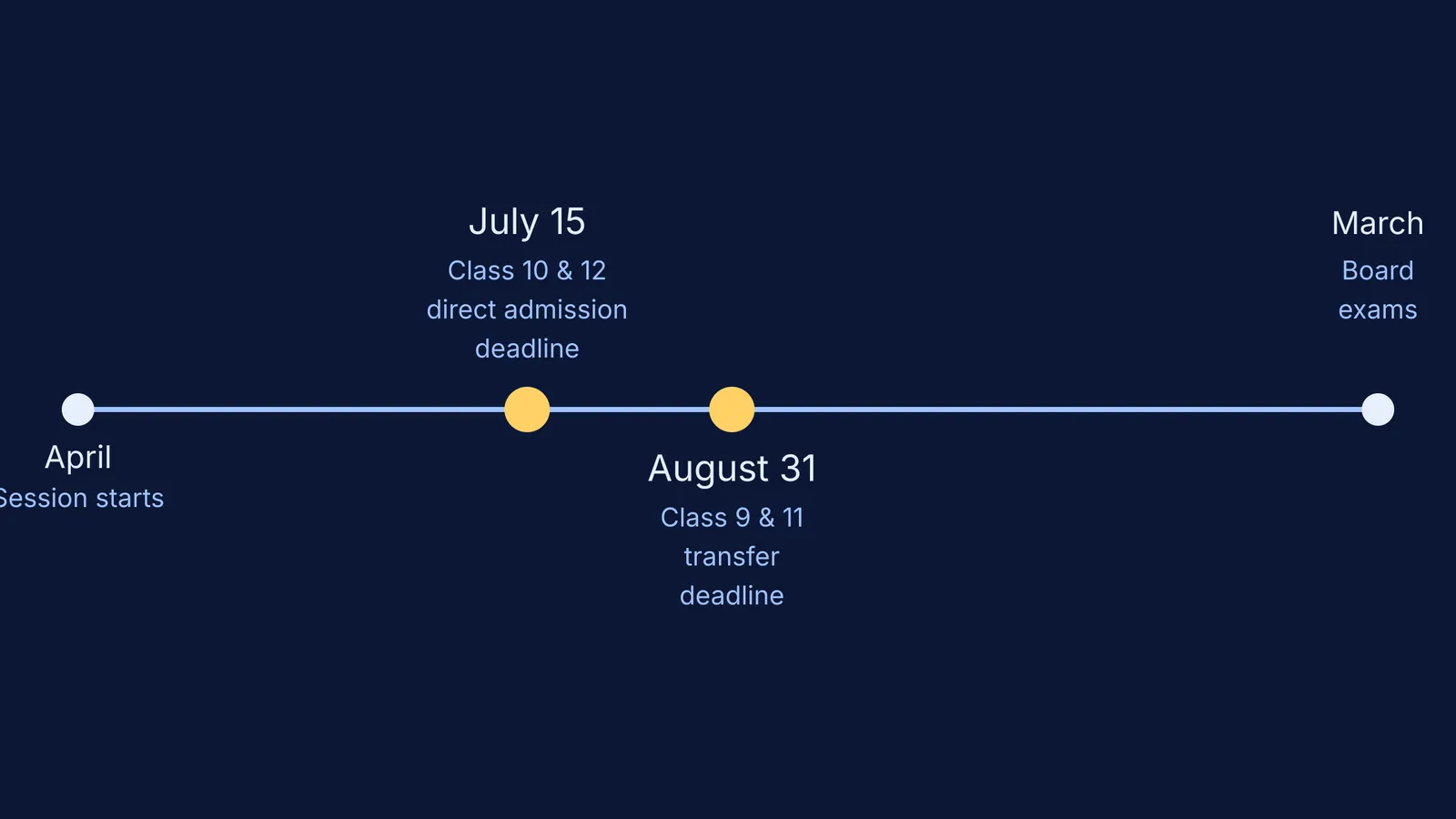
Admissions for Class 9 and 11 must generally be completed by August 31st of the academic year 1. If you are forced to move after this date, the new school cannot admit the student automatically; they must seek special approval from the CBSE Regional Office within seven days of the admission date.
The most critical document you will need is the original Transfer Certificate (TC) issued by the previous school. If the previous school was also affiliated with CBSE, the TC does not need to be countersigned by a local education officer. However, if your child is moving from a state board or an international curriculum, obtaining a countersignature on the TC is mandatory before admission can be confirmed.
Can a student transfer in Class 10 or 12?
Direct admission into Class 10 or 12 is an exception, not the norm. Because students register for their board exams during Class 9 and 11, CBSE strictly controls who can change schools in the final year to prevent last-minute shuffling.
You can only transfer a student in Class 10 or 12 under specific, documented conditions, such as a parent's job transfer, shifting of the family residence to a new location, or severe medical grounds that require a different environment. For Class 10 and 12, schools must submit cases to the CBSE Regional Office by July 15th 2.
If your request is based on a job transfer, you must provide the official transfer order. If you are shifting residence, proof such as a registered lease agreement, a sale deed, or new utility bills is required. Furthermore, the new school must offer the exact same subjects your child was registered for in the previous year. You cannot change a student's subjects while transferring in Class 10 or 12.
Mid-session transfer document checklist
When approaching a new school for admission, ensure you have the following documents ready to avoid delays in the application process:
Original Transfer Certificate (TC): Issued by the previous school and appropriately countersigned if coming from a non-CBSE board.
Previous report cards: For Class 10 admission, you need the Class 9 mark sheet; for Class 12, the Class 11 mark sheet.
CBSE Registration Slip: Mandatory for Class 10 and 12 transfers, as this carries the student's board registration number.
Proof of relocation: A parent's job transfer letter or a registered rent agreement confirming the change of address.
Medical certificates: Required only if the transfer is being sought specifically on medical grounds.
Are there attendance requirements for board exams?
One of the biggest risks of a mid-session transfer is falling short on attendance while the paperwork is being processed. A minimum of 75% attendance is mandatory to be eligible for board exams 3. When your child changes schools, the attendance from the previous school is carried forward and added to the new school's official register.
If the physical move and school-hunting process cause your child to miss several weeks of classes, they may fall below the 75% threshold. While CBSE does allow school principals to condone a shortage of up to 15% in exceptional cases (such as prolonged illness or a genuine emergency), it is always better to minimise the gap between leaving the old school and joining the new one.
How to help your child catch up
Even when the board approves the transfer and all the paperwork is complete, the academic transition can be hard on a student. Different schools often teach chapters in a completely different order, meaning your child might have missed some key topics entirely while repeating others they already know.
If they are struggling to bridge these gaps on their own, Fermi's AI tutor can help. Rather than just giving answers, the tutor works out what the student already knows and builds a plan for the session, teaching through problems step by step.
For a broader overview of topics they might have missed, the Concept Library contains every concept in physics, chemistry, biology, and mathematics, each with its own lesson and its place in the map. This allows students to quickly check where a new topic fits into what they learned at their old school and catch up at their own pace.
If you are evaluating different curricula during a move, you might find our guide on CBSE, ICSE or state board: how families can compare them useful. For a look ahead at what your high-schooler will face soon, read about the upcoming changes in the CBSE Class 10 two board exams system.


