

On this page
Walk into any teenager’s room during exam season, and you will likely see a towering stack of books. For a single physics chapter, a student might have the NCERT textbook, a coaching institute’s printed module, a heavy reference book, and a spiral-bound book of past papers.
Many families believe that having more materials gives their child a better chance of understanding a difficult topic. If they do not grasp it in the textbook, perhaps the coaching module will explain it better. However, learning science shows that this abundance of resources often does the exact opposite.
Why does having too many books lower student performance?
When a student sits down to study a concept from three different books, they are not just learning the concept three times. They are trying to reconcile three different author voices, three different ways of drawing a diagram, and three different sets of mathematical notation.
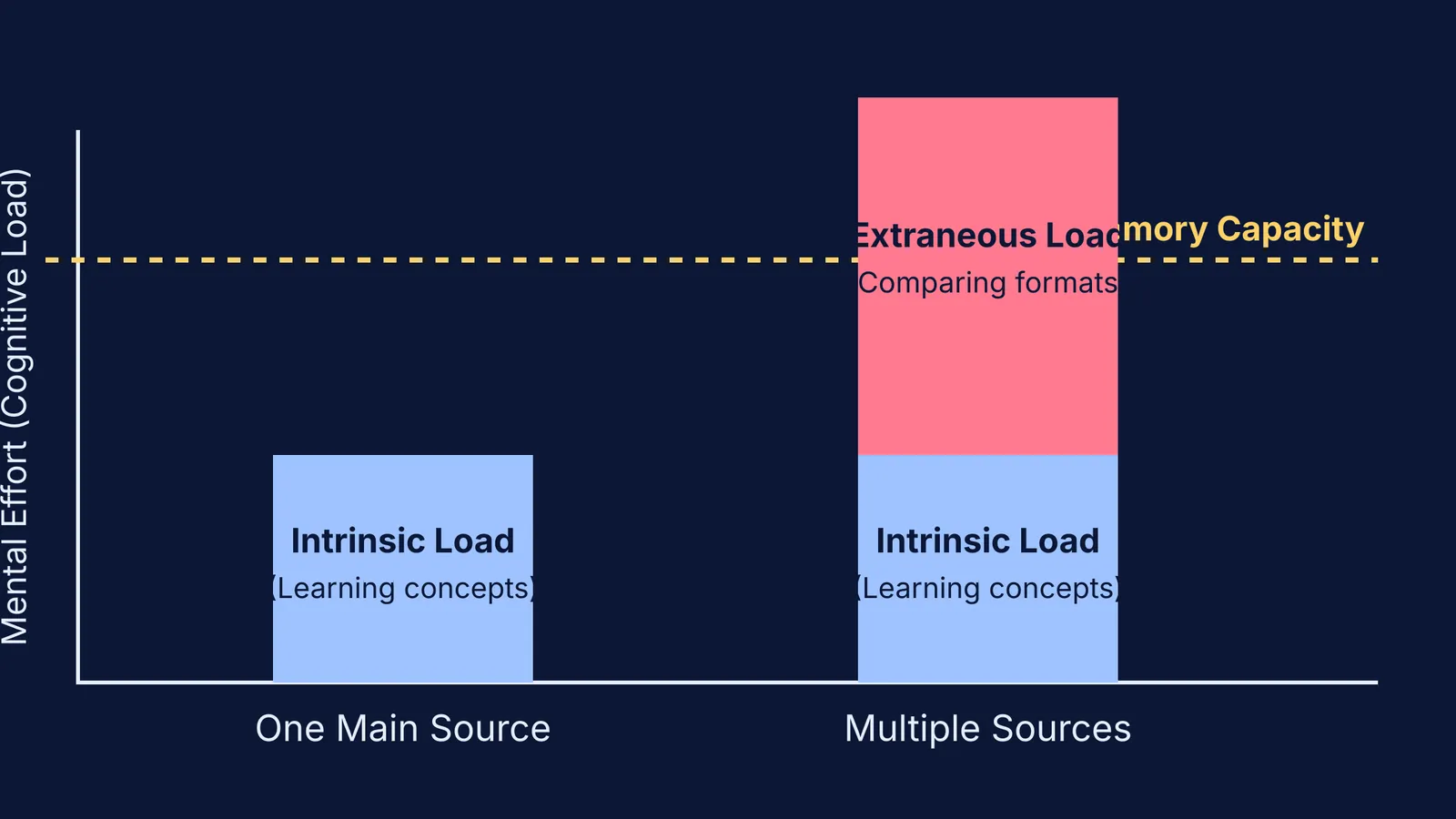
In cognitive psychology, this is known as extraneous cognitive load. The human brain’s working memory is strictly limited, typically able to hold only about 4 chunks of information at one time (Cowan, 2001). When information is distributed across multiple documents, students must use their scarce working memory resources just to search for, hold, and integrate those disparate pieces of information (Sweller, 2011).
Instead of using their mental energy to understand how a projectile moves, they use it to figure out why one book uses a certain variable while the module uses another. Their working memory overflows, leading to frustration and a feeling that the subject is impossibly hard, which is why some JEE aspirants plateau despite studying every day.
How does decision paralysis affect daily study routines?
Beyond cognitive overload, having too many materials creates decision paralysis. A study session often begins with time wasted flipping through different books trying to decide which one to read.
When a student hits a difficult paragraph in their primary book, the temptation is to switch to another book rather than doing the hard work of thinking through the problem. This hopping from source to source creates an illusion of studying, but it prevents the deep, focused attention required to actually master the material. Building a study routine that lasts relies on removing these daily friction points.
How can parents clear the study material overload?
The most effective way parents can help children learn without adding pressure is to help them curate their physical and digital workspace.
Pick one primary source for theory: Choose a single, high-quality textbook or module to serve as the "spine" of the student's learning for each subject. All theory reading should happen here. If a concept is unclear, the student should ask a teacher rather than consulting a second textbook.
Keep problem books separate: It is fine to have multiple sources for practice questions, but these should be stored away from the desk during the theory reading phase. Bring them out only when it is time to test understanding.
Box up the rest: Take the remaining reference books, duplicate modules, and older editions, and put them in a box in another room. If the student genuinely needs one, they can go get it, but it should not live on their primary desk.
For students who struggle to integrate different sources, digital tools can eliminate the clutter entirely. The Fermi Concept Library holds every concept in physics, chemistry, biology, mathematics and computing, each with its own lesson and its place in the map. Instead of jumping between multiple books to connect a maths formula to a physics problem, the AI tutor teaches — it holds a line of reasoning across a whole session. When it is time to practice, the Fermi Problem Library provides worked problems with a step-by-step solver that explains the reasoning rather than printing an answer, preventing the cognitive overload that comes from mismatched materials.
Shelving the extra books might feel like taking away a safety net, but it actually gives your child the one thing they need most: the mental space to think clearly.


