

On this page
The drop in reading during adolescence is so steep that researchers call it the "reading cliff."
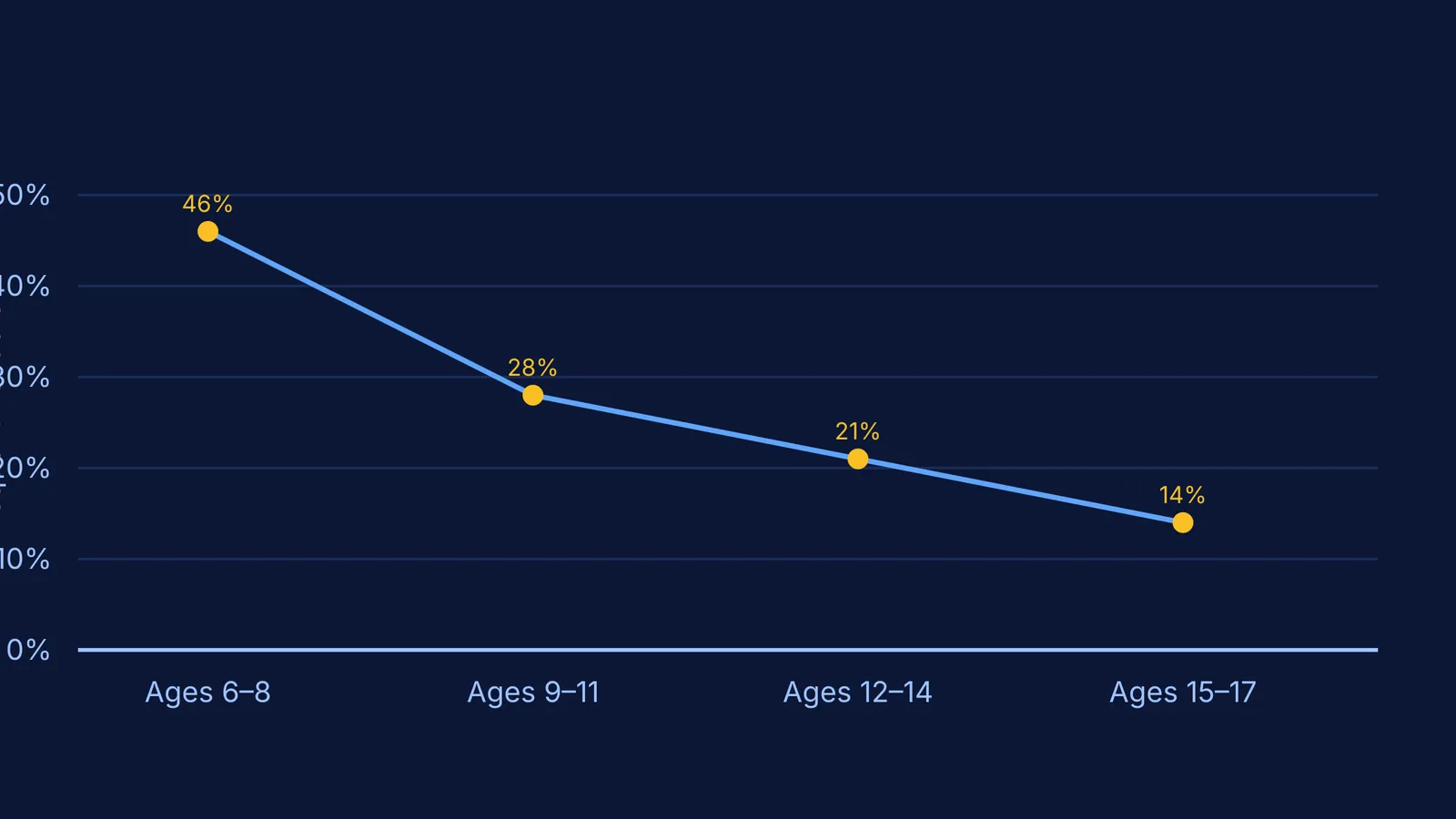
According to the 2023 Kids & Family Reading Report from Scholastic, 46% of 6- to 8-year-olds are frequent readers (reading for fun five to seven days a week). By ages 15 to 17, that number falls to just 14%. Data from the US National Assessment of Educational Progress (NAEP) confirms the long-term trend: in 2020, only 17% of 13-year-olds said they read for fun almost every day, the lowest point since 1984, according to a Pew Research Center analysis. Even more concerning, 29% of 13-year-olds now report that they "never or hardly ever" read for fun.
Why does the habit vanish, and what can parents do about it without resorting to lectures?
Why do teenagers stop reading books?
It is easy to blame smartphones, but the decline begins in the brain. Reading is a high-effort task. As teenagers move into high school, the texts they face become denser, longer and more abstract.
According to Cognitive Load Theory, our working memory can only handle a few pieces of information at a time. If a teenager has spent the day processing complex schoolwork, the intrinsic effort required to parse a challenging book leaves little room for the "germane load"—the deep, reflective thinking that makes a story enjoyable.
At the same time, their prefrontal cortex, which controls executive functions like sustained focus and impulse control, is still developing. Reading a novel requires holding the start of a chapter in mind while processing the end. It asks a teenager to intentionally ignore the impulse to switch tasks. For a tired, developing brain, this simply demands too much energy.
Does screen time cause the reading cliff?
It does not cause the cliff on its own, but it steepens the drop. Digital media is designed to be a high-reward, low-effort activity. Reading a dense book is exactly the opposite.
When a teenager finishes a school day that has exhausted their executive functions—planning assignments, taking notes, managing complex schedules—they often lack the cognitive bandwidth to read for pleasure. Scrolling on a phone requires almost no working memory and delivers immediate dopamine. Faced with a choice between an exhausting task and an effortless one, the tired brain chooses the screen.
How can you encourage a teenager to read again?
You cannot lecture a teenager into loving books again. However, you can lower the friction of reading. Here is a low-friction reading plan, along with a few scripts of what to say, to help them rebuild the habit.
Decouple reading from school: Do not ask if they have read their English or history textbook when discussing books. Let them read what they choose. Instead of asking, "Have you finished your reading for school?", try saying, "I noticed you were looking at that science fiction graphic novel. The art style looks interesting." (If you want to know how parental attitudes change academic outcomes, see this utility value trial).
Accept all forms of text: Graphic novels, audiobooks, sports biographies, and long-form articles all build vocabulary and working memory. Do not dismiss them as "not real books." A teenager listening to a ten-hour audiobook is still processing complex narratives and building cognitive endurance.
Leave books in the environment: The easiest way to encourage reading is to have interesting physical books lying around the house, without strings attached. Do not force them to pick the books up; just let the books be visible alternatives to screens.
Use active reading techniques for study: When they do have to read textbooks, they should know how to do it efficiently so it does not drain all their energy. Rereading and highlighting are often less effective than testing themselves, as shown in our breakdown of the 2013 Dunlosky review of learning techniques. For example, tackling an Indian curriculum textbook requires a specific approach; see our guide on Reading NCERT chemistry for JEE Main.
What if the academic reading is too dense?
Sometimes a teenager stops reading entirely because the academic material itself is overwhelming, creating a general distaste for all texts. When a textbook feels like a wall of text, Fermi's AI tutor can help break down complex subjects.
If they are stuck on a physics or chemistry chapter and do not know where to start, the tutor works out what they already know, builds a plan for the session, and teaches through it — writing on a board, drawing the figure, running the simulation, and checking understanding as it goes. This makes the reading load much more manageable and leaves them with more mental energy at the end of the day.


