

On this page
It is 2 AM, the house is quiet, and your child is still at their desk. For many students preparing for high-stakes exams, staying up late to push through one more chapter feels like the only way to cover the syllabus. As a parent, you know they need rest, but telling them to close their books often starts a panicked argument about failing the test.
However, trading sleep for study time is mathematically counterproductive. The hours spent cramming in the middle of the night do not just yield diminishing returns; they actively prevent the brain from keeping the information for the exam.
Here is why all-nighters hurt recall, and how you can help your teenager shift their study schedule without adding to their stress.
Why do teens study till 2 AM?
Adolescents face a biological shift in their circadian rhythm during puberty, naturally delaying their sleep cycle. They often feel alert at midnight and exhausted at 7 AM. When you pair this delayed clock with the pressure of a long syllabus, the night feels like the only uninterrupted time available.
If your child is staying up, it is usually because they believe the sheer number of hours spent reading translates directly to marks. But human memory does not work like a camera recording a video; it works more like wet concrete that needs time to set.
How does sleep restriction block memory?
Sleep is the active process where the brain stabilises and integrates new information. Facts learned during the day are initially held in a fragile state. During the deep stages of sleep, the brain consolidates these declarative memories, moving them into long-term storage.
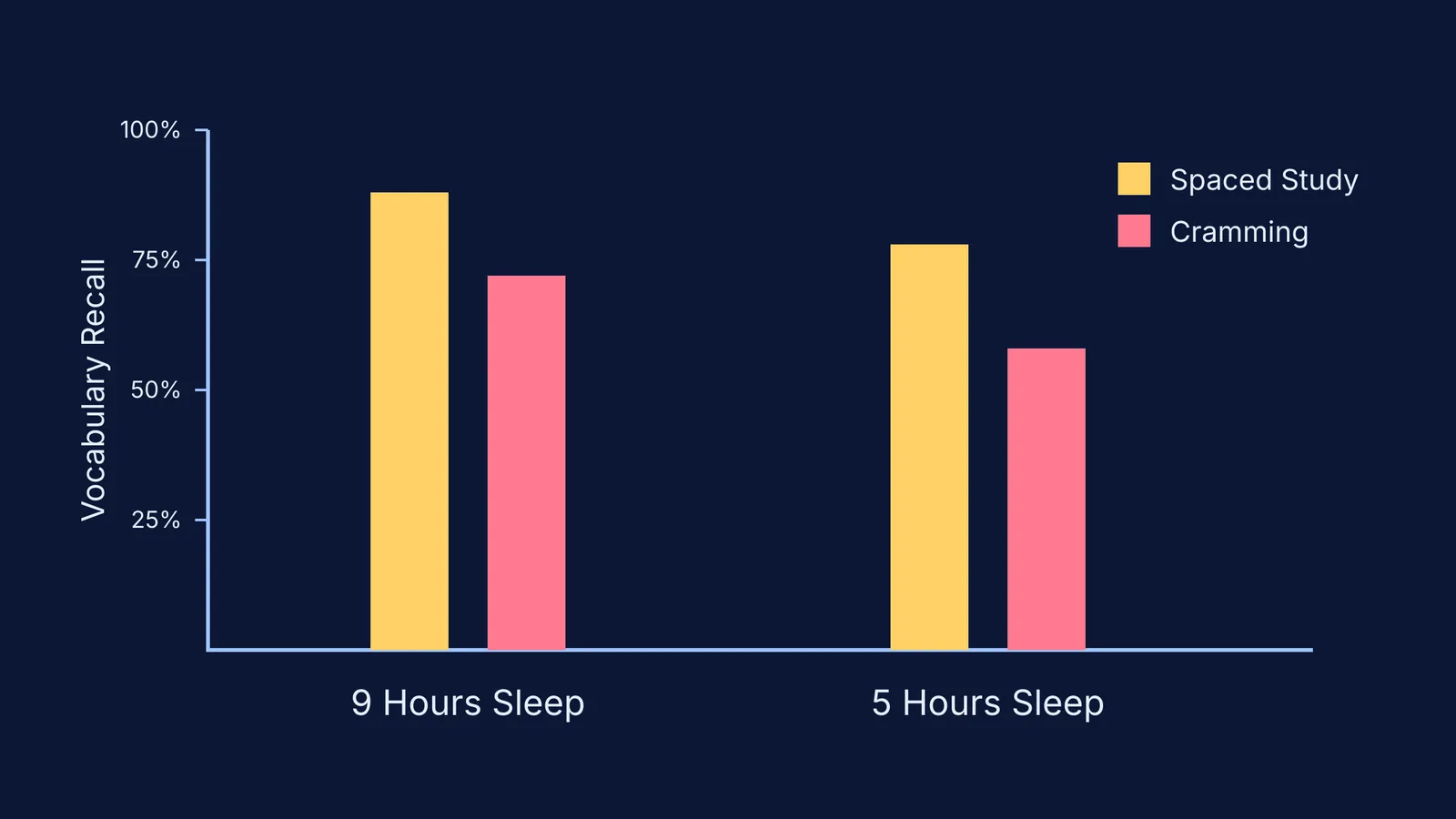
When you cut sleep short, that transfer never finishes. In a 2016 study published in *Sleep*, researchers at the Duke-NUS Medical School tested adolescents on vocabulary learning under different sleep conditions (10.5665/sleep.6092). The students who used massed practice—cramming all the words in one session—and were restricted to five hours of sleep performed significantly worse on recall tests than those who got nine hours of sleep.
The US Centers for Disease Control and Prevention states that teenagers aged 13 to 17 need 8 to 10 hours of sleep per 24 hours to support health and memory (CDC). Dropping below this baseline does not just make a student tired; it actively erases the work they did at 1 AM.
How can students shift their study earlier?
To protect their memory, teenagers need to move their intensive work to the afternoon and evening. The same Duke-NUS study (10.5665/sleep.6092) found a powerful alternative to cramming: spacing. Students who spaced their study sessions over several days were strongly protected against sleep loss, performing well even when tired.
If your child is stuck staring at a page late at night because they do not know how to start a difficult physics question, a timely intervention earlier in the evening can help. The Fermi Problem Library has worked problems with a step-by-step solver that explains the reasoning rather than printing an answer. Using this during normal study hours gives them a clear next step and prevents the midnight backlog.
If they struggle with knowing what to tackle first, Fermi's AI tutor can work out what they already know and build a plan for the session, so they sit down to a clear next step. Sitting down to a mapped-out plan means they finish faster. Teaching your child to plan their time, one step at a time is a skill that outlasts any single exam.
What should a parent's lights-out talk sound like?
Telling a stressed teenager to go to sleep can trigger anxiety if they feel unprepared. The goal is to enforce the boundary firmly while validating their hard work.
Use this script when it is time to close the books:
Acknowledge the effort: "I see how hard you are working, and I know this test is important to you."
State the science: "But reading it now will not help if your brain is too tired to store it. You are pouring water into a leaky bucket."
Offer a safety net: "Let's put the books away now. Set your alarm 15 minutes earlier, and you can do a quick, fresh review of these formulas in the morning."
It is also worth looking at their natural rhythm. Knowing Morning or night study? What chronotype research says can help you decide whether a 10 PM cut-off or an 11 PM cut-off makes more sense for your child. Ultimately, the kindest thing you can do is remind them that their brain needs rest to make their hard work count.


