

On this page
Mathematics and physics often feel abstract when confined to a textbook. A household electricity bill is a piece of reality that arrives every month, packed with units, rates, percentages, and step functions. Sitting down with your teenager to decode it is not just a lesson in financial literacy; it is an active application of their science and mathematics syllabus.
Here is a step-by-step guide to turning this monthly chore into a practical learning session.
What is a unit of electricity?
Begin with the most fundamental number on the bill: the total units consumed. Ask your teenager what a "unit" actually measures.
In standard physics terms, one unit of electricity is one kilowatt-hour (kWh). It is a measure of energy, not power. If a 1000-watt appliance, like a water heater or an iron, runs for exactly one hour, it consumes one kilowatt-hour of energy. This directly ties into the electric power chapters taught in Class 10 science.
To make it concrete, have them look at the wattage of a common appliance. If a ceiling fan is rated at 75 watts, they can calculate that it would need to run for over 13 hours to consume a single unit of electricity. When students struggle to connect these textbook definitions to real-world problems, Fermi's AI tutor can help by walking them through the reasoning step by step, asking questions to check their understanding rather than just giving the final answer.
How do fixed charges differ from energy charges?
Electricity bills are split into two main components. Have your teenager locate and separate them:
Fixed charges: This is a flat monthly fee based on the sanctioned load (measured in kW) for your house. It covers the utility company's infrastructure costs, such as maintaining poles, wires, and transformers. You pay this even if you consume zero electricity.
Energy charges: This is the variable portion based strictly on the number of units you used.
You can ask them a practical question: "If we go on holiday for a month and switch off the main breaker, will our bill be zero?" The answer, they will see from the fixed charge, is no.
How does the slab system work?
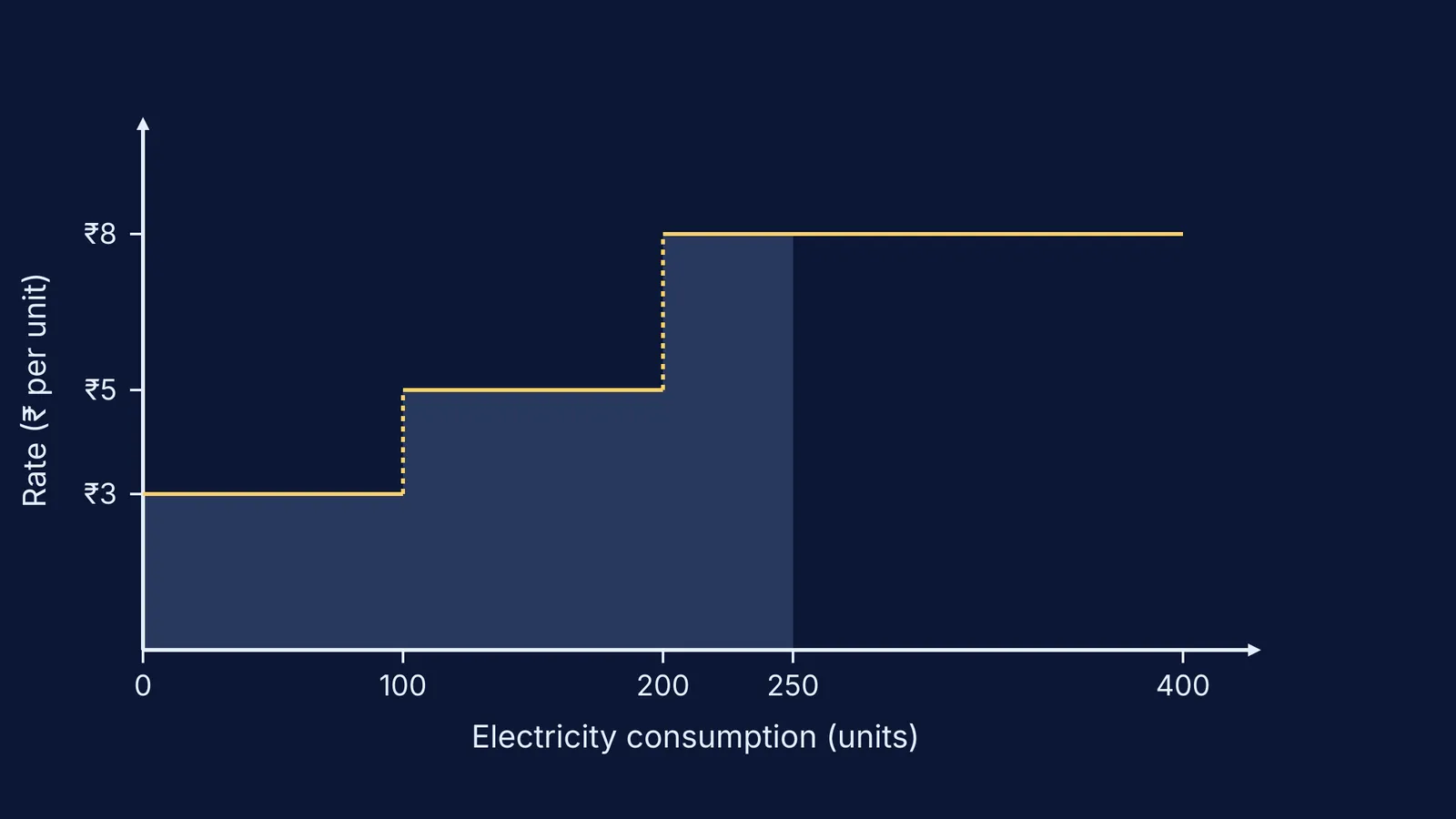
The most mathematically interesting part of a domestic bill is the step-rate tariff, commonly known as the slab system. Electricity is not priced at a flat rate. As consumption crosses certain thresholds, the rate for subsequent units increases.
According to data from NITI Aayog, the national average cost to supply electricity is approximately ₹7.10 per kWh. However, domestic billing uses slabs to subsidise low usage and charge a premium for heavy usage.
Show them the breakdown on the back of the bill. It typically looks like a step function:
The first 100 units might cost ₹3.00 each.
The next 100 units (from 101 to 200) might cost ₹5.00 each.
Any units above 200 might cost ₹8.00 each.
Have them calculate the energy charge manually for a given consumption, say 250 units. They must multiply the first 100 by 3, the next 100 by 5, and the final 50 by 8, then sum the results. This is an excellent exercise, and quadratic word problems in Class 10 often build on similar logic where rates change based on quantities.
Why are there surcharges and duties?
Finally, point out the additional lines at the bottom of the bill, such as electricity duty, fuel surcharges, or fixed municipal taxes.
These are often calculated as a percentage of the total energy charge. Ask your teenager to reverse-engineer the math: "The bill says our electricity duty is ₹45 on an energy charge of ₹900. What percentage rate are they applying?" (Answer: 5%). This reinforces basic percentage calculations and shows how taxes compound the final cost.
A practical exercise for this month
Next time the bill arrives, hand it to your teenager before you pay it and ask them to complete this quick checklist:
Find the total: How many units did we consume?
Calculate the average: What is our true cost per unit? (Divide the final payable amount by the total units. They will see that fixed charges and taxes push the real cost per unit much higher than the base slab rate).
Plan a saving: If we reduce our consumption by 50 units next month, exactly how much money will we save? (They must realise the saving comes entirely from the highest slab rate they are currently in, not the average rate).
By anchoring their mathematics in a real document, you give them a framework for both exam preparation and managing their own household in the future. Just as unit conversion using dimensions requires a structured approach, understanding a utility bill teaches a systematic way to look at numbers.


