

On this page
Many parents wait until their children are teenagers to talk about budgets, but the window for teaching financial discipline opens much earlier. A 2013 University of Cambridge report for the UK's Money Advice Service found that the cognitive and behavioural foundations for lifelong financial habits are formed by age 7. By this age, children generally understand that money is a finite resource that can be exchanged for goods, and they develop the executive functions needed to delay gratification and plan ahead. The researchers highlighted that because these habits become set so early, financial education should begin in the home well before a child starts formal schooling. Rather than teaching complex mathematics, parents should focus on fostering self-control and persistence—two habits essential for long-term academic and financial success.
However, young children struggle with abstract concepts like "saving for the future." To a six-year-old, waiting a month for a toy feels like an eternity. To bridge this gap, you have to make the abstract process of saving visual and immediate.
Why use a visual savings chart?
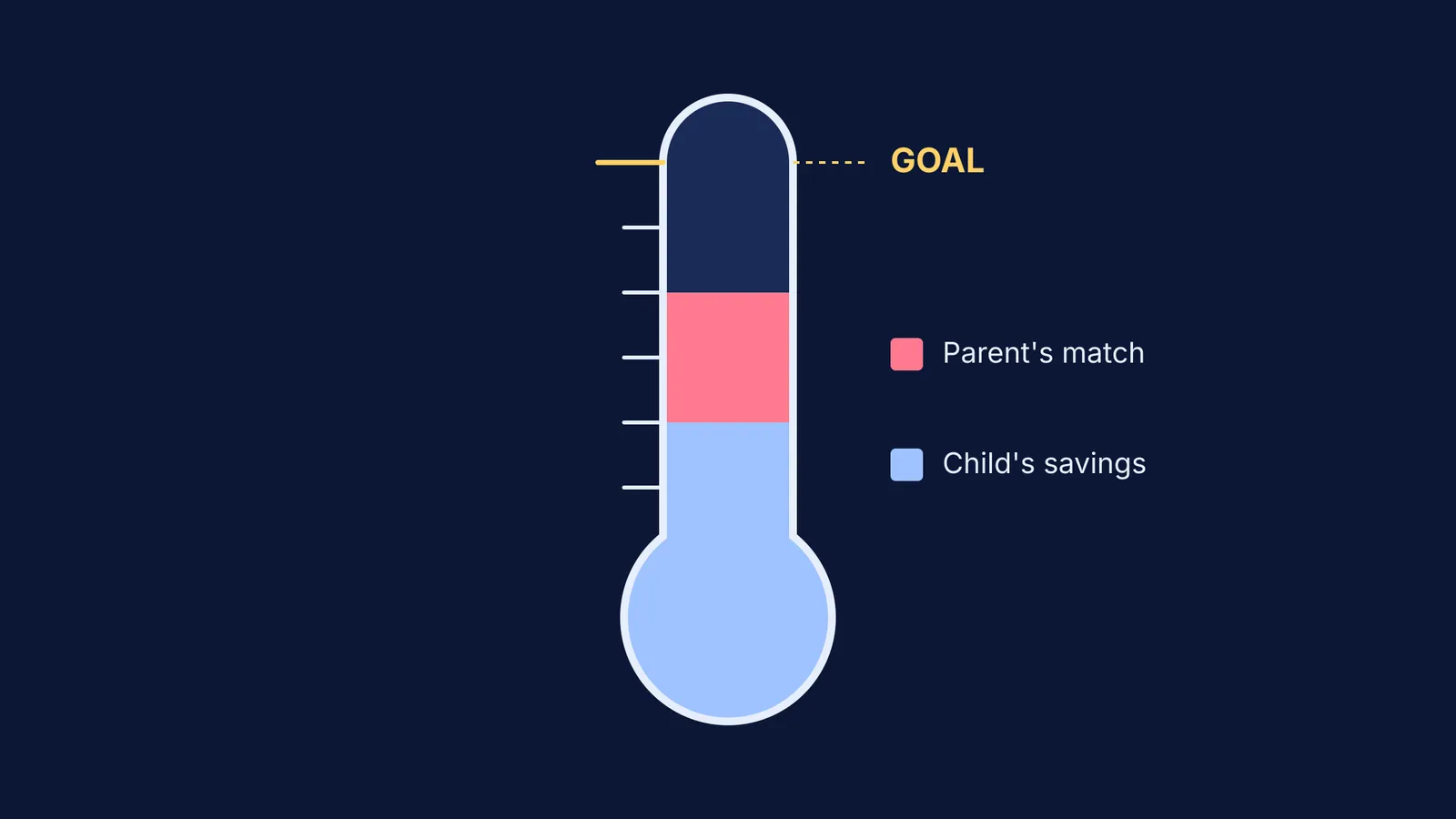
A visual progress tracker—like a drawn thermometer or a stepped bar chart—gives immediate feedback. When a child colours in a block on their chart, they get a small burst of dopamine and a tangible sense of progress, even if the actual purchase is still weeks away.
This mirrors how effective learning tools work. Just as Fermi's AI tutor builds a plan for the session so a student knows exactly what to tackle next, a visual chart breaks a large financial goal into clear next steps. Instead of staring at an empty piggy bank, the child sees exactly how much further they have to go.
How do matching contributions build the habit?
Adults save more when their employer matches their pension contributions. The same principle works for children, as visible incentives encourage both parents and children to engage with the process. The SEED for Oklahoma Kids (SEED OK) experiment by Washington University in St. Louis found that offering initial deposits and matching incentives dramatically increased engagement; 16% of families in the incentive group opened participant-owned college savings accounts, compared to just 1% in the control group. Furthermore, the study noted that children in the treatment group scored better on measures of social-emotional development, and their mothers reported higher educational expectations for their future.
You can adapt this approach for a child's short-term goal by offering a 1:1 match. If the goal is a ₹1,000 toy, the child only needs to save ₹500 from their pocket money or chores, and you provide the remaining ₹500 as they go.
What is a step-by-step plan for your child's first goal?
Follow these four steps to set up a visual saving plan:
Pick a clear, reachable goal. Let the child choose the toy, book or game. For children under 10, the goal should be reachable within four to six weeks. Print a picture of the item and stick it next to the chart.
Draw the chart together. Use paper and markers. If the child needs to save ₹500 over five weeks (with a ₹500 parent match), draw ten blocks of ₹100.
Colour it in immediately. Whenever they deposit money into their jar, have them colour in their block, and immediately colour in your matching block beside it. This shows them that their effort doubles its impact.
Celebrate the process, not just the purchase. When they reach the goal, praise the patience and discipline it took to wait. As you would when praising effort over ability in schoolwork, focus on the habit they built.
Teaching a child to plan their time and money step by step, much like teaching your child to plan their time, is a skill that compounds. The toy they buy today will eventually be forgotten, but the habit of delaying gratification will last a lifetime.


