

On this page
Long summer breaks offer a rare chance for school students to step out of the classroom and see how real science is done. National institutes across India run fully funded summer outreach programmes to catch scientific talent early, moving beyond textbook formulas to hands-on experiments, telescope viewings, and lab tours.
Whether your child is in middle school or entering their final year, there is likely a state or central initiative designed for them.
What are the types of summer science programmes for school students?
Government-funded institutes run the most established outreach camps in India. These generally fall into the following categories:
Subject-specific research camps: Programmes like PROMYS India, hosted at the Indian Institute of Science (IISc) Bengaluru, are deep dives into a single subject. The six-week residential programme in Mathematics is open to students in Classes 9 to 12 and focuses on number theory. It is highly selective, taking fewer than 40 students each year from across the country.
Exposure and familiarisation camps: The ISRO YUVIKA (Young Scientist Programme) invites Class 9 students for a two-week residential stint at space centres across India. In 2024, 350 students were selected based on their Class 8 marks, online quizzes, and extracurricular activities. The Department of Science and Technology (DST) also runs the five-day INSPIRE Internship Science Camp for Class 11 students, which is fully funded and open strictly to those who rank in the top 1% of their Class 10 board exams. (If you are looking for long-term fellowships, you might also want to check the options that replaced KVPY.)
Scientist-student connect initiatives: The CSIR Jigyasa programme connects students in Classes 6 to 12 with Council of Scientific and Industrial Research laboratories. Students can attend day camps, participate in "Student Apprentice" modules at local labs, or use the CSIR Virtual Lab, developed with IIT Bombay, to simulate experiments at home. These are often coordinated through schools, much like the Vidyarthi Vigyan Manthan talent search.
What do students do at a summer research programme?
These programmes are built to show students what a career in research actually looks like, which can be valuable long before they consider IISc BS (Research) admission.
Instead of memorising facts for a test, students spend their days in functional laboratories. At an INSPIRE camp, a Class 11 student might extract DNA, observe electron microscopes in action, or sit in on lectures by global science leaders and Nobel Laureates. In the PROMYS India programme, participants spend their days solving highly challenging mathematical problem sets, building their own proofs rather than applying known formulas.
When students face these rigorous problem sets, they often hit roadblocks their school syllabus did not prepare them for. Fermi's AI tutor can work out what they already know, build a plan for the session, and teach through it by explaining the reasoning rather than printing an answer. If they return from a camp eager to learn more, the Concept Library holds a lesson for every concept in physics, chemistry, biology, and mathematics.
How to check a science camp before applying?
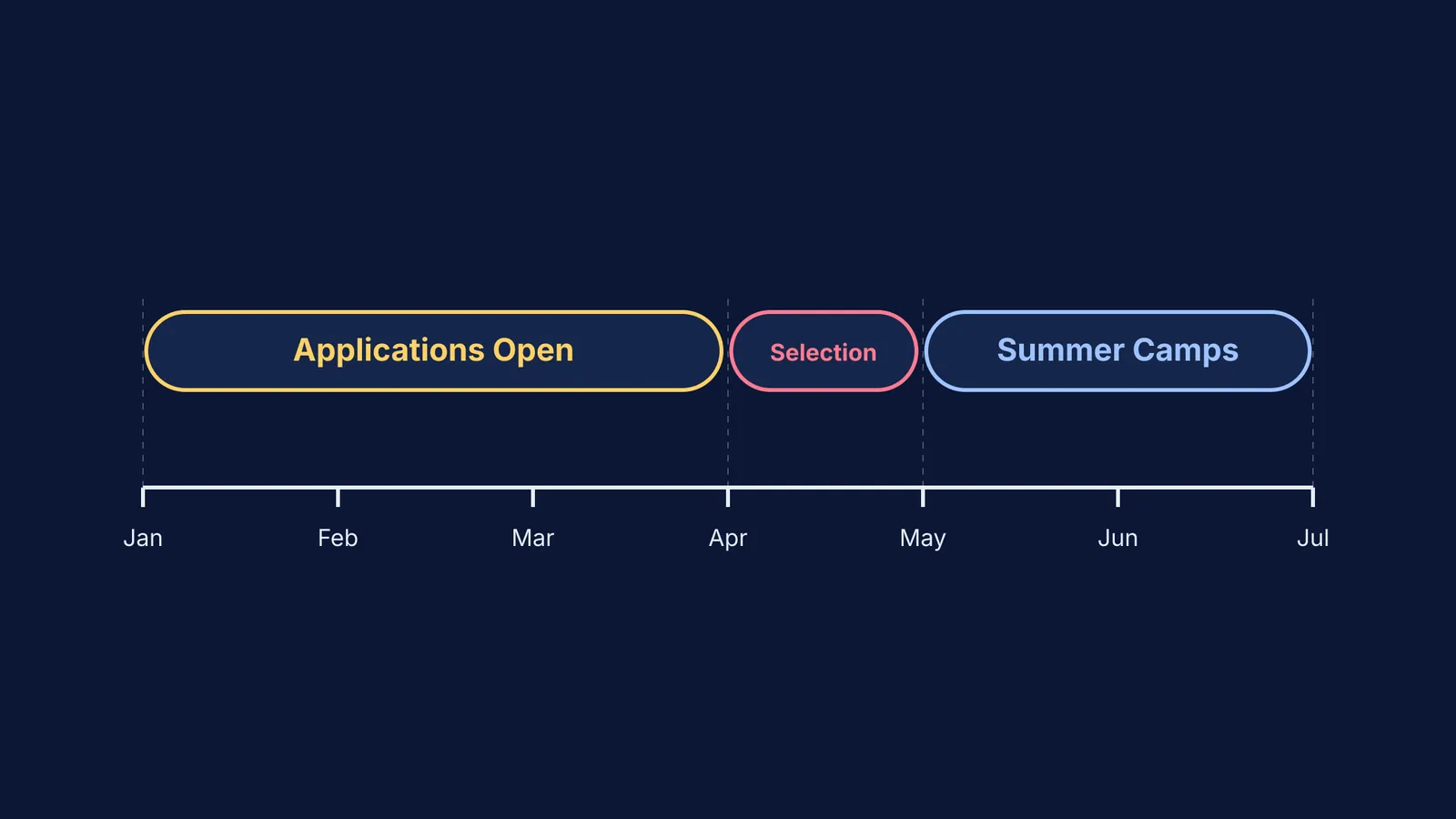
The application window for most national summer programmes, including YUVIKA, opens between January and March. Before you encourage your child to fill out an application, use this checklist to evaluate the programme:
Verify the costs and funding: Authentic government programmes like YUVIKA, PROMYS India, and INSPIRE are entirely free of charge for selected students. They cover tuition, boarding, and often reimburse train travel. Be cautious of private "science camps" that charge heavy registration or tuition fees while promising certificates.
Check the eligibility criteria early: Programmes are rigid about age and academic qualifications. YUVIKA is strictly for students who will be in Class 9 as of January 1 of the application year, while INSPIRE camps require the student to be in Class 11 and possess a certificate proving their top 1% board ranking.
Assess the time commitment: Ensure the dates do not clash with the school's reopening or crucial coaching classes. A six-week residential camp like PROMYS requires significant dedication and stamina, whereas a five-day INSPIRE camp is easier to fit into a busy summer schedule.
By matching the right programme to your child's interests and schedule, you can give them a practical, inspiring introduction to the scientific world.


