

On this page
When sitting down to read or solve problems, the light in the room plays an invisible but critical role. Poor lighting causes the eye's focusing muscles to work harder—much like adjusting a camera to maintain the minimum distance between an object and its real image—leading to fatigue, headaches and a shorter attention span.
What kind of study lamp is good for a child?
The brightness of light arriving at a surface is measured in lux. Standard guidelines, such as those discussed by the Illuminating Engineering Society, recommend between 300 and 500 lux for reading and study areas.
This intensity ensures that the contrast between the ink and the paper is high enough to read without squinting. For detailed or prolonged study, the higher end of that range—500 lux—is often preferred.
Why is ceiling light alone not enough?
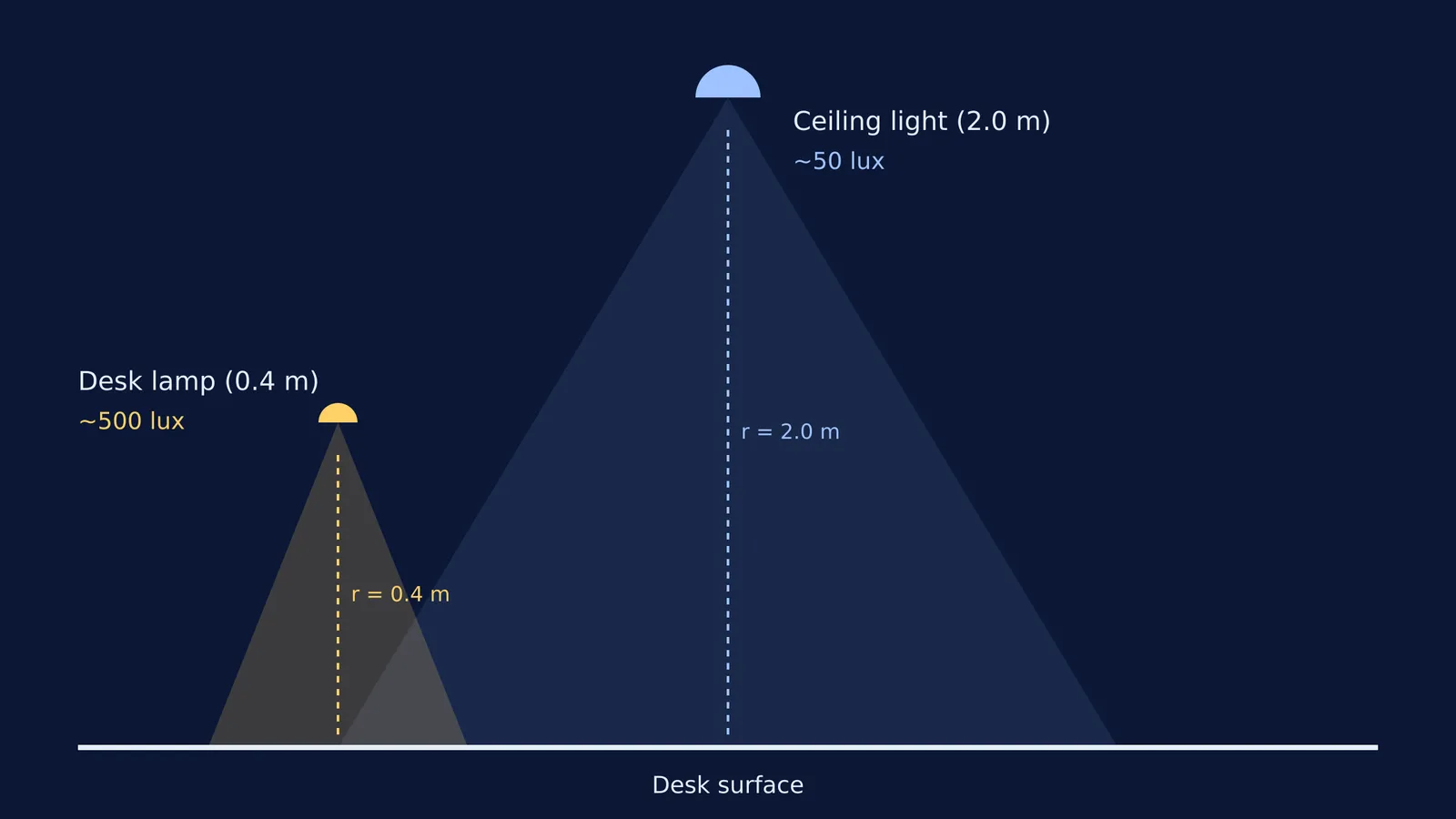
You might wonder why a desk lamp is necessary if the room already has a central light. A typical family living room with a ceiling fixture provides about 50 lux of illumination. Because light drops off dramatically with distance, a ceiling bulb two metres away delivers far less light to the desk than a small lamp placed 40 centimetres above the page.
To reach the recommended 500 lux, a dedicated task light is almost always required. When a student sits down with the Fermi Problem Library to work through physics or mathematics, the step-by-step solver explains the reasoning rather than printing an answer. Good desk lighting ensures they can read their own working out just as clearly.
How to position a study lamp to prevent glare?
Even a bright lamp can cause problems if it creates glare or shadows. Direct glare happens when the bulb shines straight into the child's eyes, while reflected glare occurs when light bounces off a glossy textbook page.
To prevent glare, choose a lamp with an opaque shade that hides the bulb from view. Position the lamp head about 40 to 50 centimetres above the desk surface, angled downwards.
Crucially, place the lamp on the side opposite to the child's dominant hand. If they write with their right hand, the lamp should sit on the left side of the desk. This ensures that their own hand and pen do not cast shadows over the words they are trying to read.
What is the best colour temperature for studying?
Just as students learn about the dispersion of white light by a glass prism, different light sources emit different blends of wavelengths, rated by their colour temperature in kelvin (K). While a lower temperature around 3000 K produces a warm, relaxing light typical of living spaces, it is not ideal for active learning.
For environments like schools and offices, a cooler light with a higher colour temperature—typically 5000 K to 6500 K—is recommended to enhance concentration and productivity. Bulbs in this range are often labelled "cool white" or "daylight". If a concept is hard to picture from a textbook, the Fermi Simulation Lab provides interactive simulations for the ideas that are easier to see than to read. Pairing this visual learning with a 5000 K task light helps keep the brain alert during an evening study session.
Does dim light cause myopia?
A major concern for parents is whether reading in the dark damages a child's eyes. Modern research shows that spending time indoors, under typical artificial lighting, is a significant risk factor for the development of myopia (nearsightedness).
The most effective method for preventing the onset of myopia is spending time outdoors in natural light. Health experts recommend at least 2 hours of outdoor time per day, which has been shown to reduce the risk of myopia by approximately 50%. The protective effect is linked to the sheer intensity of daylight—which often exceeds 10,000 lux—stimulating the release of retinal dopamine, a chemical that stops the eyeball from growing too long.
While a 500 lux study lamp makes reading comfortable and prevents short-term eye strain, no indoor bulb can replace the intense, natural light of the sun. The best lighting setup is a combination of a bright, well-positioned desk lamp for evening work and plenty of outdoor time during the day to ensure both comfortable reading and long-term visual health.


