

On this page
A board exam year on your own is a lot to carry: the job, the house, the money, and a Class 10 or Class 12 student who needs you steady. You do not have to be the only person holding it up, and your child needs less teaching from you than you might fear.
Why does sharing the load matter so much?
In a 2022 study of 200 single mothers, Xiang Zhou and Zoe Taylor of Purdue University found that support from family and from friends both went with more help with parenting, but only support from friends was linked to fewer symptoms of distress, such as anxiety and low mood. Mothers who were widely connected, with both family and friends, had the best outcomes. Those who relied only on relatives, or who were socially isolated, faced their own risks.
It was a 2019 survey of mothers in one US Midwest state, so it shows a link, not proof, and many Indian families lean on relatives more. The practical point still travels: widen the circle. A neighbour, a colleague, another parent from your child's class or an old school friend can each take one small, specific job.
What does your child need from you during board exams?
A 2009 meta-analysis of 50 studies by Nancy Hill and Diana Tyson found that parental involvement in middle school was positively linked with achievement, with one exception: helping with homework. The kind with the strongest link was what they called academic socialization, which covers talking about goals, expectations, learning strategies and plans for the future.
Those studies were of younger teenagers, but the lesson fits a board year. You do not need to re-learn trigonometry or organic chemistry. You need to ask good questions, keep the week steady and talk about what comes after the exam.
Try a three-question check-in at dinner:
"What did you finish today, and what is left for this week?"
"Which topic feels shakiest, and what is your plan for it?"
"Is there anything I can take off your plate?"
When your child is stuck on a numerical at 10 pm and nobody is awake to ask, the Fermi Problem Library has worked problems with a step-by-step solver that explains the reasoning rather than printing an answer.
What does a simple weekly plan look like?
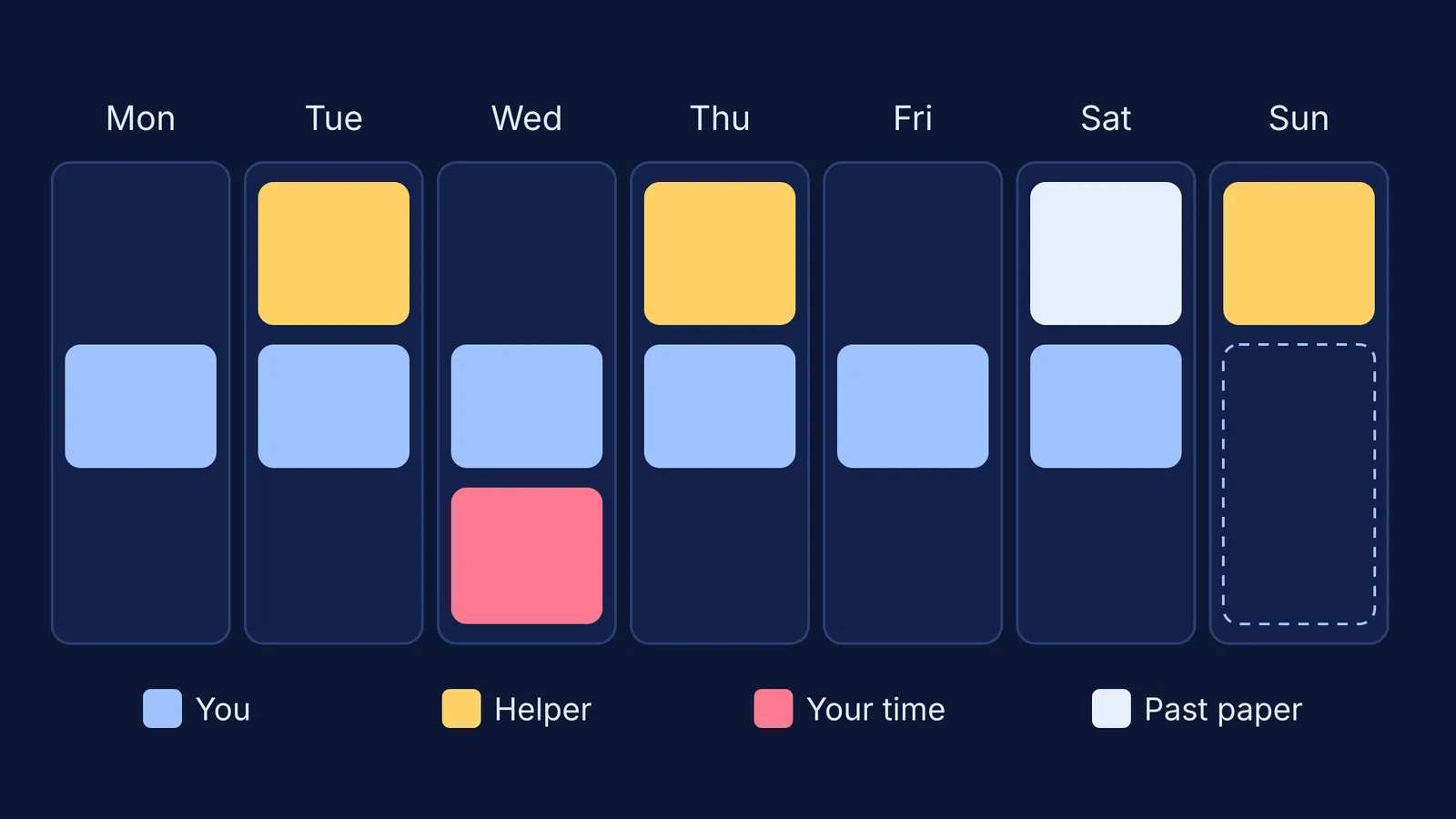
Here is a plan for a parent who works full-time. Move the days around to fit your shifts.
Monday to Friday, dinner: the three-question check-in. No talk about marks late at night.
Tuesday and Thursday: helper days. One person covers one job, such as sending dinner, doing a tuition pickup or quizzing your child from their flashcards.
Wednesday evening: your time. A walk, a call with a friend or an early night, saved in your phone like a meeting.
Saturday morning: your child sits one full sample or past paper at real exam timing while you run errands.
Saturday afternoon: sit together for half an hour on the paper's mistakes and next week's topics.
Sunday: cook for the next few days, ideally with a helper, and keep the evening free for the whole household.
How do I ask family and friends for help?
People often offer help vaguely and mean it. Turn the offer into one job, on one day, with an end date. You could say:
"The board exams are a few months away and it's just me at home. Could you take Thursday dinners until the exams finish? That one evening would really help."
On your child's side, an older cousin who took the same exam can be a calm voice for a short weekly call, as long as nobody compares marks. If younger children are at home too, our plan for board exams with siblings at home shows how to divide the jobs.
How do I keep my own energy up?
Looking after yourself is part of the plan, not time stolen from it.
Protect sleep for both of you. Our guide to how much sleep teenagers need covers your child's side.
Keep one adult conversation a week that is not about the exam.
Lower other standards for a few months: simpler meals, fewer visits, a messier house.
Watch for your own warning signs, such as snapping, poor sleep or dreading the evenings.
If stress is building for you or your child, this guide to exam stress and when to get help lists the signs worth acting on. The government's Tele MANAS service runs a 24x7 toll-free tele-mental health line, 14416, which you can call for yourself as well as for your teenager. In the 2026 exam season, CBSE also ran free counselling in Hindi and English for Class 10 and 12 students and their parents; check the CBSE website to see whether it runs again for your child's exams.
This week, make one ask: one job, one person, one day.


