

On this page
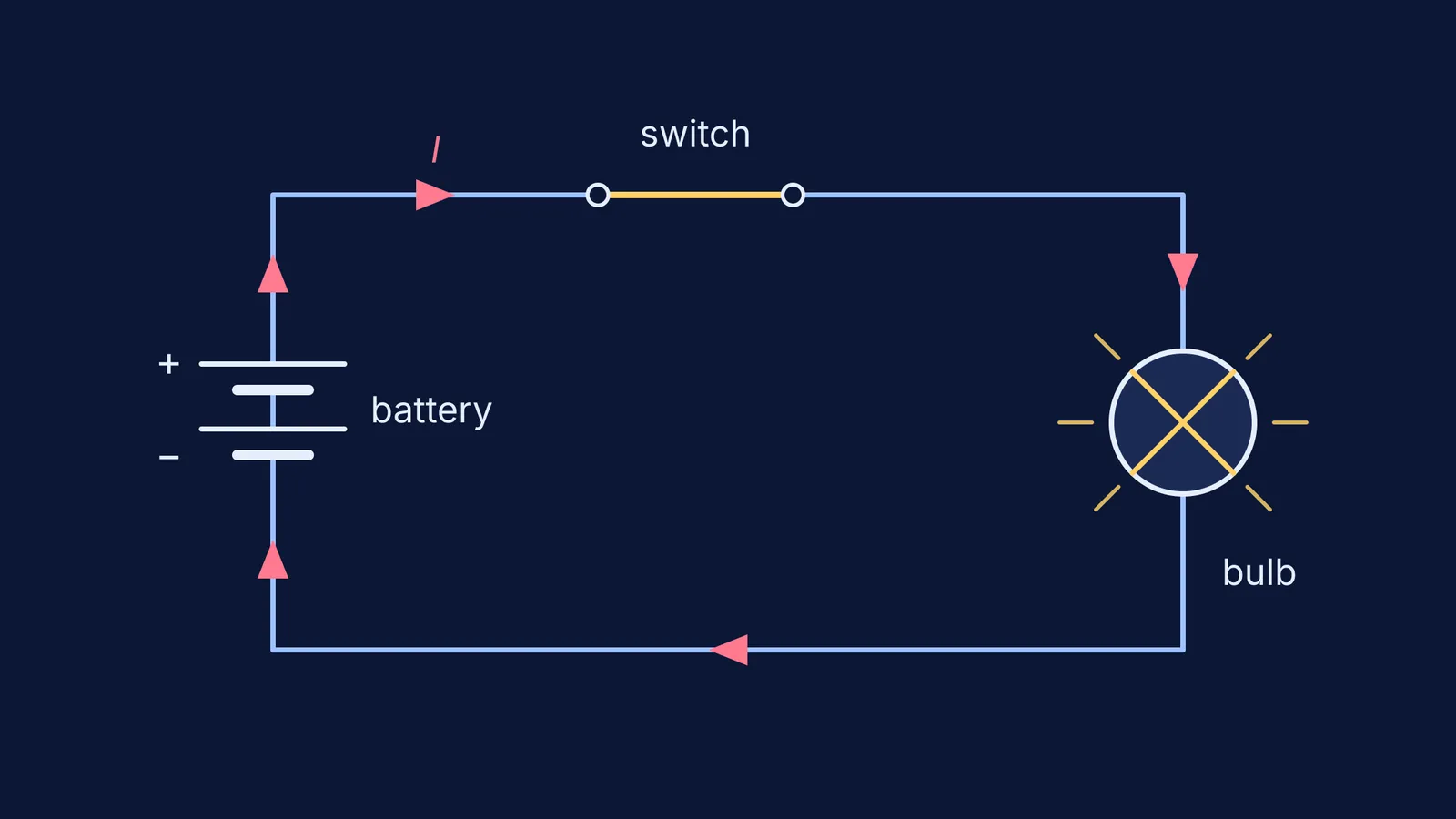
A torch is a battery, a bulb, a switch and some wire. Take one apart with your child and you have the whole idea of an electric circuit: a closed loop that lets current flow out of one end of the battery, through the bulb and back into the other. The four projects below use the same parts and suit ages 8 to 13, with an adult close by for younger children.
What safety rules should you agree before starting?
An AA cell has a nominal voltage of 1.5 volts, according to Energizer's AA product datasheet. Household mains supply in India is 230 volts at 50 Hz (IEEE RO-MAN 2019 guide), about 150 times one AA cell.
Read this agreement aloud before any wire comes out:
We only use batteries. No sockets, plugs, chargers or appliances, ever.
We never join the two ends of a battery with just a wire. That is a short circuit, and the wire gets hot.
We tape over the terminals of 9-volt batteries when they are not in use and store them away from coins, keys and paper clips.
Button and coin cells stay in the parts box, and the box stays out of reach of younger brothers and sisters.
We never open a battery or use phone batteries.
If anything gets hot or smells, we unclip the battery and call an adult.
Rule 2 makes a good first circuit sum. The same Energizer datasheet gives a fresh AA cell an internal resistance of 150 to 300 milliohms. With only a wire in the loop, Ohm's law (I = V/R) gives a rough upper estimate of 1.5 V ÷ 0.3 ohms = 5 amps, or 10 amps at 0.15 ohms. The datasheet's portable-lighting test uses a 3.9-ohm load, which draws about 0.4 amps. A short circuit can push over ten times that through a thin wire, as heat.
Rule 3 comes from the Colorado Springs Fire Department: a 9-volt battery's posts sit close together, so a stray metal object can short them and start a fire.
Rule 4 matters most with a toddler at home. A 2024 review in World Journal of Pediatrics pooled 439 children with complications from swallowed or inserted button batteries; their median age was 1.75 years, and exposure longer than six hours was among the factors linked to severe complications (Tran and colleagues, 2024). "Once a child has swallowed a button battery, it becomes a race against time since injury can occur within a couple of hours," said Dr Carlos Nunez, one of the authors, in a University of Sydney release. If you suspect one has been swallowed, go to a hospital straight away.
Which circuit projects suit ages 8 to 13?
The paper-clip switch (8 and up). Push two drawing pins into cardboard, hook a paper clip round one, and wire both pins into a loop with the battery and bulb. Swing the clip onto the second pin and the bulb lights. A switch is just a gap you control.
The conductor tester (8 and up). Leave a gap in the loop between two crocodile clips and touch them to a spoon, a coin, an eraser, a plastic ruler and a pencil lead. Have your child predict each one first. Metals conduct; plastic, rubber and dry wood do not. Pencil lead is graphite, which conducts, though the bulb may only glow dimly.
Series and parallel bulbs (10 and up). Wire two bulbs one after the other (series), then on two separate branches (parallel). Compare the brightness, then unscrew one bulb in each set. In series the bulbs share one path, so both are dimmer and both go out when one is removed. In parallel each bulb has its own path, so the other stays lit, which is why home lights are wired in parallel.
The steady-hand game (11 to 13). Bend bare wire into a wavy track fixed into a cardboard base, with a small wire loop threaded on as the wand. Connect battery, buzzer, track and wand in one loop. Touch the track and the buzzer sounds. Any conductor can complete a circuit. Swap the buzzer for an LED with a small resistor in series and your child will find it lights only one way round.
How do you turn a project into real understanding?
Ask before you explain. Three prompts work for every build:
Predict: What will happen when you close the switch?
Observe: Was it what you expected?
Explain: Draw the circuit and show me where the current goes.
Drawing the circuit is the bridge to school science; our guide to electricity and circuits in Class 7 picks up from there. For more home builds, try these kitchen science experiments, and read our piece on encouraging curiosity in children.
When a question outruns your parts box, the Fermi Simulation Lab has interactive simulations for ideas that are easier to see than to read. Start with the paper-clip switch this weekend.


