

On this page
Choosing the science stream in Class 11 often triggers a race to enroll in expensive private tuition. The pressure is undeniable, but it raises a critical question for parents and students: is a "shadow education" strictly necessary, or can a student thrive through self-study?
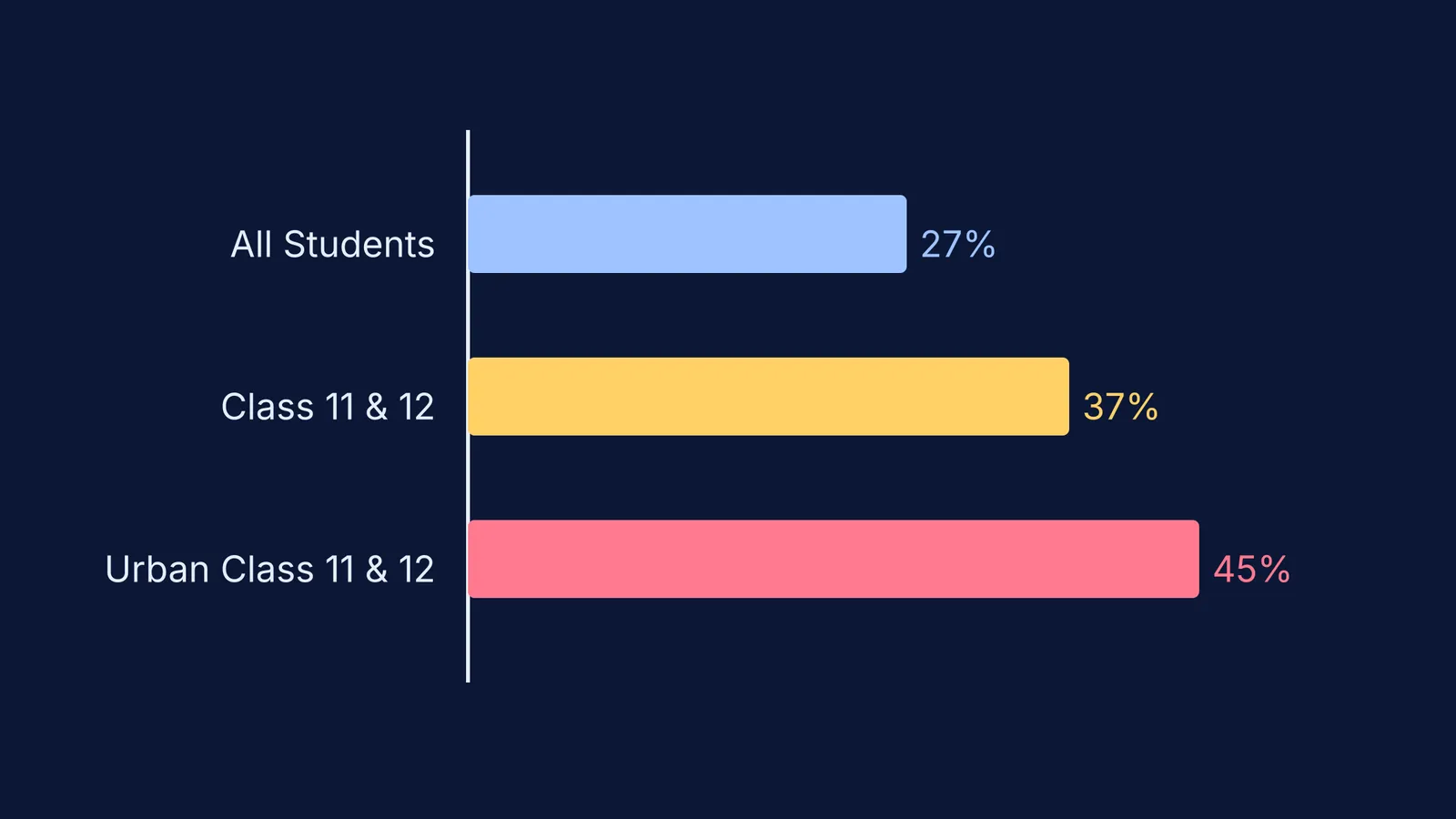
The data shows a growing reliance on external help. According to the 2025 Comprehensive Modular Survey by the National Statistical Office (NSO), roughly 27% of all school students in India take private coaching. This number jumps to 37% for students in higher secondary education (Classes 11 and 12), and reaches nearly 45% in urban areas. Similarly, the 2023 ASER "Beyond Basics" report found that 31.7% of youth aged 14–18 are enrolled in the STEM stream, where the culture of parallel schooling is most intense.
Despite these numbers, relying solely on school and self-study is not only possible but often leads to deep, resilient learning.
Can a child take science without coaching classes?
The short answer is yes. For school board examinations, thorough engagement with the prescribed textbooks and classroom instruction is entirely sufficient. The National Council of Educational Research and Training (NCERT) designs its curriculum to promote holistic understanding rather than rote memorisation—a focus that coaching institutes sometimes bypass in favour of exam-cracking shortcuts.
If a student's primary goal is to perform well in their Class 12 board exams and pursue undergraduate degrees in basic sciences, liberal arts, or non-competitive technical fields, private coaching is an unnecessary financial and mental burden. A well-planned revision schedule, like a six-week Class 10 science revision plan, scales perfectly to senior secondary physics, chemistry, and biology.
What does effective self-study look like?
Self-study is not just doing homework; it is the active process of struggling with and internalising concepts. Research by the OECD (Programme for International Student Assessment) shows that spending up to two hours per day on independent homework is positively associated with higher scores in mathematics and science. However, the OECD also warns that excessive out-of-school study hours can lead to diminishing returns, increasing anxiety without proportionally raising academic achievement.
For high-stakes preparation, consistency beats volume. A student putting in 4 to 6 hours of focused, undistracted independent study per week per subject will generally build a stronger conceptual foundation than one sitting passively in a lecture hall for 15 hours a week.
When does study coaching actually add value?
Coaching becomes a practical consideration primarily when a student is targeting highly competitive entrance examinations like the JEE (engineering) or NEET (medicine), where the syllabus depth and time pressure extend significantly beyond standard school board requirements.
Even in these extreme environments, independent, self-directed learning is the critical factor for success. While many candidates historically succeeded entirely through self-study, the current landscape has shifted. Today, many top rankers adopt a hybrid approach. They use coaching not to learn the baseline physics or chemistry from scratch, but to gain access to a structured testing schedule, competitive benchmarking against peers, and immediate doubt resolution on complex problems.
If your child hits a wall while studying independently, Fermi's AI tutor can work out what they already know, build a plan for the session, and teach through it — writing on a board, drawing the figure, running the simulation, and checking understanding as it goes. They can also explore the Fermi Concept Library, which holds every concept in physics, chemistry, biology, mathematics, and computing, each with its own lesson and its place in the map.
A framework for skipping coaching
If you and your child decide to navigate the science stream independently—perhaps after carefully choosing a stream after Class 10—success depends on planning.
Anchor to the syllabus: Treat the NCERT or state board textbook as the ultimate authority. Read it line by line before seeking out reference books.
Build a weekly rhythm: Allocate specific days for specific subjects. For example, physics on Mondays and Thursdays, chemistry on Tuesdays and Fridays.
Use active recall: Passive reading creates a false sense of security. Students should close the book and attempt to explain the concept out loud or solve problems from scratch.
Test regularly: Gather previous years' question papers. Every Sunday, simulate exam conditions for three hours. This builds stamina and exposes knowledge gaps.
Curate doubt-solving tools: When self-study reaches its limit, use school teachers during free periods, peer study groups, or intelligent digital platforms to get un-stuck quickly.
The science stream is demanding, but it does not mandate a parallel schooling system. With discipline, the right tools, and an active approach to learning, students can excel on their own terms.


