

On this page
Moving back to India means transitioning your child to a new education system. The scale of the system is vast, with over 1.48 million recognised schools across the country as of the UDISE+ database. While finding a school is rarely an issue, navigating the paperwork for a foreign transfer can be.
If your child is in primary or middle school (up to Class 8), schools generally conduct their own baseline tests for English, mathematics and science. The main requirement is a valid Transfer Certificate (TC). However, if your child is entering high school, strict board registration rules apply.
How does admission in India after studying abroad work?
The process depends entirely on the curriculum your child studied abroad and the class they are entering in India. If you are shifting from an Indian-curriculum school in the Middle East or Singapore, the transition is smooth because the board remains the same.
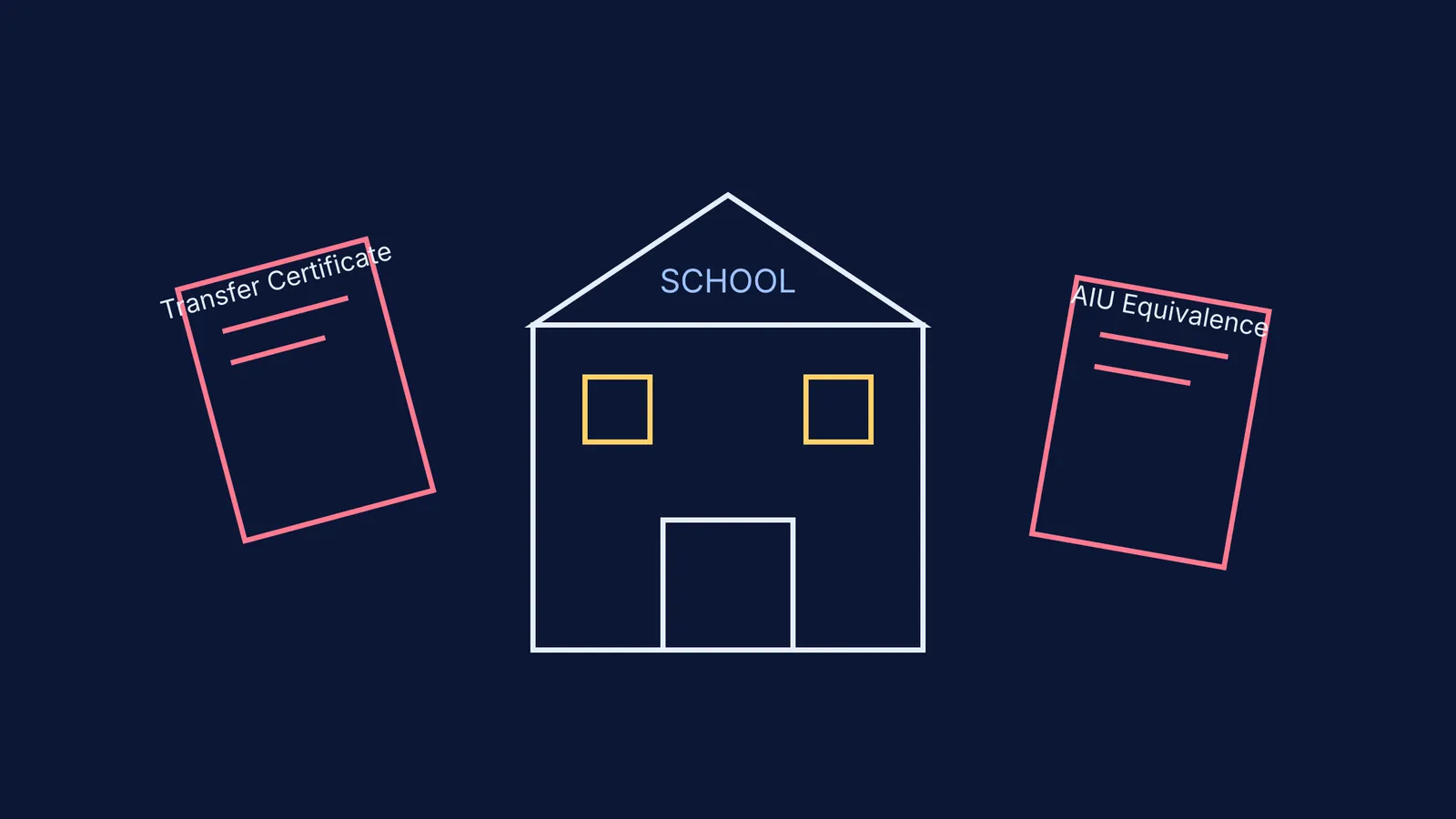
If your child studied in an international system—such as the American High School Diploma, Cambridge IGCSE, or the International Baccalaureate (IB)—the new Indian school will need to verify that their previous education maps to the Indian system. For most high schools, this means applying for formal equivalence and ensuring your transfer documents are authenticated by the Indian embassy in the country you are leaving.
Do you need an AIU equivalence certificate for school?
Yes, in many cases. The Association of Indian Universities (AIU) is the sole body in India authorised to grant academic equivalence for foreign qualifications source.
If your child has completed Class 10 or 12 under a foreign board, they will likely need an AIU Equivalence Certificate to proceed with further education or competitive exams in India. AIU grants equivalence based on specific criteria, primarily requiring that the foreign system prescribes a minimum of 12 years of regular schooling source. The processing fee for this certificate is approximately ₹14,160 source.
Students who studied at CBSE or ICSE schools abroad do not need this certificate, as their qualifications are already Indian.
Can a student get direct admission in Class 10 or 12 in CBSE?
Direct admission to CBSE Class 10 and Class 12 is treated as an exception rather than a rule. CBSE considers Classes 9 and 10, and Classes 11 and 12, as integrated courses spanning two years CBSE rules. However, the board permits direct admission midway for students whose families are relocating.
The standard deadline for schools to process direct admissions in CBSE is August 31 CBSE rules. Schools must submit these cases to the CBSE Regional Office for approval. To be eligible to sit for the board examinations, the student must maintain at least 75% attendance in the new school CBSE rules.
If you are aiming for engineering entrance exams later, you must also keep an eye on eligibility criteria JoSAA. For instance, you should understand the 75 percent board marks rule for NIT and IIIT admission, which applies regardless of where you completed your early schooling. Furthermore, as the board evolves, familiarise yourself with how the CBSE Class 10 two board exams system works.
How do returning NRI students adjust to the Indian system?
Transitioning to an Indian classroom is often a culture shock for students used to western pedagogies. Indian schools tend to place a heavier emphasis on theoretical knowledge, rigorous testing, and competitive ranking.
Students returning in high school must rapidly adapt to the demands of board exams and, frequently, parallel preparation for national entrance tests. This shift requires a change in study habits. Establishing a structured daily routine early is critical to managing this increased academic pressure without burning out.
A mid-year move often means a student has missed months of the Indian curriculum. Catching up on a different syllabus while adjusting to a new city can be overwhelming. Fermi's AI tutor can work out what they already know and build a plan for the session, teaching through it by writing on a board so the student can bridge the gap at their own pace.
Checklist: What documents to bring from your foreign school?
Do not leave your current country without securing the following paperwork:
Countersigned Transfer Certificate: The TC must be issued by the previous school and countersigned by the appropriate educational authority or the Indian Embassy in that country.
Academic Transcripts: Bring original mark sheets or report cards for recent years of schooling.
Migration Certificate: This must be issued by the foreign board if your child is changing boards for Class 11 or 12.
Proof of Relocation: Keep a copy of the parent’s job transfer order or a registered rent agreement in India.
Passport and Visa: You will need copies of the student’s passport and entry/exit stamps to verify the duration of their stay abroad.


