

On this page
Many parents wonder how to tell if their child is getting a good education. Test scores only tell part of the story, and you cannot sit in the classroom every day. In India, there is immense pressure to find the right private school, with many relying heavily on a school's reputation or past board results. However, those metrics reflect previous years, not what your child is experiencing today.
But there are visible signs of teaching quality that come home in your child's bag every afternoon. By looking closely at notebooks, homework assignments and the way your child talks about class, you can get a clear picture of what happens during the school day.
How to judge teaching quality in a school?
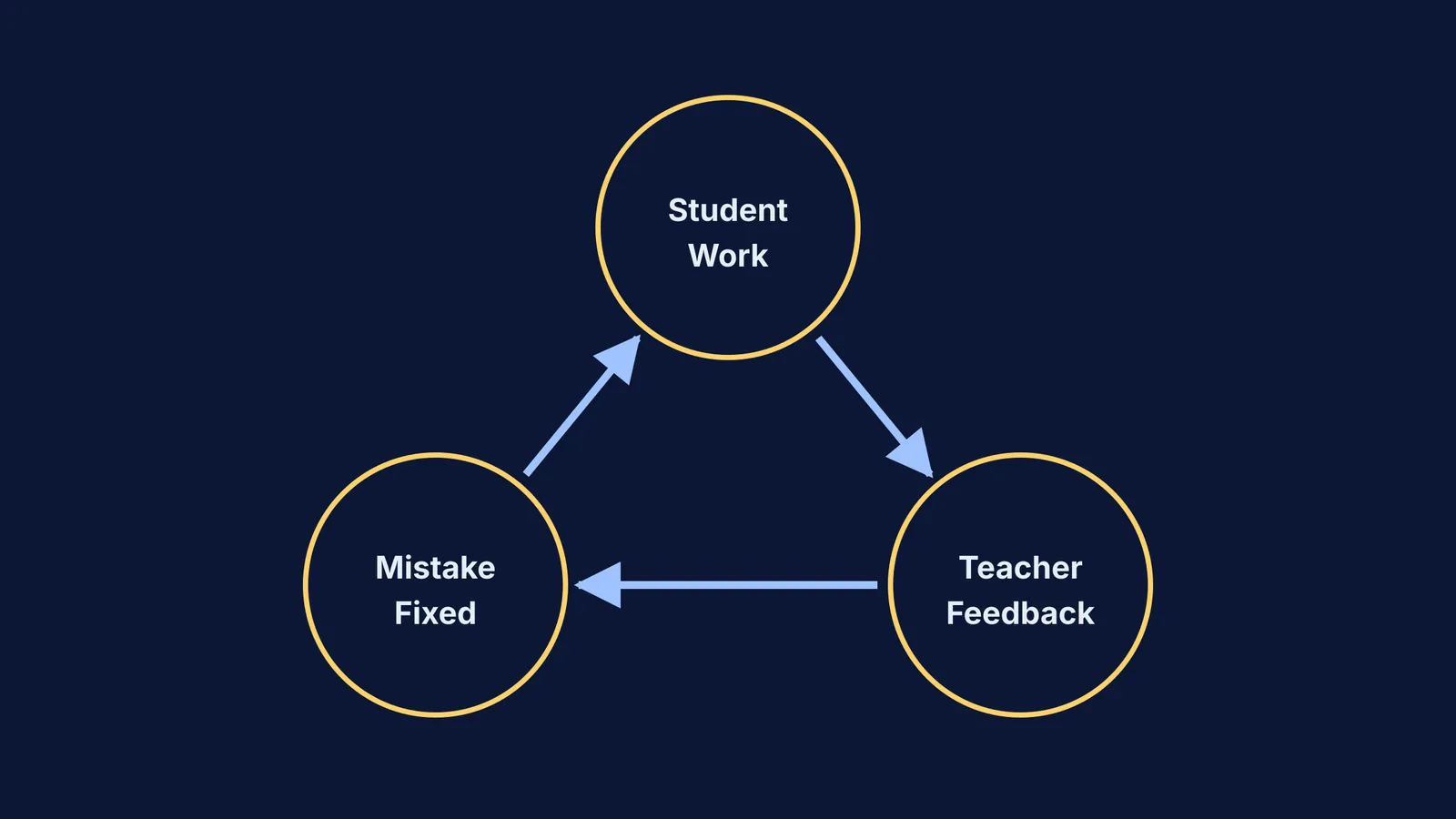
The most powerful indicator of teaching quality is not the amount of work assigned, but the quality of feedback the teacher provides. Educational researcher John Hattie's meta-analysis of tens of thousands of studies found that effective feedback has a large effect size of 0.73 (Visible Learning), which can nearly double the normal speed of learning.
When judging a school, look for evidence of this feedback cycle. Are teachers identifying where a student is stuck and offering clear next steps, or just marking answers right or wrong? Good teachers use student work to adjust their own instruction, seeing mistakes as data rather than just bad grades. If you are comparing options outside of school, the same rules apply to how to evaluate a coaching institute before you pay the fee.
What to look for in your child's notebooks?
A student's notebook is a direct record of the enacted curriculum—what actually happened in class. A 2002 study of student science notebooks found no evidence of teacher feedback at all in 60% of the classrooms observed (CRESST). Instead, students were mostly copying definitions from the board, completing mechanical tasks without deep engagement.
When you check your child's notebook, look for:
Teacher comments: Are there specific notes explaining how to improve, rather than just a red tick or a grade?
Cognitive challenge: Does the notebook show the student solving problems and explaining their reasoning, or is it mostly copied text?
Corrections: Are there places where the student has gone back to fix a misconception after receiving feedback?
If your child struggles with classwork because they do not know where to start, Fermi's AI tutor teaches rather than just answering questions: it works out what they already know, builds a plan for the session, notices where they are stuck, and decides whether to explain, ask, or show.
Is the homework helping them learn?
Homework is another window into the classroom. A 2010 study of over 3,000 students found that the quality of homework tasks predicts student achievement far better than the total time spent doing them (Journal of Educational Psychology). Homework should bridge the gap between learning a concept and mastering it. It should not be a test of how much a student can endure, but a carefully selected activity that builds confidence and skill.
Signs of high-quality homework include:
Tasks that require applying concepts to new situations, not just repetitive drill and practice.
Assignments that connect clearly to what was taught that day, showing that the teacher is deliberately selecting work to reinforce the lesson.
Tasks that are challenging but achievable without constant parent intervention.
If you notice that homework consists only of repetitive tasks, you might want to bring this up with the school. You can also read more about the research on how much homework helps to guide your conversation.
How to ask your child about their classes?
Children often answer "How was school?" with a brief "Fine." To get a better sense of the teaching quality, change the questions you ask to focus on active learning and problem-solving:
"What mistake did you make today and how did you fix it?" This reveals whether the classroom treats mistakes as a normal part of learning.
"Can you teach me how you solved this problem?" Being able to explain a concept shows deep understanding, rather than rote memorisation.
"Did the teacher ask you to explain your answer?" This shows if the teacher is regularly checking for understanding during the lesson.
Good teaching leaves a trail. By checking the quality of feedback, the level of challenge in notebooks, and how your child discusses their learning, you can confidently gauge the quality of their education without ever stepping inside the classroom.