

On this page
Schools close for summer, but competitive exams do not wait. For students preparing for JEE or NEET, the official school calendar is often replaced by a parallel, more demanding schedule. When schools announce a long summer break, coaching institutes frequently use that exact window to launch intensive syllabus drives. This leaves families stuck in a difficult position: taking a trip means the student misses crucial classes, but staying home means no one gets a break.
Are coaching holidays different from school holidays?
Yes. Schools follow a synchronised calendar designed to give students time to rest and reconnect with their families. Coaching centres, however, operate on a timeline dictated by the date of the competitive exam. They routinely ignore standard school breaks to accelerate learning or conduct revision camps. This creates a severe mismatch where a student is officially on vacation from school but remains locked in an exhausting all-day study routine.
This continuous pressure has a measurable cost. Research shows that 44.45% of students in coaching centres suffer from high academic stress, compared to just 3.33% of non-coaching students (Shekhawat et al., 2023). Without a true break from the achievement-oriented environment, this grind leads directly to cognitive exhaustion and burnout.
Why do coaching centres ignore standard vacations?
Coaching institutes operate under the assumption that more hours of instruction will inevitably lead to better exam performance. Because standard school hours consume a large part of the day, coaching centres view summer breaks and public holidays as the only time they can schedule long, uninterrupted sessions.
They often introduce crash courses or back-to-back testing modules during these windows. This structural difference means that the coaching calendar and the school calendar are fundamentally opposed: one sees a holiday as essential rest, while the other sees it as an opportunity for more intense academic work. The result is a calendar that actively discourages students from taking time off.
What do the new guidelines say?
The Indian government has recently taken steps to address this academic pressure. The Ministry of Education’s "Guidelines for Regulation of Coaching Center" mandate that institutes must provide a weekly off day where no classes or assessments are held (Ministry of Education, 2024). More importantly for family trips, the guidelines instruct centres to customise leave during important regional festivals. The explicit goal is to allow students to connect with their families for emotional support. This official recognition of the need for family time provides parents with a stronger basis to plan a short break.
How do you manage a family trip with a mismatched calendar?
You have to create your own margin. If you wait for the coaching centre to declare a clear, long holiday, your family might never travel. Here is a practical framework for taking a break without derailing your child's preparation:
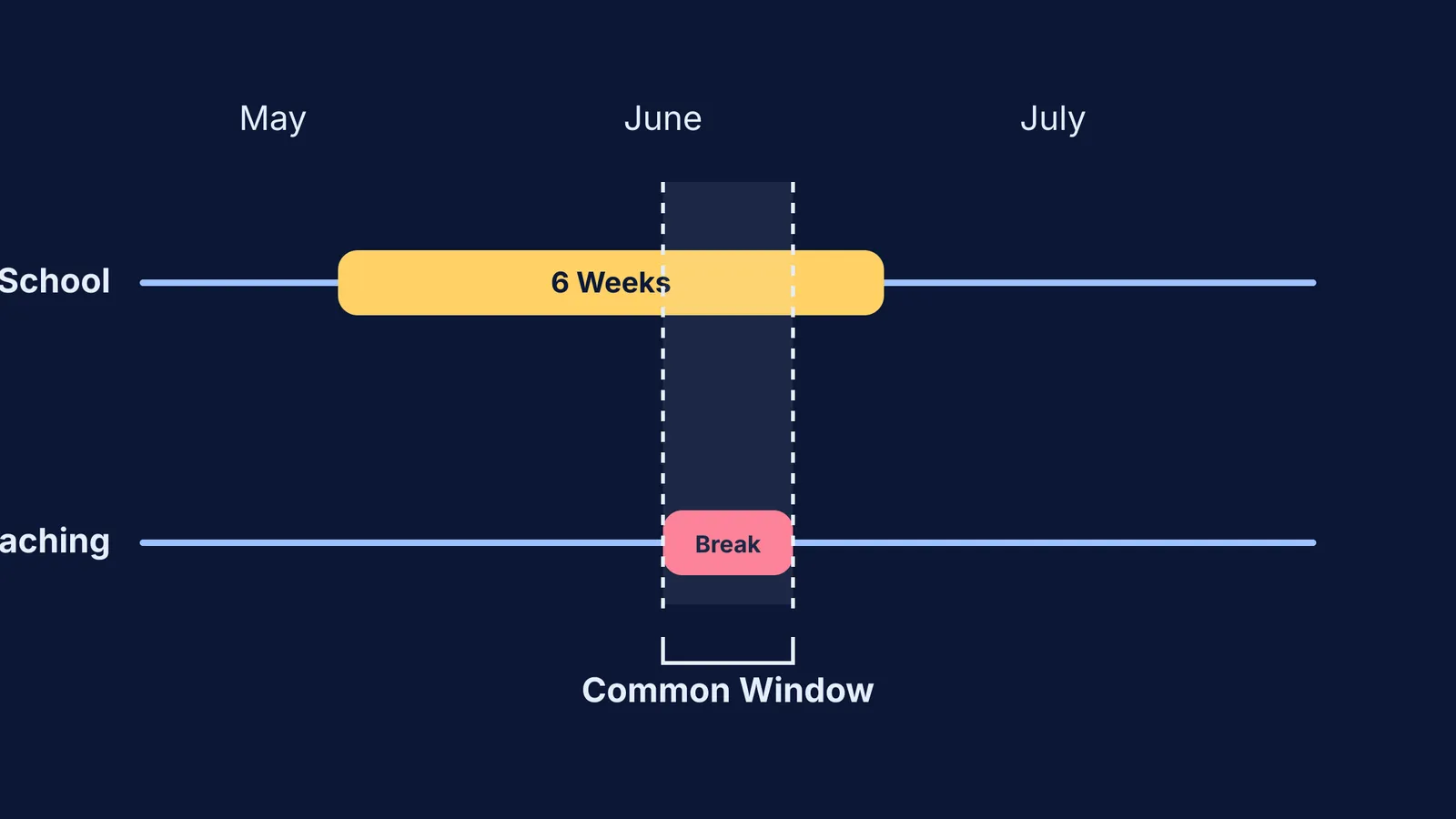
Find the common window: Look for the overlap between school holidays and the mandated festival breaks at the coaching centre. Even a long weekend is enough to break the cycle of stress.
Accept the imperfect timing: Do not wait for a week free of classes. Book a short trip during a lighter week at coaching, even if it means missing a few sessions.
Leave the books at home: A holiday where a student is secretly worrying about converting PV, PT and VT graphs in the hotel room is not a holiday. The goal is complete cognitive rest.
How do you catch up after the break?
The biggest fear preventing family trips is the backlog. Missing classes can feel catastrophic when the syllabus moves quickly. Students worry they will never understand the chapters they missed while away.
This is where the right tools help bridge the gap. If a student misses a series of physics classes and needs to learn work in irreversible expansion, they do not have to rely solely on scattered notes. Fermi's AI tutor can work out what they already know and build a plan for the session, teaching through the missed concepts step by step. With the reassurance that they have a structured way to catch up, both you and your child can actually enjoy the holiday.


