

On this page
What is peer assessment in schools today?
If your child came home describing a classroom task where classmates graded each other's science projects or essay outlines, you might wonder whether students are doing the teacher's job. In educational research, peer assessment is defined as an arrangement where learners evaluate the quality or success of learning outcomes of classmates of similar status, as established by Professor Keith Topping in the Review of Educational Research.
In Indian classrooms, this shift reflects national policy. Under the National Education Policy 2020, as announced by the Press Information Bureau, schools are adopting the 360-degree Holistic Progress Card overseen by PARAKH. Rather than relying entirely on year-end exams, the framework integrates self-assessment and peer assessment alongside teacher evaluations across cognitive, social, and practical competencies.
Crucially, classroom peer assessment is formative, not summative. Classmates do not decide report-card marks or board examination scores. Instead, students review drafts of essays, laboratory setups, or geometry proofs against explicit criteria provided by the teacher, offering actionable recommendations before work is officially graded.
Why do teachers ask students to review each other's work?
Asking teenagers to evaluate a classmate's draft sounds counterintuitive, but learning science shows that giving feedback teaches as much as receiving it. In their landmark synthesis in Assessment in Education, researchers Paul Black and Dylan Wiliam established that formative assessment produces the largest gains when students become active instructional resources for one another and take ownership of their learning.
Evaluating peer work requires students to think like an assessor. To critique a classmate's experiment or mathematical derivation, a student must examine the argument, spot hidden assumptions, and explain why a step fails to satisfy the rubric. This mirrors the cognitive benefits of learning by teaching, where explaining or reviewing a problem reorganizes the reviewer's own knowledge.
Reviewing multiple peer responses also shows students that more than one valid approach exists for open-ended problems, broadening how they structure evidence.
Does peer assessment actually improve academic performance?
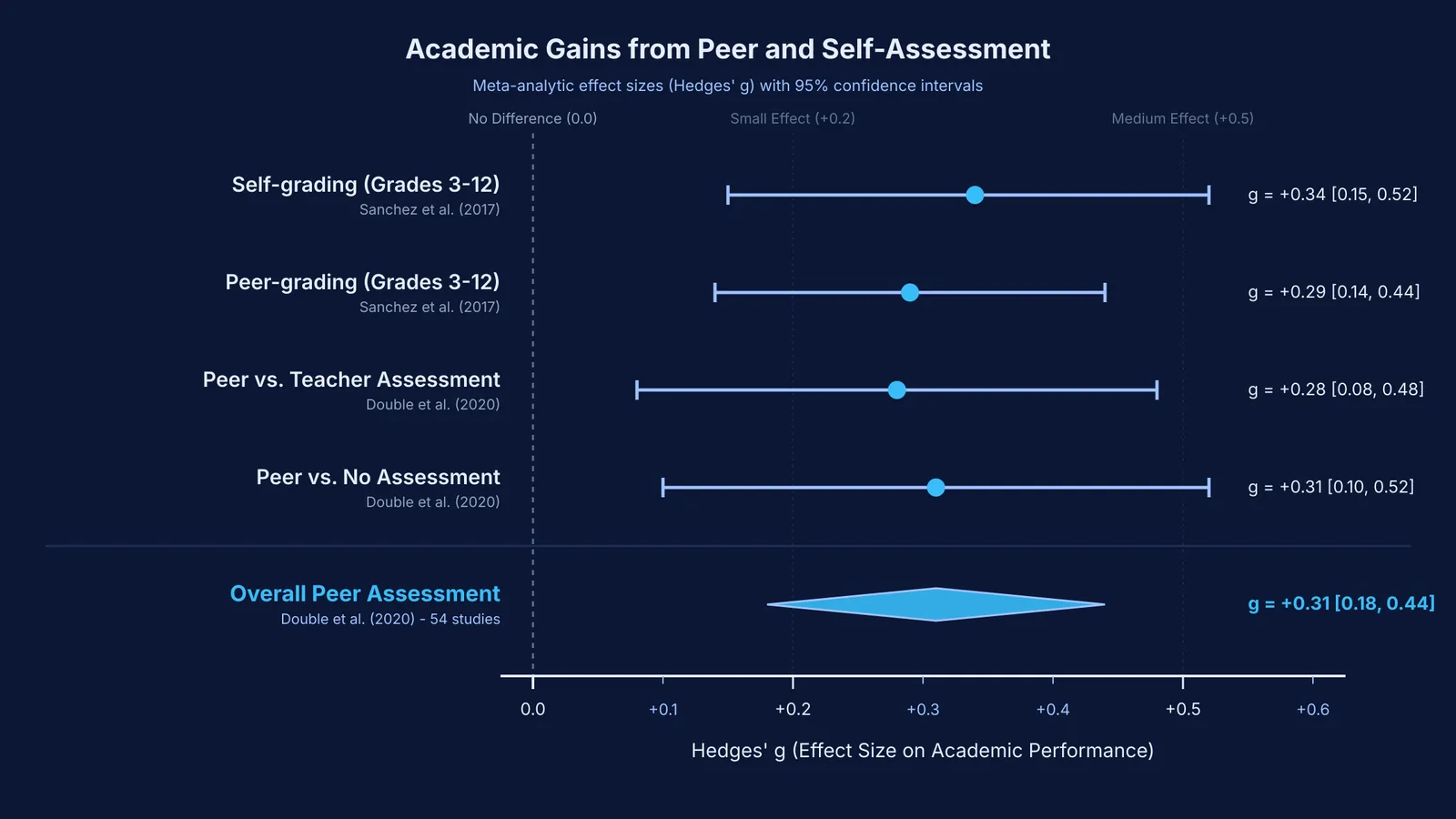
Classroom experiments demonstrate that structured peer assessment boosts academic achievement. In a 2020 meta-analysis in Educational Psychology Review, researchers Kit S. Double, Joshua A. McGrane, and Therese N. Hopfenbeck synthesized data from 54 studies with 141 effect sizes across primary, secondary, and tertiary education. The analysis revealed a statistically significant overall positive effect on academic performance of Hedges' g = 0.31 compared to no assessment.
Compared directly with teacher assessment alone, peer assessment produced an advantage of g = 0.28, largely because peers provide immediate feedback while revisions are still manageable. These findings align with a 2017 meta-analysis led by Carmen E. Sanchez in the Journal of Educational Psychology, tracking classrooms from grades 3 to 12. Sanchez and colleagues recorded an achievement effect size of g = 0.29 for peer-grading and g = 0.34 for self-grading on subsequent tests. The study also showed that student-assigned marks correlated strongly with teacher evaluations at r = 0.68, confirming that school-age learners evaluate work reliably when provided with clear rubrics.
In their classic review in the Review of Educational Research, John Hattie and Helen Timperley showed that effective feedback must address three explicit questions: Where am I going? How am I going? And where to next? Peer assessment trains students to answer all three questions independently.
How can parents help children handle constructive critique?
For many children and teenagers, receiving a classmate's critique feels personal. A comment pointing out an omitted derivation step or messy graph can trigger embarrassment or defensiveness. Parents can help by guiding them through three shifts in perspective:
Separate the draft from personal identity. A classmate's suggestion is an observation about a piece of paper, not a judgment on intellect. Connecting early mistakes to normal learning aligns with talking about failure at home, reassuring teens that imperfect drafts are necessary milestones.
Focus on process over ability. Praise the willingness to revise rather than defensive perfectionism. Emphasizing strategies and effort over innate smarts reflects the core principles of how to praise effort over ability.
Test the critique against the teacher's rubric. Ask your child: "Looking at the assignment checklist, did the question require stating units in every step? If yes, the feedback gives you an objective clue before the teacher grades it."
What practical steps build healthy feedback habits at home?
When your child brings home peer feedback or prepares to evaluate a classmate's project, use this four-step discussion routine:
Read without reacting. Read the peer notes aloud together before deciding whether you agree or disagree.
Identify the evidence. Ask your child to locate the exact sentence or calculation the classmate commented on.
Plan one concrete adjustment. Decide on a single actionable improvement for the next draft, such as adding a missing diagram label or clarifying a conclusion.
Diagnose underlying concept gaps. When a classmate's feedback flags an unexplained leap or a gap in scientific reasoning, students can explore the topic in the Fermi Concept Library, which covers every concept across school science and mathematics, or use the Fermi Problem Library to examine worked problems with a step-by-step solver that explains the reasoning rather than printing an answer.
Guiding children to give and receive constructive peer feedback teaches them to view their work through an objective lens, turning classroom critiques into practical tools for independent study.


