

On this page
When a child faces a setback—a low test score, a missed goal, or a social rejection—parents often feel the urge to jump in and fix it or brush it off. However, educational psychology suggests that one of the most powerful ways to build a child's resilience is for parents to share their own failures.
Research indicates that it is not enough to just tell children that "everyone makes mistakes." Seeing a parent model the recovery process transforms a theoretical lesson into a practical strategy.
Should I tell my child about my failures?
Yes. Sharing your failures shifts your child's perspective from believing they are not smart enough to understanding that they just need a better strategy.
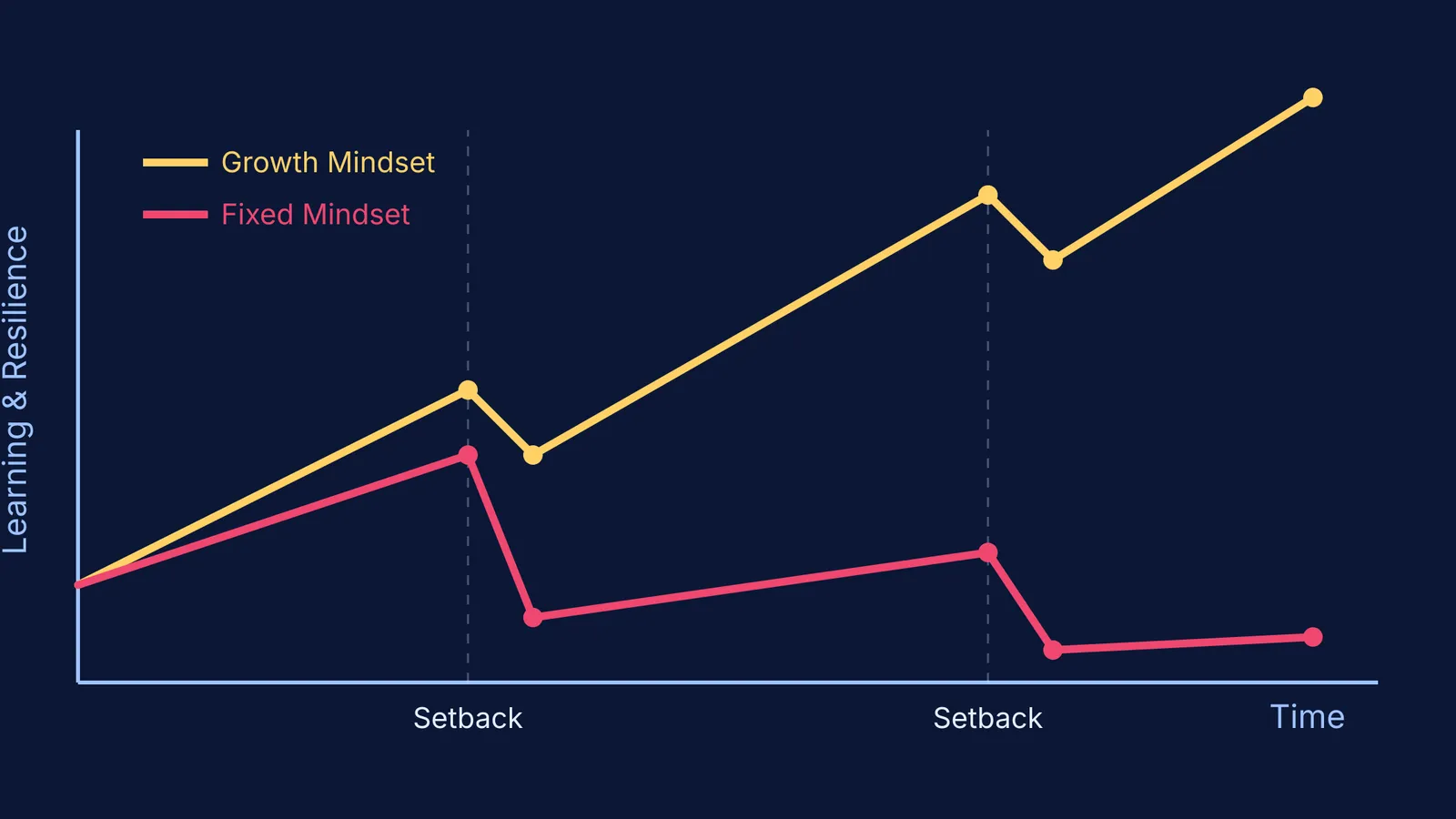
In a 2016 study published in *Psychological Science*, researchers Kyla Haimovitz and Carol Dweck at Stanford University investigated what predicts a child's mindset about intelligence. Surprisingly, they found that a parent's own belief about intelligence does not easily transfer to their child. Instead, it is the parent's *failure mindset* that matters most.
The study found that when parents view failure as an enhancing experience that facilitates learning, their children are more likely to adopt a growth mindset—the belief that intelligence can be developed through effort. Conversely, if parents treat failure as a debilitating or shameful event, their children adopt a fixed mindset, assuming that a setback simply reflects a permanent lack of ability.
How should I talk about mistakes collaboratively?
It is not enough to merely list your past mistakes; the way you discuss them makes a critical difference.
A 2024 study led by Dr. Elizabeth Peterson at the University of Auckland analyzed mother-child conversations from the "Growing Up in New Zealand" cohort. The researchers looked at how parents talked to eight-year-olds about everyday disappointments. They found that when mothers explicitly acknowledged the child's emotions and discussed collaborative ways to solve the problem, the children showed a notable decrease in their fear of making mistakes.
However, the study also revealed a surprising risk: if parents offered a clear action plan without accompanying collaborative support (e.g., just telling the child what they should do next time), the child's anxiety actually increased.
Despite the benefits, collaborative conversations remain rare. The New Zealand researchers found that 40% of the observed mothers minimally acknowledged or dismissed their child's emotions, 55% rarely discussed action plans, and 79% did not discuss collaborative resources or how they could help the child.
What should I share with my child by age?
Not every failure is appropriate to share. A good rule of thumb is to keep your disclosures age-appropriate and focused on the recovery, ensuring you do not burden your child with adult anxieties.
Young children (under 8): Share small, everyday mistakes. You might say, "I forgot to pack my umbrella, so I got wet. Next time, I will check the weather before I leave." Show them the immediate repair.
Pre-teens (8-12): Share academic or social struggles from your own childhood. Focus on the strategy you used to recover. This is the age when children start fearing academic failure.
Teenagers (13+): Share more complex setbacks, such as missing out on a promotion or struggling with a major exam, provided the focus remains firmly on how you adapted and moved forward.
What should I do when my child is stuck on a problem?
If your teenager is frustrated by a difficult maths or physics concept, telling them about a time you failed to understand a topic can normalize the struggle. It reassures them that confusion is just the beginning of learning. Sharing how you help children learn without pressure keeps the focus on steady progress.
When they need to work through the specific details of a subject, Fermi's AI tutor can help them navigate the roadblock. Rather than simply printing an answer to a question, it holds a line of reasoning across a session. It notices where a student is stuck and decides whether to explain, ask, or show the next step. By writing on a board, drawing figures, and running simulations alongside the student, Fermi teaches them how to methodically push past mistakes and arrive at the solution. The Fermi Problem Library also offers worked examples that explain the reasoning rather than just the final result, reinforcing a focus on strategy over innate ability.
How can I share my setbacks with a simple script?
The next time your child faces a failure, you can use this four-step framework to guide the conversation:
Acknowledge the feeling: "I can see you are frustrated about that test result. It is perfectly normal to feel disappointed."
Share a relevant failure: "When I was your age, I failed a science exam. I thought I just was not good at it."
Detail the recovery: "But then I realised I was studying the wrong way. I started making summary notes instead of just rereading the textbook."
Offer collaborative support: "Let's look at this together and see if we can find a new strategy for next time."
By treating your own failures as open, teachable moments, you give your child the tools to handle their own setbacks with confidence.


