

On this page
When students enter Class 11, the leap in academic difficulty is steep and immediate. For those preparing for the National Eligibility cum Entrance Test (NEET), the pressure to cover the expanded syllabus quickly can feel overwhelming for both the student and their family. Many parents ask: exactly how much of the syllabus needs to be done in this first year, and what happens if a child falls slightly behind?
Here is a detailed breakdown of the syllabus weightage between the two years, along with a practical framework to help you check on your child's academic progress constructively.
What percentage of the NEET syllabus is from Class 11?
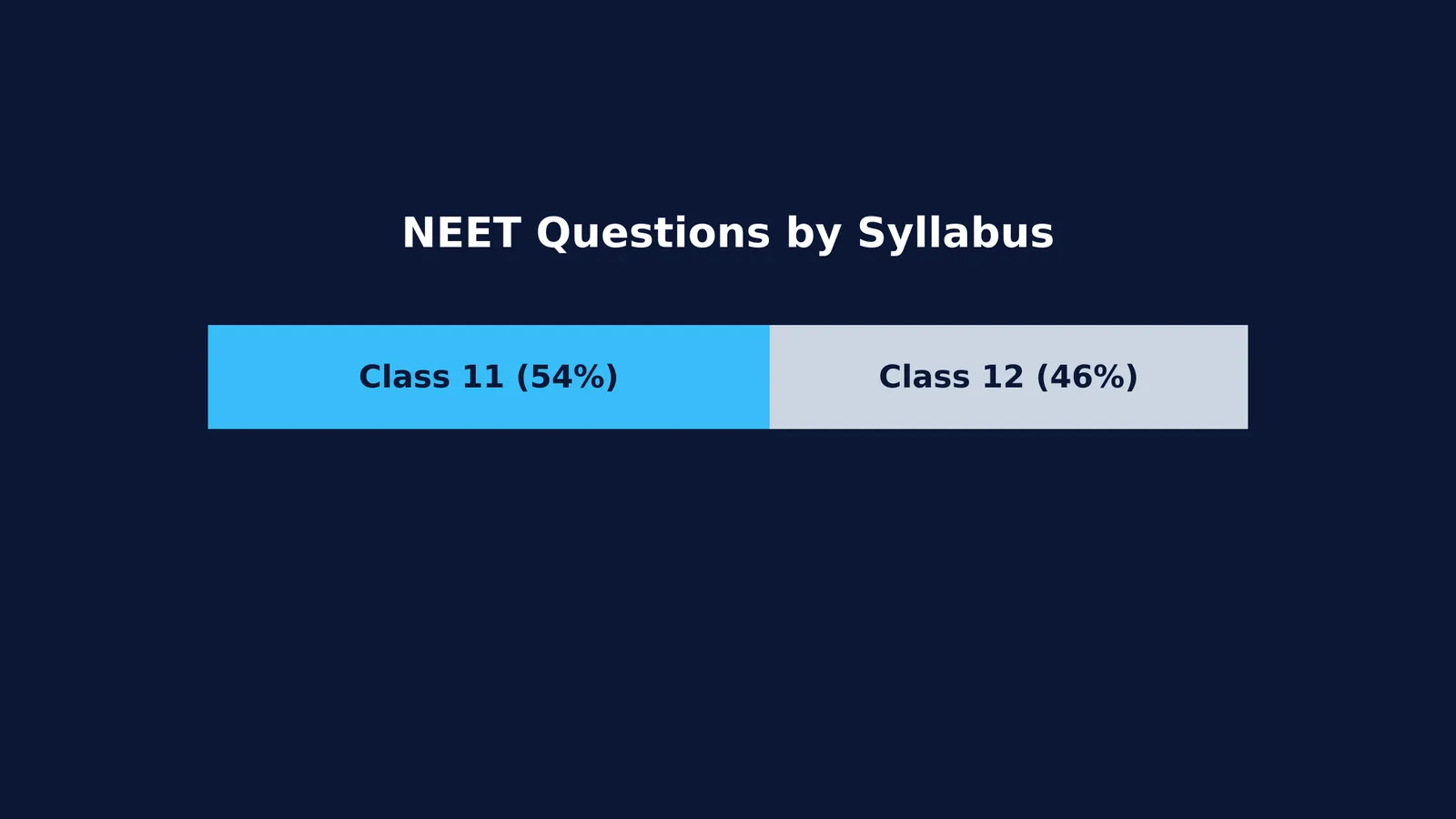
While the National Testing Agency (NTA) does not publish a rigid chapter-by-chapter weightage prior to the exam, historical trends show that the Class 11 syllabus contributes over half of the total NEET questions. According to an analysis of the 2026 paper by Careers360, out of 180 total questions, approximately 97 came from the Class 11 curriculum (around 54%).
The subjects generally split as follows:
Biology: Class 11 covers foundational topics like the cell and human physiology, making up nearly 59% of the section (53 out of 90 questions in a recent paper).
Physics: Mechanics and thermodynamics from Class 11 form the mathematical and conceptual basis for Class 12 topics, accounting for about 47% of the physics questions (21 out of 45).
Chemistry: The Class 11 physical and organic chemistry chapters hold roughly a 51% weightage (23 out of 45 questions).
A common pitfall is treating Class 11 as a "warm-up" year before the more serious Class 12 board year begins. If a student leaves large gaps in their Class 11 understanding, they will inherently struggle with the interconnected concepts when they transition from Class 11 to Class 12.
How much should be done by the end of the year?
Ideally, a student should aim to complete the entire Class 11 syllabus by the time their school academic year finishes, which is usually February or March. This milestone means they have read the NCERT textbooks thoroughly, completed any supplementary coaching modules, and solved previous years' questions for those specific chapters.
If your child is studying away from home, they might face additional hurdles in managing their time and staying on a strict schedule. Falling behind by a few chapters is normal and happens to most students at some point, but leaving an entire unit untouched—like rotational motion in physics—creates a severe backlog. That backlog is incredibly hard to clear while also keeping up with the heavy Class 12 workload that starts immediately in April.
How to check their progress (without adding pressure)?
Rather than repeatedly asking "How many chapters have you finished this week?"—which often invites a defensive "I am doing it"—try looking at how they study and exactly where they get stuck.
Here is a practical framework for a weekly check-in that focuses on the depth of learning:
Focus on the method, not the marks: Ask them to walk you through a problem they found difficult this week. If they can explain the steps out loud, they are learning actively and mastering the material.
Check the foundation: When they are stuck on a new topic, it is usually because an older, related concept is shaky. The Fermi Concept Library contains every concept in physics, chemistry, biology, mathematics and computing, each with its own lesson and its place in the map, helping a student locate exactly what they missed.
Watch how they use help: Do they jump straight to the solution key when stuck? A good tutor helps a student think rather than just handing them the answer. Fermi's AI tutor works out what a student already knows and builds a plan for the session, holding a line of reasoning across a whole session and checking understanding as it goes.
Pacing is a complex skill that takes time to learn. By knowing the weightage and keeping your conversations focused on the process of learning rather than just the speed of completion, you can help them learn without adding pressure and build a solid foundation for their final year. If they are struggling with the transition, you might also try an AI tutor with your child to see how active problem-solving changes their daily study routine.


