

On this page
Every year, over 20 lakh candidates register for the National Eligibility cum Entrance Test, according to the National Testing Agency. While many aspirants excel in biology, physics often triggers severe anxiety and score plateaus. The exam allocates 45 questions to physics out of 180 questions to be attempted, representing 180 out of 720 total marks. For a student drawn to biology, the abrupt shift to multi-step numerical calculation can feel jarring.
Cognitive science explains why this shift proves difficult. A study by Michelene Chi, Paul Feltovich, and Robert Glaser (10.1207/s15516709cog0502_2) showed that novices categorize physics problems by surface features, such as pulleys or inclined planes, whereas experts sort them by core laws like energy conservation. Without principled problem-solving habits, students understand classroom lectures but freeze during timed tests. Our guide explains why students understand theory but struggle with numericals.
Which high-weight physics chapters should your child prioritise?
A common mistake is treating every chapter across the physics syllabus equally. Historical question distributions from the National Testing Agency show that certain topics yield far higher returns on effort.
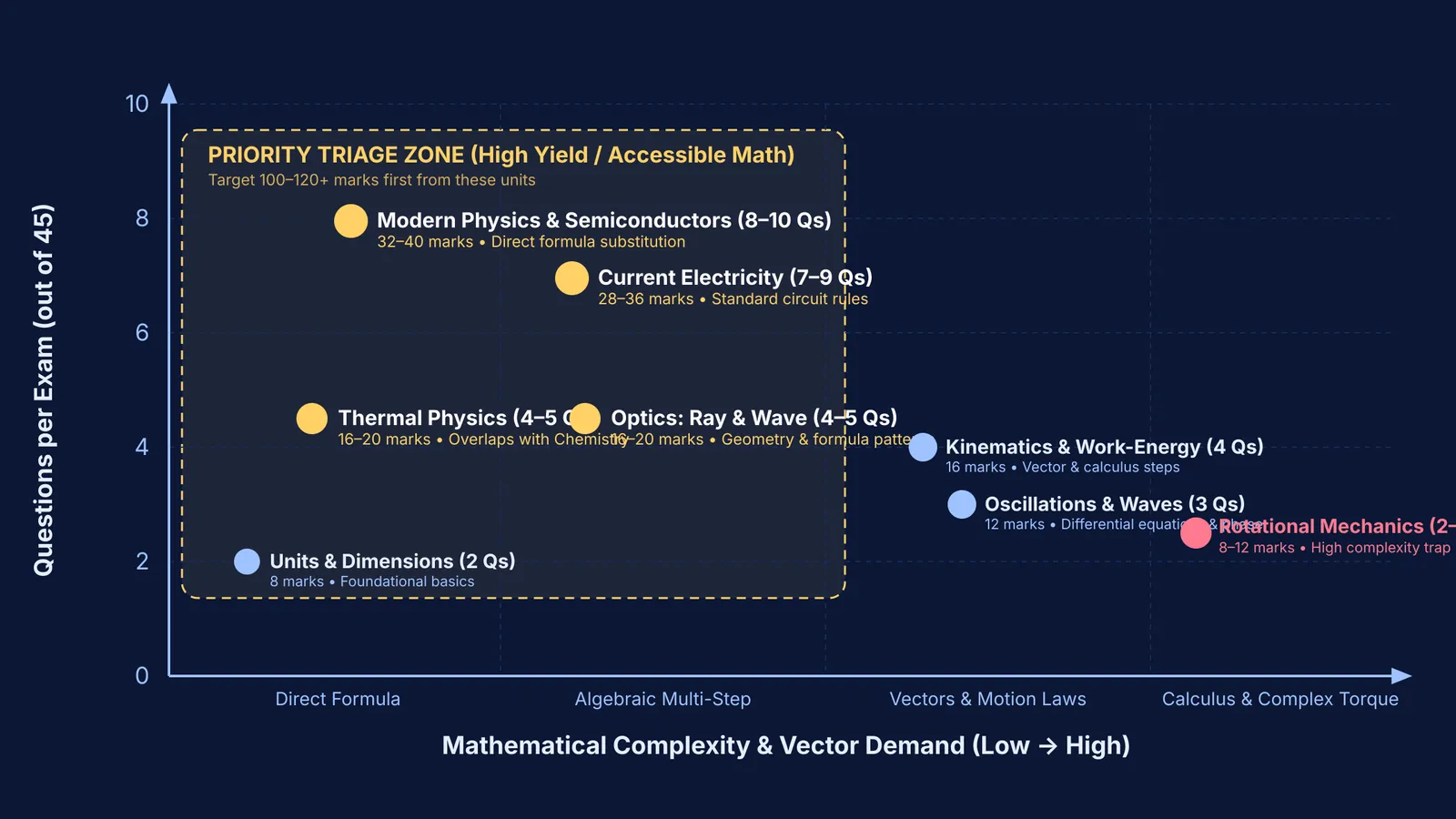
Focus first on high-yield, accessible units:
Modern Physics and Semiconductors: Topics like Dual Nature, Atoms, Nuclei, and Semiconductor Devices consistently provide 8 to 10 questions (32 to 40 marks), based on exam papers from the National Testing Agency.
Current Electricity and Magnetism: Direct-current circuits and magnetic effects reliably contribute 7 to 9 questions (28 to 36 marks) with standard circuit formulas.
Thermal Physics: Heat transfer, thermodynamics, and kinetic theory account for 4 to 5 questions (16 to 20 marks), linking directly with physical chemistry.
Optics: Ray and wave optics yield 4 to 5 questions (16 to 20 marks).
Securing these units can lift a student past 110 to 130 marks out of 180 marks. For study routines, see NEET physics for students who are strong in biology.
How should parents handle daily physics practice and doubts?
When marks drop, parents often suggest solving 50 questions daily. Yet research shows that unguided drilling can impede learning. John Sweller's cognitive load experiments (10.1207/s15516709cog1202_4) revealed that heavy unassisted problem-solving overloads working memory, hindering schema construction. Furthermore, John Dunlosky and colleagues (10.1177/1529100612453266) demonstrated that distributed retrieval practice builds durable retention, whereas rereading offers minimal benefit.
Support daily practice with these four steps:
Emphasize depth over volume: Have your child solve 15 to 20 problems daily with complete self-explanation, rather than rushing through 50 problems while checking answers.
Maintain a doubt log: Provide a notebook where they note the exact calculation step where they got stuck each evening.
Study worked reasoning steps: When stuck, seeing how a problem is structured helps bridge concept gaps. The Fermi Problem Library provides worked problems with a step-by-step solver that explains the reasoning rather than printing an answer.
Visualise abstract concepts: For phenomena that are difficult to picture from text alone, interactive tools build intuition. The Fermi Simulation Lab offers interactive simulations for ideas that are easier to see than to read.
When does a NEET aspirant need a private tutor?
In large coaching lecture halls, quiet students often hesitate to ask fundamental questions about basic vectors or trigonometry. Educational research by Benjamin Bloom (10.3102/0013189X013006004) showed that students receiving one-to-one tutoring achieved learning gains of two standard deviations over conventional classroom lecture instruction.
If your child's score remains below 60 marks out of 180 marks across three consecutive tests despite regular study hours, classroom lectures alone are insufficient. A dedicated one-to-one tutor can diagnose whether the issue is mathematical fluency or conceptual confusion. Look for an instructor who watches your child set up problems rather than lecturing passively. You can also explore how parents can help children learn without adding pressure.
What can parents say to reduce physics anxiety?
Medical entrance preparation carries heavy emotional pressure. When physics scores lag, students often conclude they lack mathematical aptitude. How parents respond at home directly impacts persistence.
Protect your child's focus with three principles:
Praise process, not aptitude: Commend consistent practice logs and daily doubt resolution rather than test ranks.
Treat errors as diagnostic data: Frame lost marks as indicators of specific formulas or algebra steps to review.
Watch for burnout: If exam pressure leads to acute anxiety, families can call the national Tele MANAS helpline at 14416 or 1800-891-4416, a free 24/7 service operated under the Ministry of Health and Family Welfare.


