

On this page
When the syllabus feels endless, parents often see their NEET aspirant studying late and sleeping little. It looks like dedication, but pushing past midnight to cram chemistry or physics usually backfires. The brain is not a sponge that passively absorbs whatever is read; it is a living organ that requires downtime to cement new facts.
Why does cutting sleep hurt memory?
To master the vast NEET syllabus, a student needs strong declarative memory—the ability to recall facts, formulas, and concepts. It is easy to think that reading a chapter three times will lock it in, but the real work happens after the book is closed.
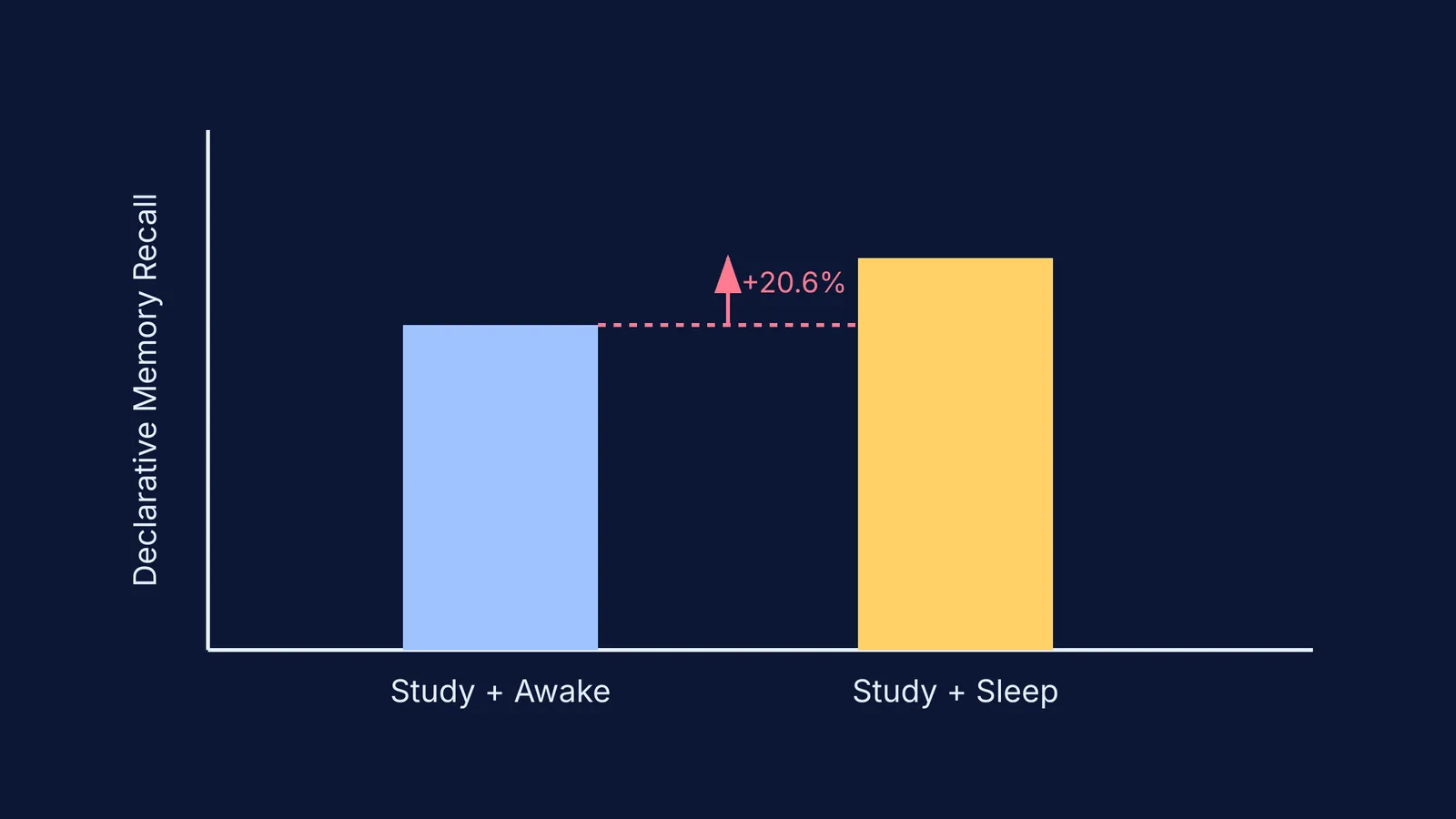
A 2012 study by Potkin and Bunney in *PLoS ONE* (10.1371/journal.pone.0042191) found that early adolescents showed a 20.6% increase in declarative memory performance after sleep compared to those who stayed awake. During sleep, the brain actively replays the day's learning. Patterns known as sleep spindles synchronize with slow brain waves, transferring fragile new memories from the hippocampus to the neocortex for long-term storage.
When a teenager cuts their sleep short, this transfer is interrupted. They might read the same biology chapter until 2 AM, but without enough rest, they are likely to forget the details. This is why students often struggle with judging what you know—they remember the feeling of reading the page late at night, but the actual facts were never consolidated.
Does studying late affect exam grades?
It is not just the total hours of sleep that matter; the routine itself is critical. A 2024 study of over 770 adolescents published in *Sleep* (10.1093/sleep/zsae062) tracked students using wrist actigraphs to measure sleep timing. The researchers found that highly variable bedtimes were strongly linked to poorer academic outcomes. Students with irregular sleep schedules earned fewer "A" grades and had a significantly higher chance of receiving a "D" or lower in their classes.
Teenagers naturally experience a biological "phase delay" that pushes their internal clocks later. When this delay meets the pressure of competitive exams, it is easy to slip into a cycle of late nights and exhausted mornings. But shifting sleep patterns confuse the brain's circadian rhythms. A consistent routine allows the brain to anticipate sleep and drop more efficiently into the deep, slow-wave sleep required to process heavy academic loads.
Even short sleep research on daytime naps shows that consistency and timing are key to keeping the brain fresh.
How can you set a fixed lights-out routine?
To fix a broken study schedule, start by protecting sleep as fiercely as study time. You can guide your teen by setting firm boundaries that prioritize rest over cramming.
Set a non-negotiable lights-out time: Choose a time (e.g., 11:00 PM) when all screens and books are put away.
Move the hardest subjects earlier: The brain's capacity to process complex ideas drops late at night. Schedule heavy physics or maths problem-solving for the afternoon or early evening.
Wind down with light review: Use the hour before bed for light reading or reviewing notes, rather than trying to grasp entirely new concepts. This aligns with Alan Baddeley's working memory model, which shows that the brain has a limited capacity for actively manipulating new information when fatigued.
How do you plan earlier study blocks?
The hardest part of a new routine is sticking to it when the syllabus looms large. A student staring at a blank page at 9 PM might procrastinate until midnight because they simply do not know what to tackle first.
Planning earlier study blocks gives them a clear runway. When a student doesn't know where to start their evening revision, Fermi's AI tutor works out what they already know and builds a plan for the session, so they sit down to a clear next step.
If they get stuck on a difficult question, the frustration can easily delay bedtime. For these roadblocks, the Fermi Problem Library has worked problems with a step-by-step solver that explains the reasoning rather than printing an answer. This keeps them moving forward instead of wasting hours stuck on a single concept.
Sleep is not a break from learning; it is the final step of the study process. By enforcing a regular bedtime and moving intense work earlier in the day, your NEET aspirant will retain more of what they read and wake up ready to tackle the next challenge.


