

On this page
Class 9 is the year school starts pointing towards the board exam. In CBSE schools, the Secondary School Curriculum 2026-27 says Classes 9 and 10 “constitute a composite course”, so students should take in Class 9 only the subjects they intend to continue in Class 10.
Below: what changes from Class 8, how marks now work, and a four-week plan for the start of the year. ICSE and state boards differ in the details, so check your own board's scheme.
What changes from Class 8 to Class 9?
Every point below comes from the CBSE 2026-27 secondary curriculum.
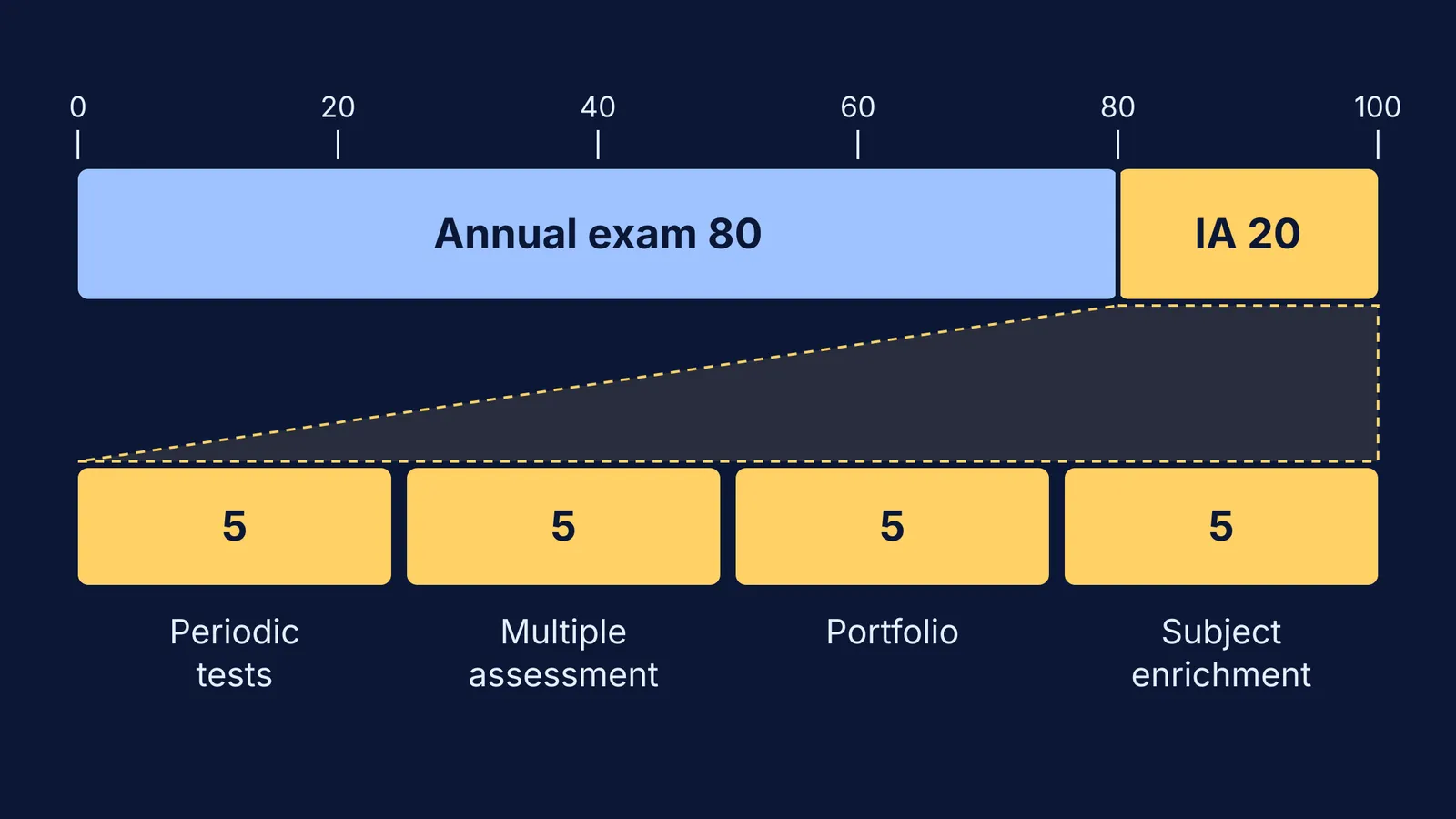
Core subjects. Two languages, maths, science and social science each carry an 80-mark, 3-hour annual exam plus 20 marks of internal assessment.
A third language. From 2026-27, a third language is compulsory in Class 9. Only the school assesses it, but students must pass it to get the Class 10 certificate.
Two levels in maths and science. Everyone takes the standard paper. Students who want more can add Mathematics Advanced or Science Advanced, an optional 25-mark, 1-hour paper whose marks are not added to the total.
Vocational Education. It is listed as a compulsory Class 9 subject, with internal assessment and an annual exam.
School-marked areas. Art Education, Physical Education and Well-being, and a new subject, Individuals in Society, which starts as and when NCERT textbooks are available.
Question style. About 50% of board exam questions are currently competency-focused: case-based, source-based, data and application questions. CBSE says the Class 9 scheme is similar to the board exam.
To pass a subject, a student needs at least 33% of the marks and must complete both the internal assessment and the annual exam.
How is Class 9 marked?
The 20 internal marks are not one test. The CBSE assessment scheme splits them into four parts, each worth 25%:
Periodic assessment: three tests per subject across the year, best two averaged, at least one competency-based.
Multiple assessment: quizzes, presentations, experiments and projects, marked with rubrics shared in advance.
Portfolio: a small, chosen set of your child's work that shows growth over time.
Subject enrichment: investigations in science and maths, speaking and argument in languages, case studies in social science.
Class 9 uses absolute grading: 91 to 100 marks is an A1, 81 to 90 an A2, down to 33 to 40 for a D. Class 10 board grades are positional instead, with the top eighth of passed candidates getting A1. In Class 9, your child's grade depends only on their own marks.
So marks are earned steadily from the first weeks. A forgotten portfolio piece costs marks that a good final paper cannot win back.
How do I help my child start Class 9 well?
Use the first month to set up systems, not to race ahead in the syllabus.
Week 1, map the year. Put every test, project and portfolio deadline from the school calendar on one sheet, and fix a daily study slot. Our guide to teaching your child to plan their time shows how to hand this over gradually.
Week 2, same-day recall. Each evening your child closes the book, writes what they remember from each lesson, then checks. In a 2006 study by Roediger and Karpicke, students who practised recalling a passage remembered more of it a week later than students who restudied it, even though restudying made them feel more confident.
Week 3, a mistakes notebook. For each wrong answer in maths and science, note the question, what went wrong (concept, method or slip) and the right method. For method errors, the Fermi Problem Library has worked problems with a step-by-step solver that explains the reasoning; for concept gaps, the Fermi Concept Library has a lesson for each concept in physics, chemistry, biology and maths.
Week 4, a weekend check-in. Keep it short and about the process, not the score. Protect sleep too: our guide on how much sleep teenagers need explains how parents can help.
Three questions that work at the check-in:
“What was the hardest thing this week, and what did you try?”
“Which test or project is next, and what is your plan for it?”
“Is there anything you would like me to stay out of?”
Avoid opening with a mark (“Why only 14?”). There is more in how to talk to your teenager about marks without a fight.
When should parents worry in the first term?
An early dip in marks is common while routines settle. Talk to the class teacher if it lasts past the first periodic test, or if one subject keeps sliding while the others hold.
Watch mood as well as marks. If your child seems low for weeks, stops sleeping or eating normally, or talks about feeling hopeless, speak to the school counsellor or a doctor. Tele MANAS, the government's free mental health helpline, answers on 14416.
Start this weekend with the week 1 calendar, and add one habit at a time.


