

On this page
The transition from CBSE Class 10 to Class 11 is a significant academic shock in the Indian education system. It is extremely common for students who scored top grades in their Class 10 board exams to struggle to pass their first Class 11 unit tests.
For many families, this sudden drop in performance causes panic. Parents wonder if their child has lost focus, while teenagers begin to doubt their own intelligence. However, this struggle is rarely about a lack of effort; it is a structural issue caused by the gap between the two syllabuses.
Why does Class 11 feel so hard after Class 10?
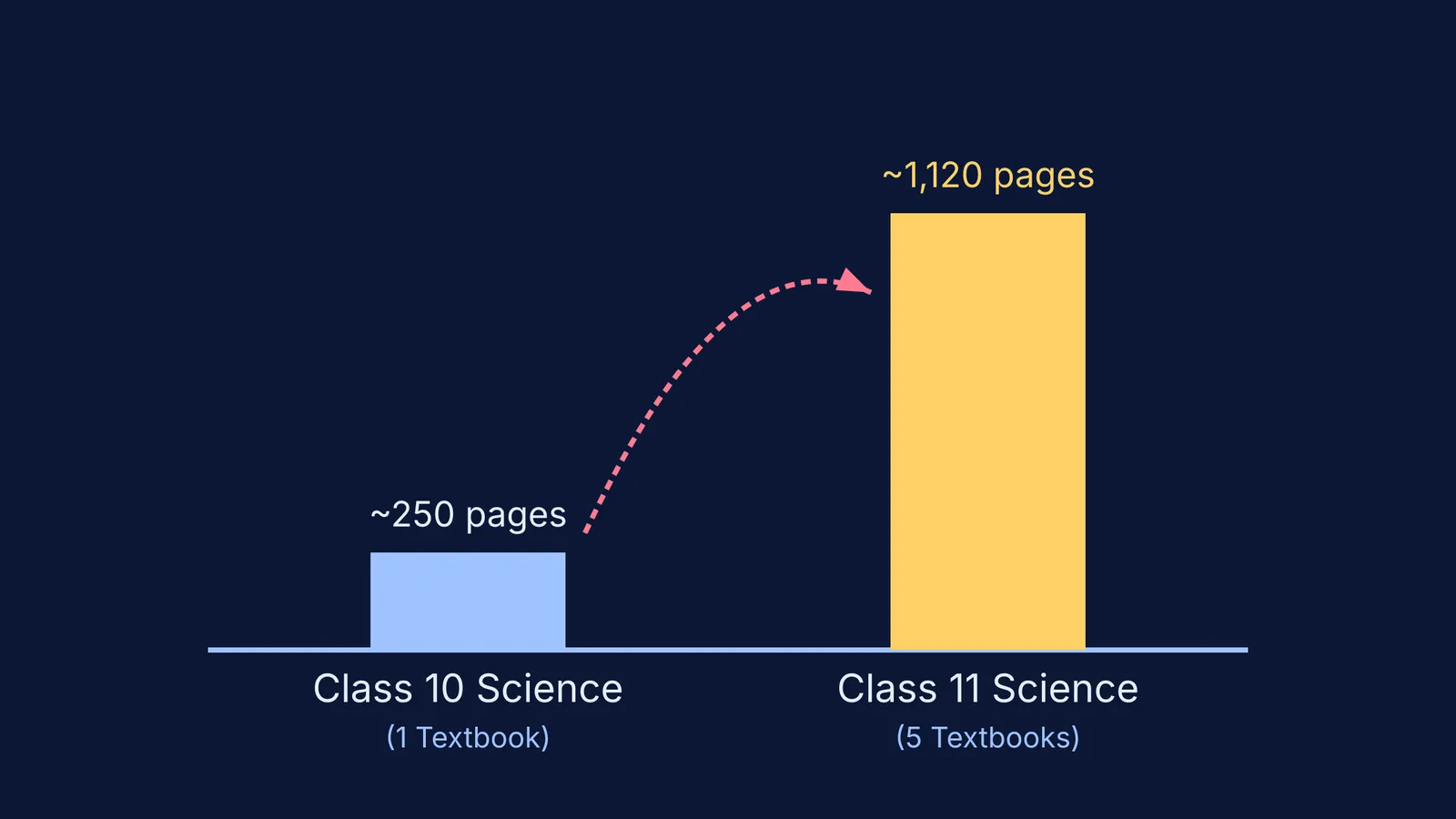
The primary reason is the sheer volume of the syllabus. In Class 10, Physics, Chemistry, and Biology are combined into a single NCERT science textbook of about 250 pages. In Class 11, these subjects branch out into five textbooks (two each for Physics and Chemistry, one for Biology) totalling over 1,100 pages. This is nearly a fivefold increase in reading material over a single summer.
Beyond volume, the nature of the questions changes entirely. Class 10 exams often reward consistent recall and solving standard problem types. A student can memorise the steps to find the focal length of a mirror and score full marks. Class 11, however, introduces abstract concepts and heavy mathematics, testing application over memory.
In Class 11 Physics, for example, students must suddenly use calculus and vector algebra to solve mechanics problems. In Chemistry, they move from balancing simple equations to visualising 3D molecular structures and predicting reaction mechanisms. You have to understand the "why" behind a formula to solve problems that combine multiple concepts. If a student tries to apply their Class 10 study habits to the Class 11 syllabus, they quickly fall behind because there is simply too much to memorise.
What are the early warning signs?
It takes a few months for most students to find their footing in the new academic year. During this adjustment window, parents should look out for several indicators that their teenager is struggling to cope:
A sharp drop in marks: It is normal for high scores to drop significantly in the first internal exams. Parents should not immediately assume the student is slacking off. (Do Class 11 marks matter for college applications?)
Sleep deprivation: If your teenager is regularly sacrificing sleep to complete assignments, they are heading for burnout. Chronic lack of sleep impairs the working memory needed to grasp complex scientific concepts.
Rote learning habits: Attempting to memorise derivations or organic chemistry exceptions instead of understanding the underlying logic is a recipe for failure. (Why memorising physics formulas fails, and what to do instead)
Withdrawal from hobbies: The Karnataka study noted that a lack of time for cocurricular activities or hobbies was a major stressor for nearly a third of the students.
How can parents support their teenagers?
The most common stressor cited by students in the Karnataka study was a lack of time for revision, closely followed by parental expectations and social pressure from relatives asking about academic performance.
To help your teenager navigate this difficult year, consider the following strategies:
Shift focus from marks to process: In the first term, praise the effort rather than the outcome. Ask "Did you understand the concepts better today?" instead of "Why did you lose marks?" This reduces the pressure of parental expectations.
Buffer them from social pressure: Shield your child from academic queries from neighbors or relatives. Keep test scores private within the family to prevent unnecessary comparisons.
Help them build a realistic plan: The Class 11 syllabus cannot be crammed at the last minute. Sit down and help them map out a weekly schedule that includes time for revision, hobbies, and rest. For an example, see How to study Class 11 physics: a research-based weekly plan.
Equip them with the right tools: When a student gets stuck at home, they often spend hours spinning their wheels on a single numerical, wasting precious revision time. This is where an AI tutor makes a difference.
When your teenager hits a wall with a complex topic like rotational motion or chemical equilibrium, Fermi's AI tutor can guide them. Most learning tools answer questions, but Fermi teaches—it holds a line of reasoning across a whole session, notices where a student is stuck, and decides whether to explain, ask, or show. If a concept is hard to picture, the Fermi Simulation Lab provides interactive simulations for the ideas that are easier to see than to read.
A conversation script for parents
If your child is discouraged after a bad test result, try starting the conversation like this:
"I know these marks aren't what you are used to, and that is completely okay. The jump from Class 10 is huge, and right now you are just learning how to study at this new level. Let's look at the mistakes not as lost marks, but as a map of what we need to figure out next. How can I help you clear these doubts?"
Remind them that Class 11 is a marathon, not a sprint. The goal of the first term is simply to learn how to learn again.


