

On this page
Your child has noticed the Moon is a thin smile one week and a round plate the next, and asked why. You don't need a telescope to answer: a notebook, a ball, a lamp and a few minutes each evening for a month will do.
Why does the Moon change shape?
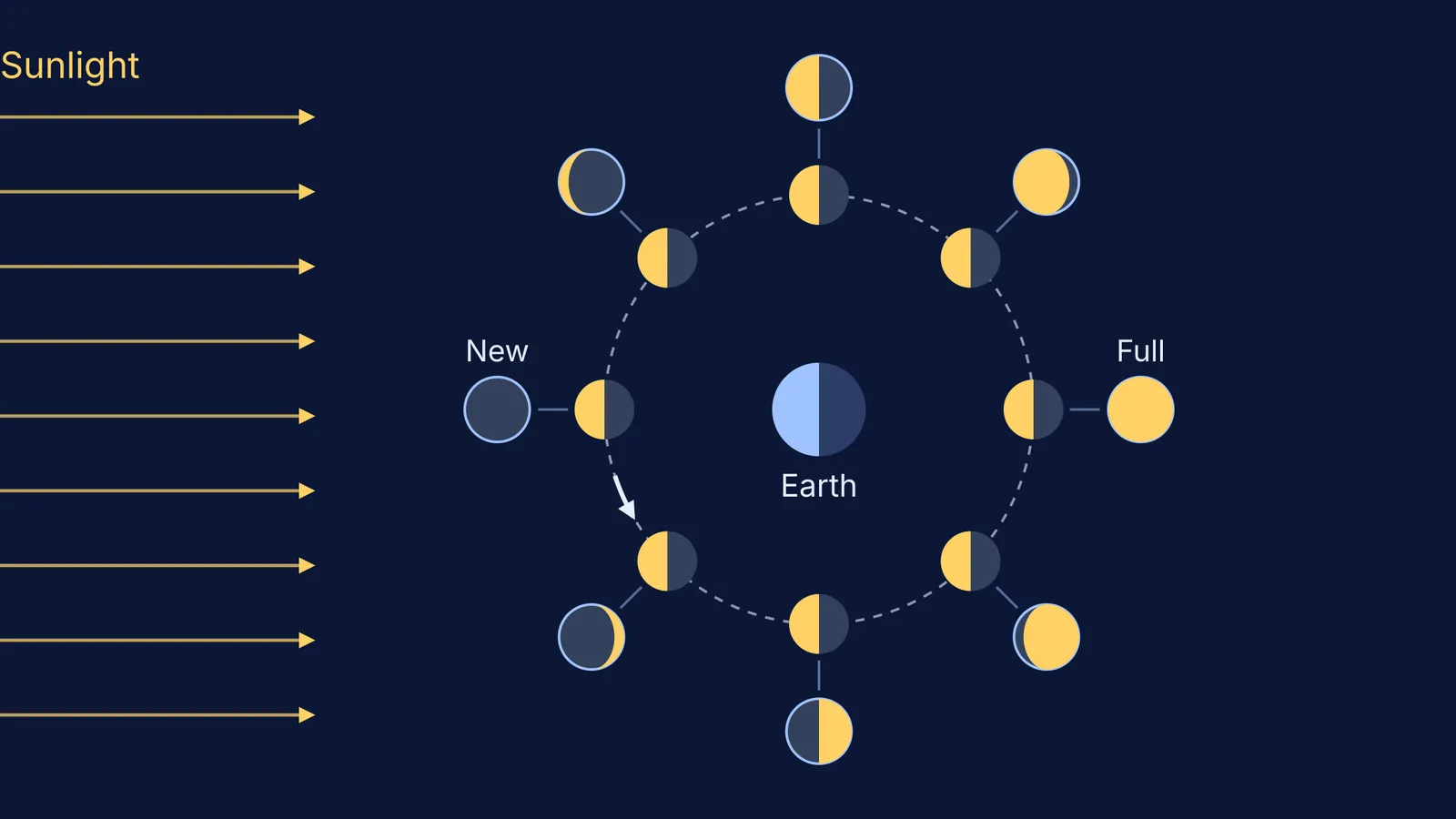
The Moon makes no light of its own: moonlight is sunlight bouncing off it, and the Moon is always half-lit by the Sun, as NASA's moon phases guide explains. What changes is how much of that lit half faces us as the Moon travels around Earth. When the Moon sits roughly between Earth and the Sun, the lit half faces away: new moon. When it is on the far side of Earth, the whole lit half faces us: full moon.
One full cycle, from new moon to new moon, takes about 29.5 days, according to NASA. The eight phases, in order, are new moon, waxing crescent, first quarter, waxing gibbous, full moon, waning gibbous, third quarter and waning crescent. Many Indian families already know the cycle by other names: Amavasya is the new moon, Purnima the full moon, Shukla paksha the brightening fortnight and Krishna paksha the darkening one (overview of Hindu lunar phases).
In one small interview study, none of four young children explained phases with Earth's shadow (Wilhelm, 2014), though four children is a tiny sample. Adults get it wrong too: a study of 78 trainee primary teachers found that, without targeted instruction, most were likely to hold alternative ideas about the cause of phases (Trundle, Atwood and Christopher, 2002).
How do you start a moon diary with your child?
Watching comes first. In a study of sixth-grade students, those whose moon journals scored higher, and who made more entries, tended to score higher on a lunar phases test afterwards (Cole, Wilhelm and Yang, 2015). That is a link, not proof, but a child who looks every night often spots the pattern before anyone explains it.
A plan for the month:
Start a day or two after Amavasya, when a thin crescent may show low in the west just after sunset.
Use one notebook page per evening, or a printable such as the PBS moon journal.
Each entry gets the date, the time, a sketch (shade the dark part in pencil), where the Moon was (above the water tank, left of the neem tree) and one word your child chooses.
Look at about the same time each evening, say 7 pm.
If it is cloudy, draw a cloud. A gap is data too.
Expect the Moon to move. It rises about 50 minutes later each day on average, says NASA's skywatching FAQ, so at 7 pm it sits a little further east each night. A full moon rises at sunset and the third quarter Moon around the middle of the night, according to NASA, so within a few days of Purnima the Moon is no longer up in the early evening. For the second fortnight, look before school while the waning Moon is still in the morning sky, or ask your child to predict and draw the shape they would have seen.
How do you show moon phases with a ball and a lamp?
After a week or two of sketches, show the reason with the NASA JPL classroom moon phases activity at home.
A lamp with the shade off (or a torch propped on books) at one end of a dark room is the Sun.
A white ball on a pencil is the Moon. Your child's head is Earth.
Your child faces the lamp, ball at arm's length just in front of the light. The side facing them is dark: new moon.
They turn slowly to their left, ball in front of their face. A sliver of light appears on the right edge, then half, then nearly all.
Back to the lamp, ball raised just above their head's shadow: the whole face is lit, full moon.
They keep turning until only a left-hand sliver remains, then nothing.
Now open the diary beside the ball and ask: which page looks like this?
What should you say when your child asks why?
Match the words to the age:
Ages 5 to 7: "The Sun always shines on half of the Moon, like the lamp on our ball. As the Moon goes round us, we see more or less of the bright half."
Ages 8 to 11: "Half of the Moon is always in daytime. When the Moon is between us and the Sun, its daytime side faces away, so we see almost nothing. When it is behind us, we see all of it."
Ages 12 and up: ask instead of telling. "Your diary says the half Moon was high in the sky at sunset. Where was the Sun? Show me with the ball."
For an older child who wants to keep going, the Fermi Simulation Lab has interactive simulations for ideas that are easier to see than to read.
Tonight, check whether the Moon is up after sunset, open a notebook and draw what you see.


