

On this page
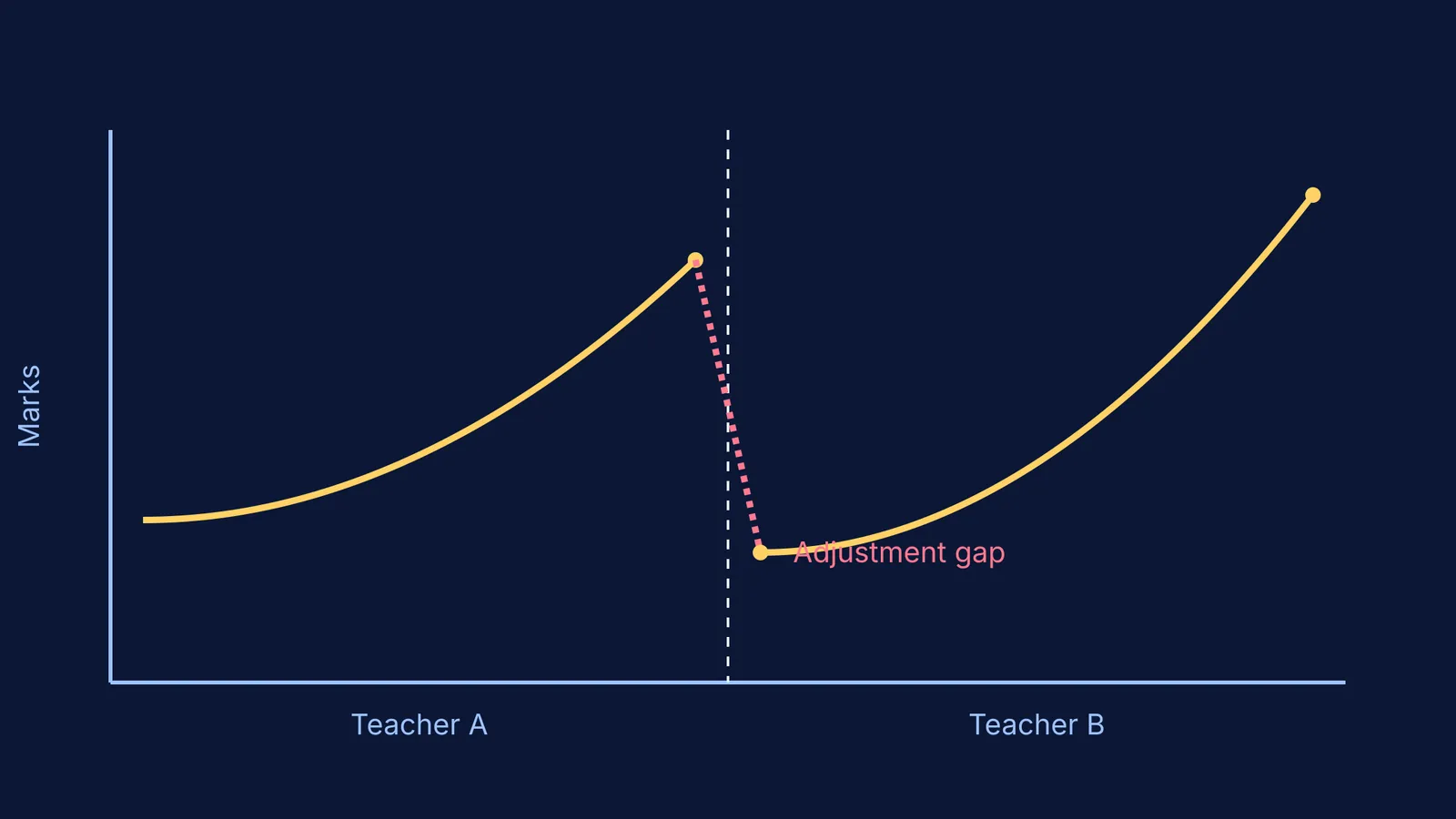
It is disheartening to see your child's marks drop midway through the year. When this drop happens right after a change in teachers, it is natural to wonder if the new teacher is at fault, or if your child has suddenly lost their grasp of the subject.
The reality is usually somewhere in the middle. Changing teachers mid-year or at the start of a new grade disrupts the continuity of learning. An analysis of over 850,000 students in New York City tracked over eight years found that teacher turnover significantly lowers student achievement in mathematics and language arts. The researchers noted that this drop is not necessarily because the new teacher is less capable. Rather, the turnover itself breaks classroom routines and institutional knowledge.
Why do a child's marks drop after a teacher changes?
Every teacher has a distinct instructional style. One physics teacher might write every step of a derivation on the board, while another might ask students to read the textbook and spend class time discussing the concepts.
When the teacher changes, the unwritten rules of the classroom change with them. Your child must suddenly figure out new expectations for homework, how tests are graded, and what the teacher considers important. This requires mental flexibility, and it often leads to a temporary dip in performance while the student adjusts. You can help them through this transition by talking to your teenager about marks without a fight, focusing on the adjustment rather than the result.
How to tell if a new teacher's style is the cause?
Before assuming your child is struggling with the subject matter itself, look for signs that they are simply struggling to adapt to the new style.
Check their notes: Are their class notes suddenly less structured than they were a few months ago?
Ask about test preparation: Do they know what format the next test will take?
Listen to their complaints: Are they saying "I don't get the maths," or are they saying "She explains it too fast"?
If the issue is primarily about the teaching style, a conversation with the teacher can help. You can prepare parent-teacher meeting questions that lead to real follow-up to understand the new expectations.
Steps to bridge the gap without blaming
The goal is to help your child adapt without blaming the new teacher. Blaming the teacher gives your child an excuse to disengage. Instead, focus on what your child can control: their own study habits.
If the new teacher moves quickly through the material, your child may need to read the textbook before class. If the teacher focuses heavily on application questions rather than rote learning, your child will need to change how they practise for exams.
When classroom continuity is broken, an AI tutor can help bridge the gap. Fermi's AI tutor can work out what your child already knows and build a plan for the session, so they sit down to a clear next step. If they have missed fundamental ideas during the transition, the Concept Library has every concept in physics, chemistry, biology, mathematics and computing, each with its own lesson and its place in the map.
A practical plan to regain lost ground
If your child's marks have dropped, you can use this simple framework to help them get back on track:
Compare the syllabuses: Sit down with your child and look at what was covered before the teacher changed, and what is being covered now. Identify any gaps in the curriculum.
Review the first bad test: Go through the mistakes together. Did they lose marks for not showing working, or did they fundamentally misunderstand the concepts?
Change the study routine: Adjust their daily habits to match the new teacher's style. If the teacher does not provide step-by-step notes, your child must start making their own. If your child seems unmotivated by the shift, consider what to try first when your child loses interest in studies.
Adjusting to a new teacher takes time, but it is a valuable skill. Learning how to succeed under different teaching styles builds resilience and will serve your child well in university and beyond.


